
Plug-in hybrid vehicle
For best battery service
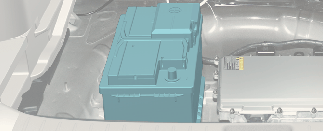
-
Keep the battery securely mounted.
-
Keep the battery top clean and dry.
-
Keep the terminals and connections clean, tight, and coated with petroleum jelly or terminal grease.
-
Rinse any spilled electrolyte from the battery immediately with a solution of water and baking soda.
-
If the vehicle is not going to be used for an extended time, disconnect the battery cables.






If electrolyte gets on your skin, thoroughly wash the contacted area. If you feel pain or burning sensation, get medical attention immediately.


-
When lifting a plastic-cased battery, excessive pressure on the case may cause battery acid to leak, resulting in personal injury. Lift with a battery carrier or with your hands on opposite corners.
-
Never attempt to recharge the battery when the battery cables are connected.
-
The electrical ignition system works with high voltage. Never touch these components with the engine running or the ignition switched on.
Failure to follow the above warnings can result in serious bodily injury or death.

If you connect unauthorized electronic devices to the battery, the battery may be discharged. Never use unauthorized devices.

Your vehicle is equipped with maintenance free battery. If your vehicle is equipped with the battery marked with LOWER and UPPER on the side, you can check the electrolyte level. The electrolyte level should be between LOWER and UPPER. If the electrolyte level is low, it needs to add distilled (demineralized) water (Never add sulfuric acid or other electrolyte). When refill, be careful not to splash the battery and adjacent components. And do not overfill the battery cells. It can cause corrosion on other parts. Make sure that the cell caps are tightened.
Contact a professional workshop. Kia recommends to visit an authorized Kia dealer/service partner.
Battery capacity label
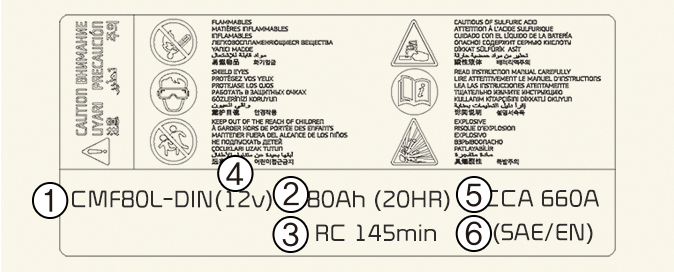
* The actual battery label in the vehicle may differ from the illustration.
-
The Kia model name of battery
-
The nominal capacity (in Ampere hours)
-
The nominal reserve capacity (in min.)
-
The nominal voltage
-
The cold-test current in amperes by SAE
-
The cold-test current in amperes by EN
Battery recharging
Your vehicle has a maintenance-free, calcium-based battery.
-
If the battery becomes discharged in a short time (because, for example, the headlights or interior lights were left on while the vehicle was not in use), recharge it by slow charging (trickle) for 10 hours.
-
If the battery gradually discharges because of high electric load while the vehicle is being used, recharge it at 20~30A for two hours.
-
When recharging the battery, observe the following precautions:
-
The battery must be removed from the vehicle and placed in an area with good ventilation.
-
Do not allow cigarettes, sparks, or flame near the battery.
-
Watch the battery during charging, and stop or reduce the charging rate if the battery cells begin gassing (boiling) violently or if the temperature of the electrolyte of any cell exceeds 49°C (120°F).
-
Wear eye protection when checking the battery during charging.
-
Disconnect the battery charger in the following order.
-
Turn off the battery charger main switch.
-
Unhook the negative clamp from the negative battery terminal.
-
Unhook the positive clamp from the positive battery terminal.
-
-
-
Before performing maintenance or recharging the battery, turn off all accessories and stop the engine.
-
The negative battery cable must be removed first and installed last when the battery is disconnected.
Do not open or remove the cap on top of the battery. This may cause leaks of internal electrolyte that could result in severe injury.