

Tire Pressure Monitoring System (TPMS) (Type B): (if equipped)
The Tire Pressure Monitoring System (TPMS) detects the pressure of the vehicle’s tires and displays it on the instrument cluster.
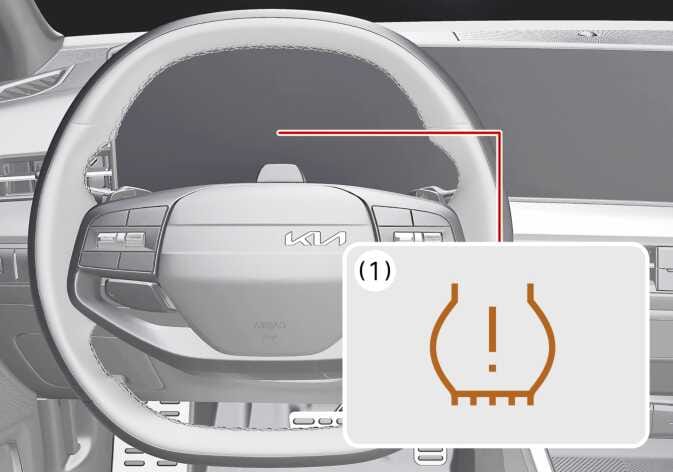 P_CD27_C11_008_1_E |
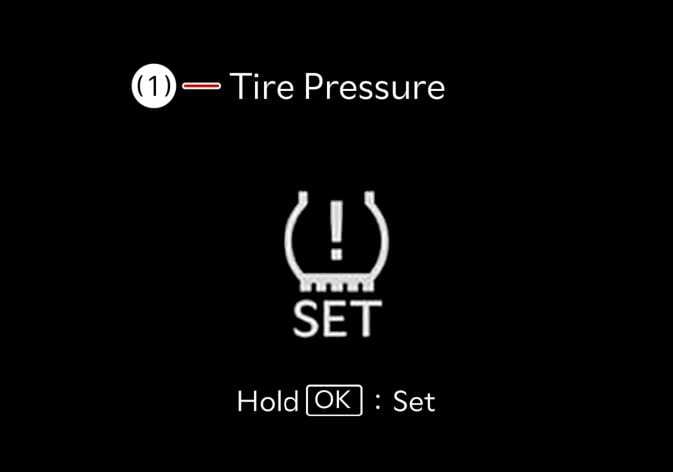 P_CD27_C00_028_E |
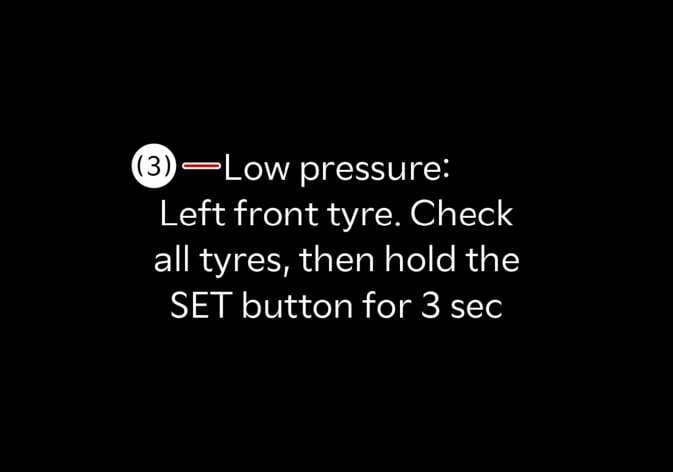 P_CD27_C00_030_E |
-
Low Tire Pressure Telltale/TPMS Malfunction Indicator
-
TPMS Reset
-
Low Tire Pressure warning message
The Tire Pressure Monitoring System (TPMS) determines whether the tire pressure is low through sensors in the wheel, which detects changes in tire radius and vibration while driving.
For this system to work properly, you need to reset and save the current tire pressure.
After resetting the TPMS, when one or more of your tires are under-inflated compared to the saved tire pressure, a warning light appears on the instrument cluster.
A warning light also appears if there is a problem with the TPMS system.
If vehicle conditions are satisfied, TPMS can indicate one position of low pressure tire.
Even if TPMS indicate one position, you should check all the tires inflation pressure and adjust the tires to the recommended tire inflation pressure.
TPMS reset procedure
You should reset TPMS in below situations.
-
After repairing or replacing tires (or wheels)
-
After rotating the position of a tire or wheel.
-
After adjusting tire pressure
-
After replacing the suspension or ABS/ESC.
-
When the low tire pressure indicator illuminates
-
Be sure to reset after the inflation pressure of all four tires are set to the recommended inflation pressure. If you reset without adjusting the inflation pressure, the warning sound may not activate or may activate improperly.
-
If the inflation pressure of the four tires are adjusted, be sure to perform reset. Otherwise, the system may malfunction and the warning sound may not activate or may activate improperly.
-
Adjust the inflation pressure when the tires are cold. A cold tire means the vehicle has not been driven for 3 hours or has been driven for less than 1.6 km (1 mi.).
-
Adjust all tire pressure to the recommended tire inflation pressures.
-
Press the button on the steering wheel with the vehicle parked and engine running.
-
Select Tire Pressure on the cluster by using the, (UP, DOWN) switch.
-
Press and hold the OKbutton on the steering wheel for approximately 3 seconds to reset TPMS. The reset process completes automatically.
-
Check whether the message appears on the cluster and the warning light
 blinks for about 4 seconds
-
After resetting the TPMS, drive the vehicle for approximately 20 minutes to store the new tire pressure in the system.
-
If the message on the cluster does not appear or
the warning light does not blink, try again from Step 2. -
When the message appears on the cluster, stop the vehicle and press and hold the OK button again.
-
if you push the OK button while driving, the TPMS reset process is not activated. You must push the OK button while the vehicle is at a complete stop
-
For more information on the recommended inflation pressure for your vehicle, Refer to Tires and wheels
Low tire pressure telltale
 P_CD27_C00_138_E |
|
|
P_CD27_C00_028_E |
|
-
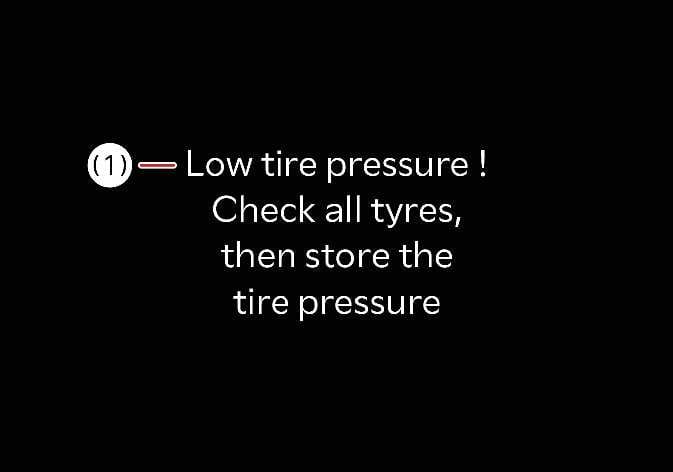
When the Low Tire Pressure warning light
illuminates and a warning message appears on the cluster for 10 seconds, one or more of your tires is significantly under-inflated. -
The position of the under-inflated tire also appears. (if equipped)
-
If the warning light illuminates, reduce your speed, and also avoid hard cornering and sudden braking. Have your vehicle inspected by a professional workshop. Kia recommends visiting an authorized Kia dealer or service partner.
-
Check the condition and inflation pressure of all four tires, then reset the TPMS (For more information, refer to this section in this chapter) or take required counteractions such as repairing or replacing the tires.
-
When an authorized Kia dealer is not nearby, stop at a safe place and check the condition and inflation pressure of all four tires, then reset the TPMS.
-
If you cannot unable to adjust the inflation pressure, use the Tire Mobility Kit (TMK) to repair or replace the under-inflated tire with a spare tire (if equipped). Have your vehicle inspected by a professional workshop. Kia recommends visiting an authorized Kia dealer or service partner.
-
You may not be able to identify a tire with low pressure by simply looking at it. Always use a good quality tire pressure gauge to measure. Note that a tire that is hot (from being driven) has a higher pressure measurement than a tire that is cold. A cold tire means the vehicle has been sitting for 3 hours and driven for less than 1.6 km (1 mi.) in that 3 hour period. Allow the tire to cool before measuring the inflation pressure. Always be sure the tire is cold before inflating to the recommended pressure.
-
Low pressure damage
-
Significantly low tire pressure makes the vehicle unstable and can contribute to loss of vehicle control and increased braking distances.
-
Continued driving on low pressure tires can cause the tires to overheat and fail.
-
Continued driving on low pressure tires can cause the tires to overheat and fail. Under-inflation may cause the vehicle to be unstable and reduce tire life and fuel economy, increase braking distance, and other tire failures that result in loss of vehicle control. Have your vehicle inspected by a professional workshop. Kia recommends visiting an authorized Kia dealer or service partner.
-
The TPMS cannot alert you to severe and sudden tire damage caused by external factors. If you notice any vehicle instability, immediately take your foot off the accelerator pedal, apply the brakes gradually with light force, and slowly move to a safe position off the road.
-
The warning light may remain on even after replaced with a spare tire. Replace your vehicle with original sized tires.
- Note that the TPMS is not a substitute for proper tire maintenance. It is the driver’s responsibility to maintain the appropriate recommended inflation pressure, and the tires must be inspected periodically to maintain the recommended inflation pressure.
-
The Low Tire Pressure warning light may illuminate when the TPMS is not reset when necessary.
-
In winter or cold weather, the Low Tire Pressure warning light may illuminate if the tire pressure was adjusted to the recommended tire inflation pressure in warm weather. It does not mean your TPMS is malfunctioning because the decreased temperature leads to a proportional lowering of tire pressure. Check the tire inflation pressure and adjust the tires to the recommended tire inflation pressure.
-
TPMS performance may reduce in the following situations when:
Reset is done incorrectly.
Original sized tires are not installed.
Driving on rough roads such as snowy, slippery roads, or unpaved roads.
Repeating hard cornering, sudden acceleration, or sudden braking.
Driving too slow or too fast.
The vehicle is overloaded.
Spare tire or snow chains are installed.
TPMS malfunction indicator
The TPMS malfunction indicator illuminates after blinking for about 70seconds when there is a problem with the Tire Pressure Monitoring System.
If the indicator remains illuminated even after the TPMS is reset, have your vehicle inspected by a professional workshop. Kia recommends visiting an authorized Kia dealer or service partner.
If there is a malfunction with the TPMS, the under-inflated tire cannot be detected.
|
Condition |
TPMS malfunction indicator status |
|---|---|
|
Low pressure |
On |
|
System malfunction |
Blinks for about 70 seconds and goes off |
|
Reset |
Blinks for about 4 seconds and goes off |