Towing service
-
Wheel dollies
If towing is necessary, we recommend having it done by an authorized Kia dealer or a commercial tow-truck service.
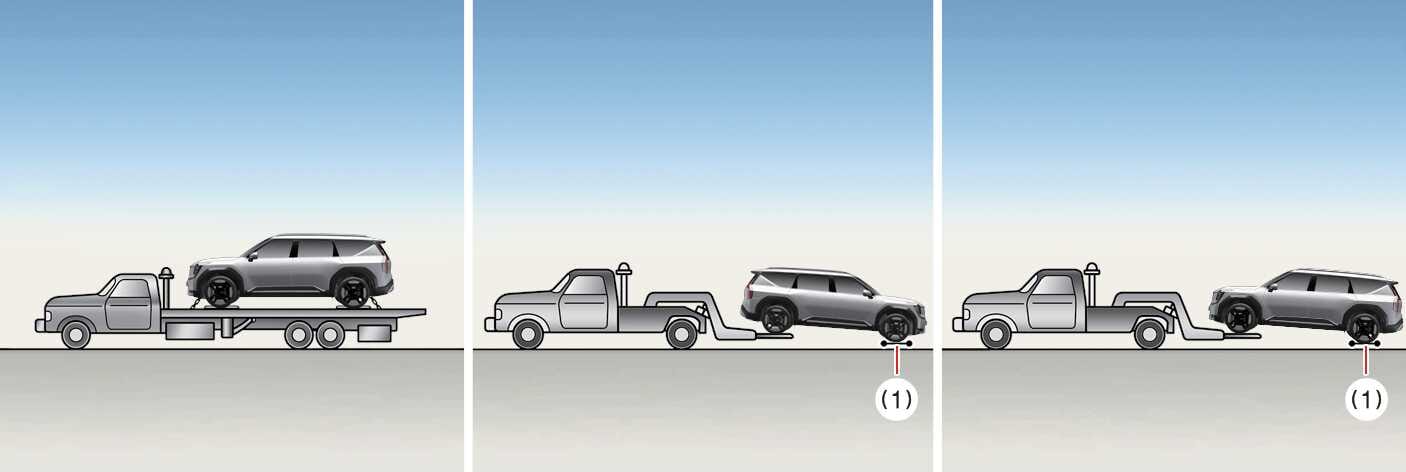
Proper lifting and towing procedures are necessary to prevent damage to the vehicle. The use of wheel dollies (1) or flatbed is recommended.
Side and curtain air bag
If your vehicle is equipped with side and curtain air bag, set the vehicle to ACC position when the vehicle is being towed. The side and curtain air bag may deploy when the vehicle is in ON position and the rollover sensor detects the situation as a rollover.
The AWD vehicle should never be towed with the wheels on the ground. Always use wheel dollies or flatbed. If not, the power electric system and the AWD system could be seriously damaged.
-
Shift to N (Neutral) to tow a vehicle with the tires on the ground. For more details, refer to N (Neutral) in vehicle ON/ACC position.
-
If the Electronic Parking Brake (EPB) does not release normally, load your vehicle onto a flatbed tow truck and have your vehicle inspected by a professional workshop. Kia recommends visiting an authorized Kia dealer or service partner.
When flatbed is unavailable
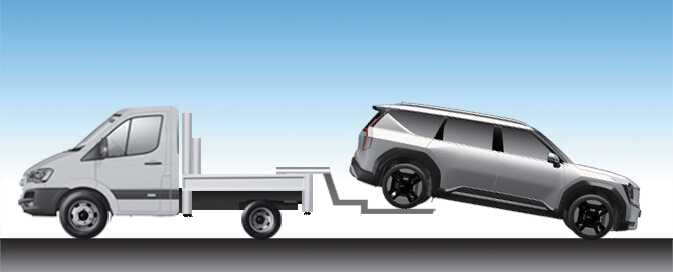
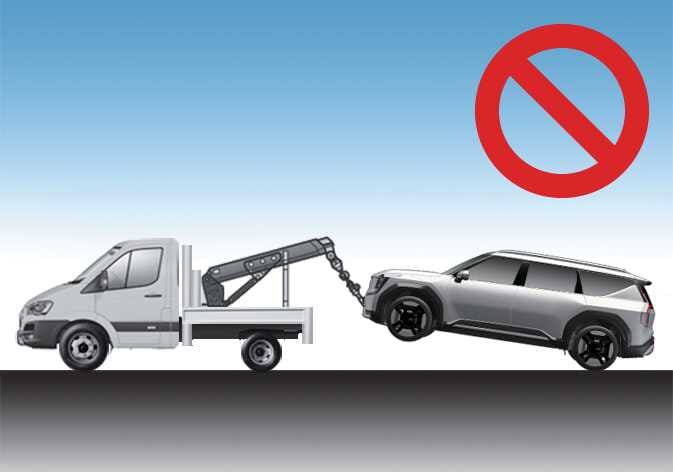
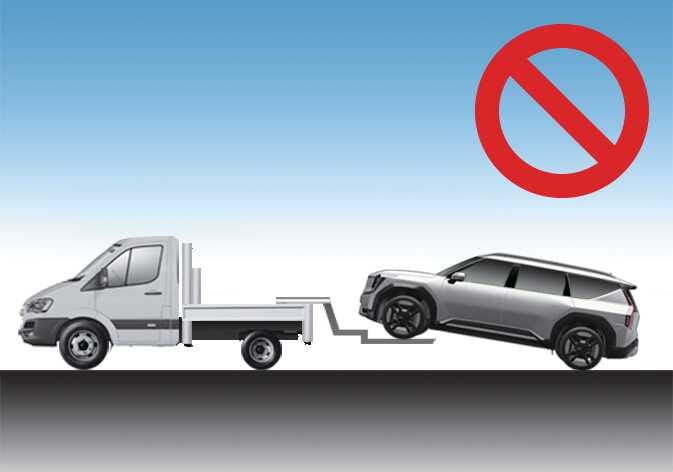
2-wheel drive vehicle can be towed with the opposite tires on the ground (without dollies) and parking brake released before turning off the vehicle.
If you must tow the vehicle using only two wheels, lift the driven wheels off the ground and tow the vehicle.
 OMV064011 |
|
 OMV064012 |
|
Precautions when moving a short distance using towing hook and so on before towing vehicle
Move short distances within 100 m (328 ft) at a speed of 5 km/h (3 mph) or less only when loading on a tow truck or if the vehicle needs to be repositioned.
At this time, the gear must be in the N (Neutral) position and the parking brake must be released. If it is impossible to operate the gear and parking brake, move the vehicle by using dollies, tire skate, etc. with rear wheels, i.e. driving wheel, lifted.
Move short distances within 100 m (328 ft) at a speed of 5 km/h (3 mph) or less only when loading on a tow truck or if the vehicle needs to be repositioned.
At this time, the gear must be in the N (Neutral) position and the parking brake must be released. If it is impossible to operate the gear and parking brake, move the vehicle by using dollies, tire skate, etc. with all wheels lifted.
Emergency towing
-
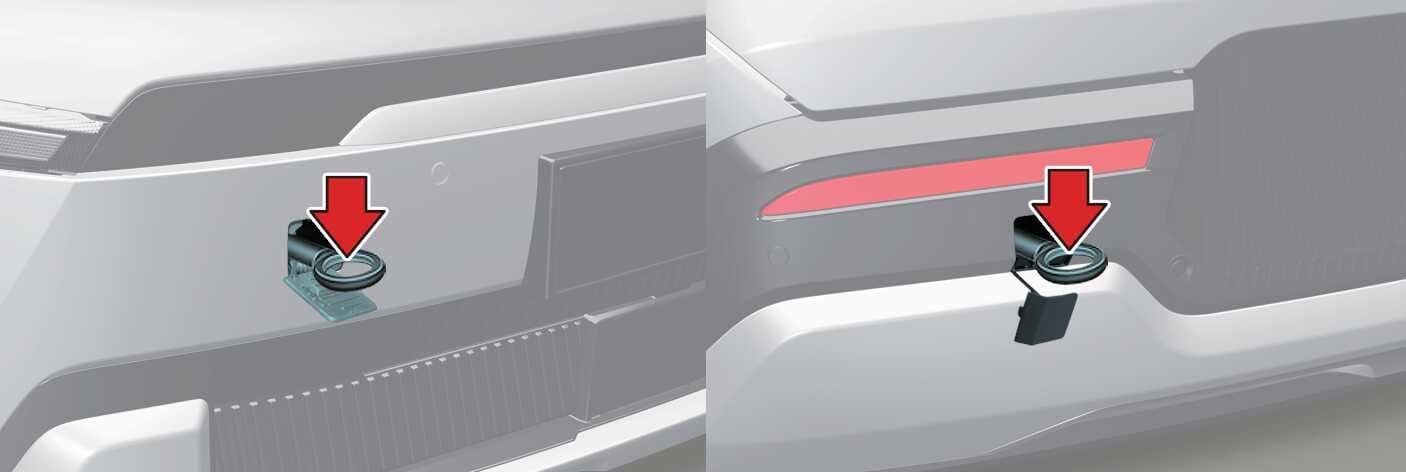
Remove the hole cover pressing the lower part of the cover on the bumper.
-
Install the towing hook by turning it clockwise into the hole until it is fully secured.
-
Remove the towing hook and install the cover after use.
-
Use extreme caution when towing the vehicle.
-
Avoid sudden starts or erratic driving maneuvers which would place excessive stress on the emergency towing hook and towing cable or chain. The hook and towing cable or chain may break and cause serious injury or damage.
-
If the disabled vehicle is unable to be moved, do not forcibly continue the towing. We recommend that you contact an authorized Kia dealer or a commercial tow truck service for assistance.
-
Tow the vehicle as straight ahead as possible.
-
Keep away from the vehicle during towing.
-
Attach a towing strap to the tow hook.
-
Using a portion of the vehicle other than the tow hooks for towing may damage the body of your vehicle.
-
Use only a cable or chain specifically intended for use in towing vehicles. Securely fasten the cable or chain to the towing hook provided.
-
Accelerate or decelerate the vehicle in a slow and gradual manner while maintaining tension on the tow rope or chain to start or drive the vehicle, otherwise tow hooks and the vehicle may be damaged.
-
Before towing, check the reducer for fluid leaks under your vehicle. If the reducer fluid is leaking, flatbed equipment or a towing dolly must be used.
-
Towing in this manner may be done only on hard-surfaced roads for a short distance and at low speed.
-
If towing is necessary, we recommend you to have it done by an authorized Kia dealer or a commercial tow truck service. If towing service is not available in an emergency, your vehicle may be temporarily towed using a cable or chain secured to the emergency towing hook under the front (or rear) of the vehicle. Use extreme caution when towing the vehicle. A driver must be in the vehicle to steer it and operate the brakes.
-
Do not use the tow hooks to pull a vehicle out of mud, sand or other conditions from which the vehicle cannot be driven out under its own power.
-
Avoid towing a vehicle heavier than the vehicle doing the towing.
-
The drivers of both vehicles should communicate with each other frequently.
-
Before emergency towing, check if the hook is not broken or damaged.
-
Fasten the towing cable or chain securely to the hook.
-
Do not jerk the hook. Apply it steadily and with even force.
-
To avoid damaging the hook, do not pull from the side or at a vertical angle. Always pull straight ahead.