
Seat belt restraint system
-
A properly positioned shoulder belt should be positioned midway over your shoulder, across your collarbone.
-
Never allow children to ride in the front passenger seat. See More Details for further discussion.

Twisted seat belt
Make sure your seat belt is not twisted when worn. A twisted seat belt may not properly protect you in an accident and could even cut into your body.
Shoulder belt
-
Never wear the shoulder belt under your arm or behind your back. An improperly positioned shoulder belt cannot protect the occupant in the event of a crash.
-
Always wear both the shoulder portion and lap portion of the lap/shoulder belt.
Damaged seat belt
Any damage to webbing or hardware may cause serious injury or death in an accident. The entire seat belt assembly should be replace dwhen any part of the webbing or hardware is damaged.
Seat belts are designed to bear upon the bony structure of the body, and should be worn low across the front of the pelvis, chest and shoulders, as applicable; wearing the lap section of the belt across the abdominal area must be avoided.
Seat belts should be adjusted as firmly as possible, consistent with comfort, to provide the protection for which they have been designed.
A slack belt will greatly reduce the protection afforded to the wearer.
Care should be taken to avoid contamination of the webbing with polishes, oils and chemicals, and particularly battery acid. Use mild soap and water. The belt should be replaced if webbing becomes frayed, contaminated or damaged.
-
No modifications or additions should be made by the user which could either prevent the seat belt adjusting devices from operating to remove slack or prevent the seat belt assembly from being adjusted to remove slack.
-
When you fasten the seat belt, be careful not to latch the seat belt in buckles of other seats. It is very dangerous and you may not be properly protected.
-
Do not fasten and unfasten the seat belt repeatedly while driving. This could cause loss of control, and an accident causing death, serious injury, or property damage.
-
When fastening the seat belt, make sure that the seat belt does not pass over objects that are hard or can break easily.
Seat belt buckle
Do not allow foreign material (gum, crumbs, coins, liquids, etc.) to obstruct the seat belt buckle orifice. This may prevent the seat belt from fastening securely.
Seat belt warning

The seat belt warning light and warning chime operate under the following conditions:
Driver's seat belt warning
As a reminder to the driver, the seat belt warning light will appear for approximately 6 seconds each time you turn the ENGINE START/STOP button ON regardless of belt fastening. If the seatbelt is not fastened, the warning chime will sound for about 6 seconds.
If you start to drive without the seat belt fastened over approximately 5 mph (9 km/h) and less than approximately 12 mph (20 km/h), the corresponding warning light will appear. The warning light will turn off when the vehicle speed drops below approximately 5 mph (9 km/h).
If you start to drive without the seat belt fastened or you unfasten the seat belt when you drive approximately 12 mph (20 km/h) and faster, the warning light will blink and warning chime will sound for approximately 100 seconds. When the seat belt is unfastened during driving, the warning light will appear when the speed is over approximately 5mph (9 km/h) and less than approximately 12 mph (20 km/h). When the speed is approximately 12 mph (20 km/h) and faster, the warning light will blink and warning chime will sound for approximately 100 seconds.
Front passenger's seat belt warning
As a reminder to the front passenger, the seat belt warning light will appear for approximately 6 seconds each time you turn the ENGINE START/STOP button ON regardless of belt fastening. If you start to drive without the passenger seat belt fastened when you drive over approximately 5 mph (9 km/h) and less than approximately 12 mph (20 km/h), the corresponding warning light will appear. The warning light will turn off when the vehicle speed drops approximately below 5 mph (9 km/h).
If you start to drive without the passenger seat belt fastened or you unfasten the seat belt when you drive approximately 12 mph (20 km/h) and faster, the warning light will blink and warning chime will sound for approximately 100 seconds. When the passenger seat belt is unfastened during driving, the warning light will appear when the speed is over approximately 5mph (9 km/h) and less than approximately 12 mph (20 km/h). When the speed is approximately 12 mph (20 km/h) and faster, the warning light will blink and warning chime will sound for approximately 100 seconds.

-
Even if the front passenger seat is not occupied, the seat belt warning light will appear for approximately 6 seconds.
-
The front passenger's seat belt warning may operate when luggage is placed on the front passenger seat.
Rear passenger's seat belt warning

* 2nd row seat: (1) Left side, (2) Center, (3) Right side
* 3rd row seat: (4) Left side, (5) Right side
As a reminder to the rear passenger, the rear passenger's seat belt warning lights will appear for approximately 6 seconds each time you turn the ignition switch ON regardless of belt fastening.
If you start to drive without the seat belt fastened, the seat belt warning light will blink for approximately 70 seconds.
If you unfasten the seat belt when you drive under 12 mph (20 km/h), the seat belt warning light will blink for approximately 70 seconds.
If you unfasten the seat belt when you drive over 12 mph (20 km/h), the seat belt warning chime will sound for approximately 35 seconds and the corresponding warning light will blink.
If the rear door is opened or closed under 6 mph (10 km/h), warning light and warning sound does not work even if driving over 12 mph (20 km/h).
Seat belt - Driver's 3-point system with emergency locking retractor
Buckling your seat belt
-
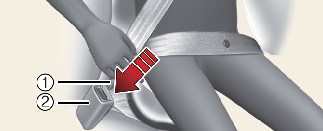
To buckle your seat belt, pull it out of the retractor and insert the metal tab (1) into the buckle (2). There will be an audible "click" when the tab locks into the buckle.
The seat belt automatically adjusts to the proper length only after the lap belt portion is adjusted manually so that it fits snugly around your hips. If you lean forward in a slow, easy motion, the belt will extend and let you move around. If there is a sudden stop or impact, however, the belt will lock into position. It will also lock if you try to lean forward too quickly.
You should place the lap belt portion as low as possible and snugly across your hips. If the lap belt is located too high on your waist, it may increase the chance of injury in the event of a collision.

The arm closest to the seat belt buckle should be over the belt while the other arm should be under the belt as shown in the illustration. Never wear the seat belt under the arm closest to the door.
If you are not able to pull out the seat belt from the retractor, firmly pull the belt out and release it. You will then be able to pull the belt out smoothly.
Releasing the seat belt
-
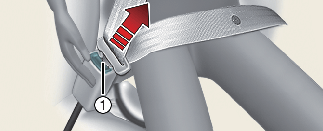
Press the release button (1) in the locking buckle.
When it is released, the belt should automatically draw back into the retractor.
If this does not happen, check the belt to be sure it is not twisted, then try again.
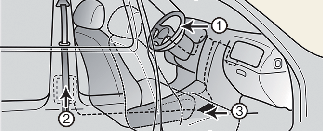
Adjusting the height of shoulder belt

The height of the adjusting seat belt should not be too close to your neck. You will not be getting the most effective protection. The shoulder portion should be adjusted so that it lies across your chest and midway over your shoulder near the door and not your neck.
To adjust the height of the seat belt anchor, lower or raise the height adjuster into an appropriate position.
-
To raise the height adjuster, pull it up (1).
-
To lower it, push it down (3) while pressing the height adjuster button (2).
Release the button to lock the anchor into position. Try sliding the height adjuster to make sure that it has locked into position.
Improperly positioned seat belts can cause serious injuries in an accident.
Shoulder belt positioning
Verify the shoulder belt anchor is locked into position at the appropriate height. Never position the shoulder belt across your neck or face. Improperly positioned seat belts can cause serious injuries in an accident.
Seat belt replacement
After a collision, the seat belt system should be inspected to ensure it is operating normally. Replace any belts that are not functioning appropriately.
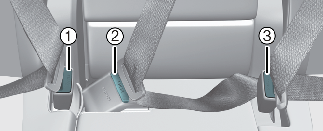
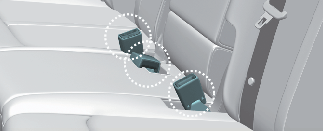
The seat belt should be locked into the buckle on each seat cushion to be properly buckled.
-
Rear right seat belt buckle
-
Rear center seat belt buckle
-
Rear left seat belt buckle
-
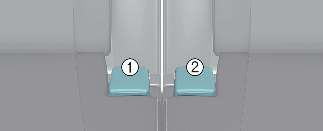
Rear right seat belt buckle
-
Rear left seat belt buckle
Prior to buckling the rear seat belts, ensure the latch matches the seat belt buckle. Forcefully connecting the left or right seat belt to the center buckle will not secure the occupant in an accident.
Stowing the rear seat belt
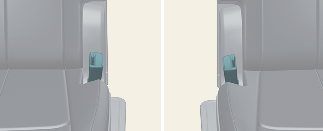
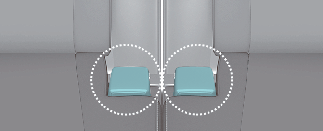

When pulling out to wear the seat belt, the tongue should be slowly pulled out of the seat belt guide so that the seat belt guide does not come off the trim.
Pretensioner seat belt
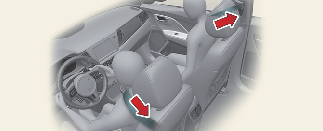
Your Kia is equipped with pre-tensioner seat belts for the front driver and passenger, as well as the second row passengers.
The purpose of the pre-tensioner is to make sure that the seat belts fit tightly against the occupant's body in certain collisions.
The pre-tensioner seat belts may be activated in crashes where the collision is severe enough.
When the vehicle stops suddenly, or if the occupant tries to lean forward too quickly, the seat belt retractor will lock into position. In certain frontal collisions, the pre-tensioner will activate and pull the seat belt into tighter contact against the occupant's body.
If the system senses excessive tension on the driver or passenger's seat belt when the pre-tensioner system activates, the load limiter inside the retractor pre-tensioner will release some of the pressure on the affected seat belt.
For your safety, be sure that the belt webbing is not loose or twisted and always sit properly on your seat.
The pre-tensioner may activate not only in a frontal collision but also in a side collision, if the vehicle is equipped with a side or curtain air bag.
The seat belt pre-tensioner system consists mainly of the following components. Their locations are shown in the illustration:
-
SRS air bag warning light
-
Front retractor pre-tensioner assembly
-
SRS control module
Skin irritation
Wash all exposed skin areas thoroughly after an accident in which the pre-tensioner seat belts were activated. The fine dust from the pre-tensioner activation may cause skin irritation and should not be inhaled for prolonged periods.
-
Both the driver's and front passenger's seat belt pre-tensioner systems may be activated not only in certain frontal collisions, but also in certain side collisions or rollovers, if the vehicle is equipped with a side or curtain air bag.
-
Because the sensor that activates the SRS air bag is connected with the pre-tensioner seat belt, the SRS air bag warning light
 on the instrument panel will appear for approximately 3 ~ 6 seconds after the ENGINE START/STOP button has been turned to
the ON position, and then it should turn off.
on the instrument panel will appear for approximately 3 ~ 6 seconds after the ENGINE START/STOP button has been turned to
the ON position, and then it should turn off.
-
If the pre-tensioner seat belt system is not working properly, this warning light will appear even if there is not a malfunction with the SRS air bag. If the SRS air bag warning light does not appear when the ENGINE START/STOP button has been turned to the ON position, or if it remains appears after illuminating for approximately 3 ~ 6 seconds, or if it appears while the vehicle is being driven, have an authorized Kia dealer inspect the pre-tensioner seat belt and SRS air bag system as soon as possible.
Do not attempt to service or repair the pre-tensioner seat belt system in any manner. Do not attempt to inspect or replace the pre-tensioner seat belts yourself. This must be done by an authorized Kia dealer.
Hot pre-tensioner
Do not touch the pre-tensioner seat belt assemblies for several minutes after they have been activated. When the pre-tensioner seat belt mechanism fires during a collision the pre-tensioner becomes hot and can burn you.
Pre-tensioners are designed to operate only one time. After activation, pre-tensioner seat belts must be replaced. If the pre-tensioner must be replaced, contact an authorized Kia dealer.