
Dual clutch transmission
Shift lever type (if equipped)
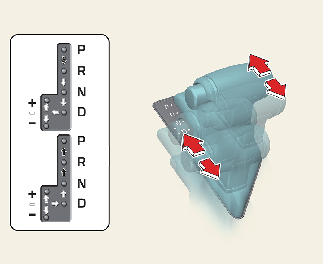
 Depress the brake pedal and the lock release button when shifting.
 Press the unlock button when shifting.
 The shift lever can be shifted freely.
-
P (Park)
-
R (Reverse)
-
N (Neutral)
-
D (Drive)
Operation
-
Depress the brake pedal and shift the lever.
Manual mode
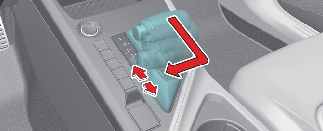
Operation
-
Push the shift lever from D (Drive) position into the manual gate.
-
Up (+): Push the lever forward once to shift up one gear.
-
Down (-): Pull the lever backward once to shift down one gear.
-
-
Push the shift lever back into D (Drive) position to return to automatic mode.
Shift lock
Shift lock prevents shifting from P (Park) into R (Reverse) unless the brake pedal is depressed.
Operation
-
Depress and hold the brake pedal.
-
Turn the vehicle to the ON position.
-
Move the shift lever.

If the brake pedal is repeatedly depressed and released with the shift lever in the P (Park), a chattering noise near the shift lever may be heard. This is a normal condition.
Overriding shift lock
If the shift lever cannot be moved fromthe P (Park) position into the R (Reverse)position with the brake pedal engaged,continue engaging the brake, then dothe following:
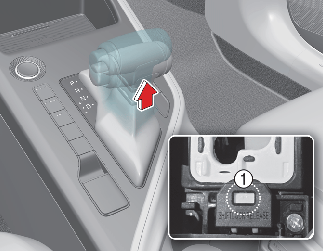
Operation
-
Continue depressing the brake.
-
Turn the vehicle to the OFF position.
-
Make sure the parking brake is applied.
-
Carefully remove the shift knob boot.
-
Insert a tool (e.g. flathead screwdriver) into the access hole and press down on the tool.
-
Move the shift lever.
-
Remove the tool from the shift lock override access hole then install the knob boot (1).
If the shift lever does not move even after performing this procedure, have the system inspected by a professional workshop. Kia recommends to visit an authorised Kia dealer/service partner
Parking in N (Neutral) gear
Follow below steps when parking and you want the vehicle to move when pushed.
-
After parking your vehicle, step on the brake pedal and move the shift lever to P (Park) with the ignition button in ON or whilst the engine is running.
-
If the parking brake is applied, unlock the parking brake.
-
Whilst pressing the brake pedal, turn the ignition button OFF. For smart key equipped vehicles, the ignition switch can be moved to OFF only when the shift lever is in P (Park).
-
Change the gear shift lever to N (Neutral) whilst pressing the brake pedal. Pull the shift lever boot, inserting and pressing down a tool (e.g.flathead screw-driver) into the shift lock release access hole at the same time. Then, the vehicle will move when external force is applied.

-
Except for parking in neutral gear, always park the vehicle in P (Park) for safety and engage the parking brake.
-
Before parking in N (Neutral) gear, first make sure the parking ground is level and flat. Do not park in N (Neutral) gear on any slopes or gradients. If parked and left in N (Neutral), the vehicle may move and cause serious damage and injury.
Shift dial SBW type (if equipped)
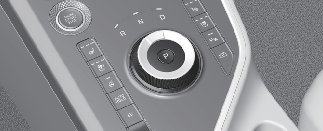
-
P (Park)
-
R (Reverse)
-
N (Neutral)
-
D (Drive)
Operation
-
Depress the brake pedal and turn the knob to the desired position.
-
Press P button to shift to P (Park).
Transmission ranges
The indicator in the instrument cluster displays the shift lever position when the ignition switch is in the ON position.
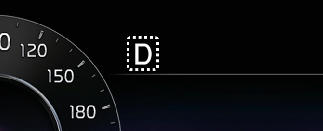
P (Park)
Always come to a complete stop before shifting into P (Park). To shift from P (Park), you must depress firmly on the brake pedal and make sure your foot is off the accelerator pedal. If you have done all of the above and still cannot shift the lever out of P (Park), see More Details. The shift lever must be in P (Park) before turning the engine off.
N in vehicle ON position
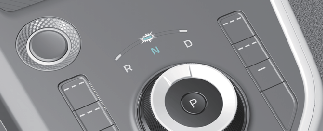
Operation
-
Deactivate AUTO HOLD and release the parking brake.
-
Depress the brake pedal.
-
Turn the shift dial to N (Neutral) and the message will appear on the instrument cluster.
-
Press and hold the OK button on the steering wheel for more than 1 second.
-
Turn the engine off after the message appears on the instrument cluster.
Operating condition(s)
-
The vehicle is in ON position.
When the battery is discharged
Operation
-
Connect the battery cables to the jump-starting terminals inside the engine compartment. For more details, refer to More Details.
-
Release the parking brake when the vehicle is in ON position.
-
Shift to N (Neutral).
Characteristics of Dual clutch transmission
The dual clutch transmission has seven forward speeds and one reverse speed. The individual speeds are selected automatically when the shift lever is in the D (Drive) position.
-
The dual clutch transmission can be thought of as an automatically shifting manual transmission. It gives the driving feel of a manual transmission, yet provides the ease of a fully automatic transmission.
-
When D (Drive) is selected, the transmission will automatically shift through the gears similar to a conventional automatic transmission. Unlike a traditional automatic transmission, the gear shifting can sometimes be felt and heard as the actuators engage the clutches and the gears are selected.
-
The dual clutch transmission incorporates a dry-type dual clutch mechanism, which allows for better acceleration performance and increased fuel efficiency whilst driving. But it differs from a conventional automatic transmission because it does not incorporate a torque converter. Instead, the transition from one gear to the next is managed by clutch slip, especially at lower speeds.
As a result, shifts are sometimes more noticeable, and a light vibration can be felt as the transmission shaft speed is matched with the engine shaft speed. This is a normal condition of the dual clutch transmission.
-
The dry-type clutch transfers torque more directly and provides a direct-drive feeling which may feel different from a conventional automatic transmission. This may be more noticeable when launching the vehicle from a stop or when travelling at low, stop-and-go vehicle speeds.
-
When rapidly accelerating from a lower vehicle speed, the engine rpm may increase dramatically as a result of clutch slip as the dual clutch transmission selects the correct gear. This is a normal condition.
-
When accelerating from a stop on an incline, press the accelerator smoothly and gradually to avoid any shudder feeling or jerkiness.
-
When travelling at a lower vehicle speed, if you release the accelerator pedal quickly, you may feel engine braking before the transmission changes gears. This engine braking feeling is similar to operating a manual transmission at low speed.
-
When driving downhill, you may wish to move the gear shift lever to Manual Shift mode and downshift to a lower gear in order to control your speed without using the brake pedal excessively.
-
When you turn the engine on and off, you may hear clicking sounds as the system goes through a selftest. This is a normal sound for the dual clutch transmission.
-
During the first 1,500 km (1000 miles), you may feel that the vehicle may not be smooth when accelerating at low speed. During this break-in period, the shift quality and performance of your new vehicle is continuously optimized.