

Safe All Wheel Drive (AWD) operation
AWD
Compared to normal road conditions, on road or off road conditions that necessitate using AWD expose your vehicle to extreme stress. When using AWD, slow down and be ready for changes in the composition and traction of the road surface. If you have any doubt about the safety of road conditions, stop driving and consider the best way to proceed.
-
Do not drive in deep standing water or mud, which can stall your engine and clog your exhaust pipes. Do not drive down steep hills that require extreme skill to maintain control of the vehicle.
-
When you drive up or down a hill, drive as straight as possible. When you drive up or down a steep hill, be extremely cautious of vehicle rollover caused by the grade, terrain, water, or mud.
WARNINGHills
Traversing steep hills can be extremely dangerous due to slight changes in the wheel angle that can destabilize your vehicle. Your vehicle can become unstable if it stops its forward motion (even if your vehicle maintains stability under power). Your vehicle may roll over without warning or enough time for you to correct a mistake that could cause serious injury or death.
-
You must learn how to turn in an AWD vehicle. Do not rely on your experience with conventional Front Wheel Drive (FWD) vehicles when you turn your vehicle in AWD mode. You must drive more slowly when using AWD.
WARNINGAWD
Reduce your speed when turning. AWD vehicles have a higher center of gravity than conventional FWD vehicles, and are more likely to roll over when you turn too quickly.
 OMQ4A045047
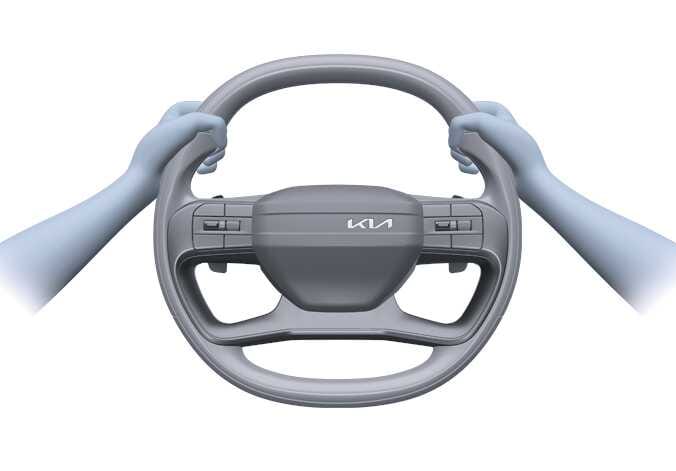
Steering wheel
When you are drive on an unpaved road, do not grab the inside of the steering wheel. If you do so, a sudden steering maneuver or steering wheel rebound caused by impact with objects on the ground may hurt your arm, and you could lose control of the steering wheel.
-
Always hold the steering wheel firmly when you drive on unpaved roads.
-
Make sure all passengers are wearing seat belts.
WARNINGWind danger
If you drive in strong wind, your vehicle’s higher center of gravity lessens steering control, so you must drive more slowly.
NOTEDriving through water
When you drive through water, drive slowly. If you drive through water too fast, the water can enter the engine compartment, get the ignition system wet, and cause your vehicle to suddenly stop. If this happens when your vehicle is in a tilted position, your vehicle may roll over.
TIP-
Do not drive in water higher than the bottom of your vehicle.
-
Check the condition of your brakes after you drive through mud or water. To do so, engage the brake pedal several times (as you drive slowly) until you feel normal braking forces return.
-
If you drive in off road conditions such as sand, mud, or water, shorten your scheduled maintenance interval (refer to Maintenance under severe usage conditions). Always wash your vehicle thoroughly, especially the underbody, after driving off road.
-
The condition of the tires greatly affects AWD vehicle performance because driving torque is always applied to all 4 wheels. Be sure to equip your vehicle with 4 tires of the same size and type.
-
An AWD vehicle cannot be towed by an ordinary tow truck. If your vehicle must be towed, make sure a flatbed truck is used.
WARNINGAWD driving
-
Avoid high speeds when turning.
-
Do not make quick steering wheel movements (such as sharp lane changes or fast, sharp turns).
-
The risk of a rollover greatly increases if you lose control of your vehicle at highway speeds.
-
In a collision, an unbelted person is significantly more likely to die than a person wearing a seat belt.
-
Loss of control often occurs when 2 or more wheels leave the road and the driver overcorrects to reenter the road. If your vehicle leaves the road, do not steer sharply. Instead, slow down before you reenter the road.
NOTEMud or snow
If a front or rear wheel begins to spin in mud or snow, you can sometimes drive your vehicle out by further engaging the accelerator pedal. However, avoid continuously revving the engine at a high RPM, which could damage your vehicle’s AWD system.
-