Overview
The actual features in your vehicle may not necessarily be available due to the selected options or regions.
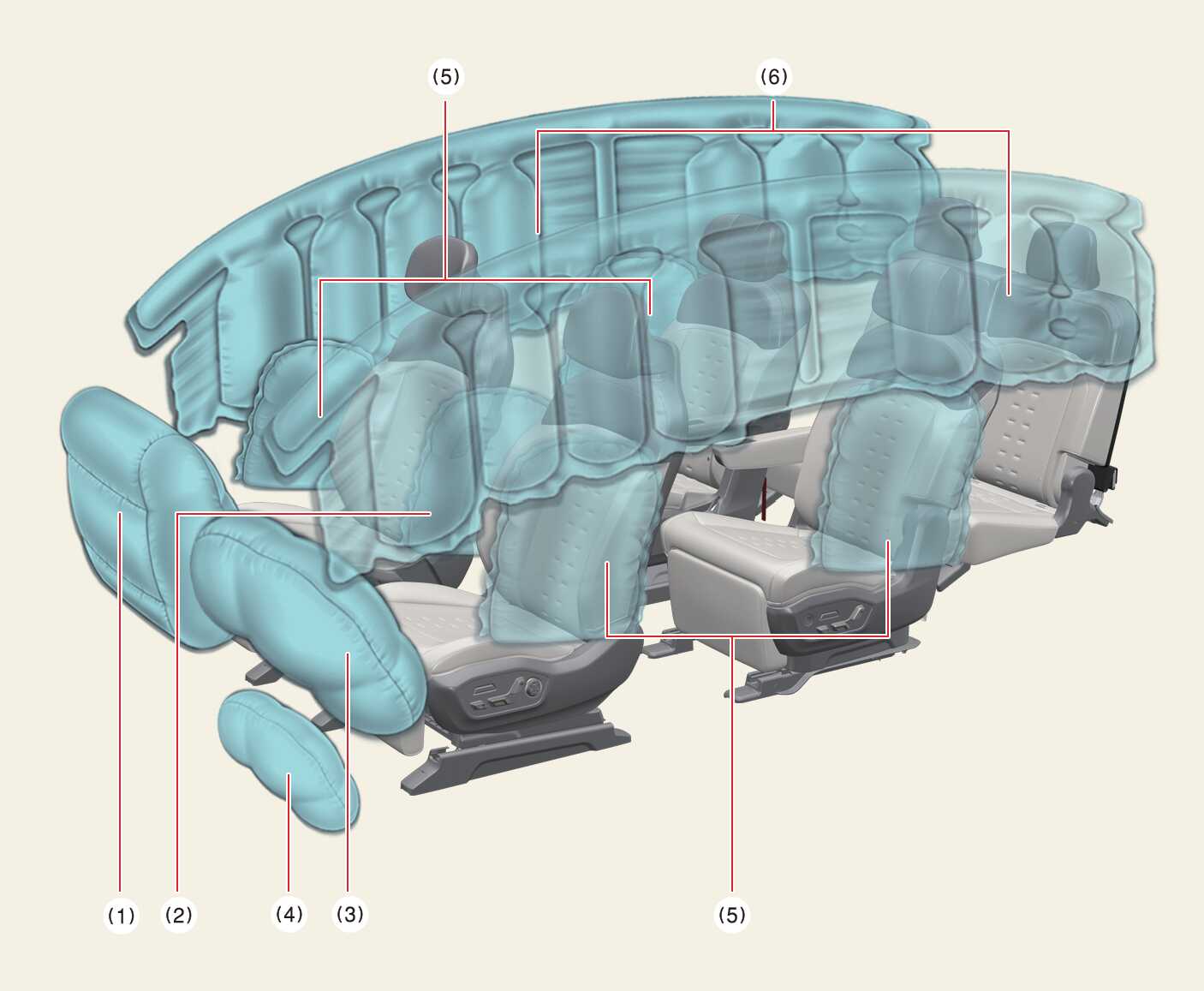
The actual air bags in the vehicle may differ from the illustration.
-
Passenger's front air bag
-
Front center side air bag
-
Driver's front air bag
-
Driver's knee air bag*
-
Side air bag
-
Curtain air bag
: if equipped
How does the air bag system operate?
-
Air bags are activated (able to inflate if necessary) only when the EV button is in the POWER ON or DRIVE READY position and it can be activated within about 3 minutes after the vehicle is in OFF position.
-
Air bags inflate instantly in the event of serious frontal or side collision (if a side air bag or a curtain air bag is present) in order to help protect the occupants from serious physical injury.
-
Generally, air bags are designed to inflate based upon the severity of a collision and its direction, etc. These two factors determine whether the sensors produce electronic deployment/inflation signal.
-
The front air bags will completely inflate and deflate in an instant. It is virtually impossible for you to see the air bags inflate during an accident. It is much more likely that you will simply see the deflated air bags hanging out of their storage compartments after the collision.
-
In order to help provide protection in a severe collision, the air bags must inflate rapidly. The speed of air bag inflation is due to the extremely short time when a collision occurs and the need to get the air bag between the occupant and the vehicle structures before the occupant impacts those structures. This speed of inflation re duces the risk of serious or life-threatening injuries in a severe collision and is thus a necessary part of air bag design.
-
However, air bag inflation can also cause injuries, including facial abrasions, bruises, and broken bones, because the inflation speed also causes the air bags to expand with a great deal of force.
-
There are even circumstances under which contact with the steering wheel air bag can cause fatal injuries, especially if the occupant is positioned excessively close to the steering wheel.
Noise and smoke
When the air bags inflate, they make a loud noise and leave smoke and powder in the air inside the vehicle. This is normal and is a result of the ignition of the air bag inflator. After the air bag has inflated, you may feel substantial discomfort in breathing due to the contact between your chest and both the seat belt and the air bag, as well as from breathing the smoke and powder.
Open your doors and/or windows as soon as possible after an impact in order to reduce discomfort and prevent prolonged exposure to the smoke and powder.
Though the smoke and powder are nontoxic, they may cause skin irritation (eyes, nose,throat, etc.). If this is the case, wash and rinse with cold water immediately and consult the doctor if the symptom persists.