
Transmission ranges
R (Reverse)
Use this position to drive the vehicle backward.

-
Always come to a complete stop before shifting into R (Reverse) position.
-
When moving to R (Reverse) position the gear is not shifted if the vehicle speed is over 2 km/h (1 mph).
-
Depress the brake pedal fully. If not, the brake press indicator will illuminate and the gear is not shifted.
N (Neutral)
The wheels and transmission are not engaged.Use N (Neutral) if you need to restart a stalled engine, or if it is necessary to stop with the engine ON. Always depress the brake pedal when you are shifting from N (Neutral) to another gear.

Do not shift into gear unless your foot is firmly on the brake pedal. Shifting into gear when the engine is running at high speed can cause the vehicle to move very rapidly. You could lose control of the vehicle and hit people or objects.
D (Drive)
This is the normal forward driving position. The transmission will automatically shift to the appropriate gear position upon operation of the accelerator pedal and variation of vehicle speed.For extra power when passing another vehicle or driving uphill, depress the accelerator further until you feel the transmission downshift to a lower gear.
When starting off on an uphill
-
Engage the parking brake firmly to prevent the vehicle from rolling backwards.
-
Move the shift lever to D (Drive) position while depressing the brake pedal. Make sure that the shift indicator in the cluster displays 1st gear.
-
Take your foot of the brake pedal and depress the accelerator pedal gradually. Then, when the vehicle starts moving, release the parking brake and depress the accelerator pedal.
When starting off on a downhill
-
Depress the brake pedal and move the shift lever to D (Drive) position. Make sure that the shift indicator in the cluster displays 1st gear.
-
Take your foot off the brake pedal and slowly depress the accelerator pedal. When the vehicle speed increases, the clutch will be engaged.
-
If the gear is not shifted after changing the shift lever from N (Neutral) to D (Drive)/M (Manual)/R (Reverse), try to shift the gear again. In this case, time delay and intermittent noise may occur which are normal.
-
Always come to a complete stop and depress the brake pedal before shifting into D (Drive) position .
-
When moving from R (Reverse) to D (Drive) position, the gear is not shifted if the vehicle speed is over 7 km/h (4 mph).
-
Depress the brake pedal fully. If not, the brake press indicator will illuminate and the gear is not shifted.
Manual shift mode
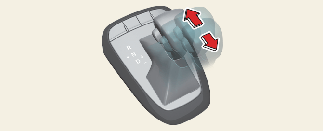
Whether the vehicle is stationary or in motion, Manual shift mode is selected by pushing the shift lever from the D (Drive) position into the manual gate (M). To return to D (Drive) range operation, push the shift lever back into the main gate.In Manual shift mode, moving the shift lever backwards and forwards will allow you to select the desired range of gears for the current driving conditions.
+ (Up) : Push the lever forward once to shift up one gear.
- (Down) : Pull the lever backwards once to shift down one gear.
-
Only the five forward gears can be selected. To reverse or park the vehicle, move the shift lever to the R (Reverse) or N (Neutral) position as required.
-
Downshifts are made automatically when the vehicle slows down. When the vehicle stops, 1st gear is automatically selected.
-
When the engine rpm approaches the red zone the transmission will upshift automatically.
-
If the driver presses the lever to + (Up) or - (Down) position, the transmission may not make the requested gear change if the next gear is outside of the allowable engine rpm range. The driver must execute upshifts in accordance with road conditions, taking care to keep the engine rpms below the red zone.
-
When accelerating from a stop on a slippery road, push the shift lever forward into the + (Up) position. This allows the transmission to shift into the 2nd gear which is better for smooth driving on a slippery road. Push the shift lever to the - (Down) side to shift back to the 1st gear.