
Using the TMK
-
Detach the speed restriction label (1) from the sealant bottle (2), and place it in a highly visible place inside the vehicle such as on the steering wheel to remind the driver not to drive too fast.
-
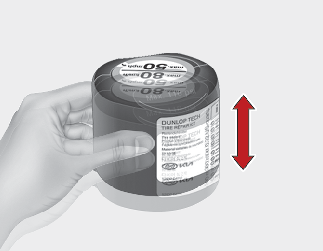
Shake the sealant bottle.
-
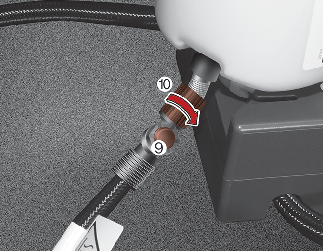
Screw connection hose (10) onto the connector of the sealant bottle.
-
Ensure that button (9) on the compressor is not pressed.
-
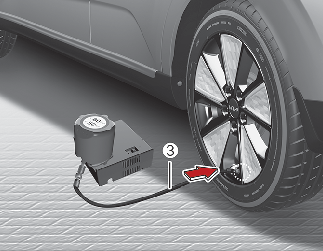
Unscrew the valve cap from the valve of the flat tyre and screw filling hose (3) of the sealant bottle onto the valve.
-
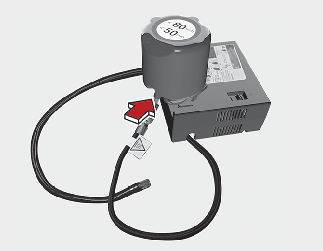
Insert the sealant bottle into the housing (5) of the compressor so that the bottle is upright.
-
Ensure that the compressor is switched off, position 0.
-
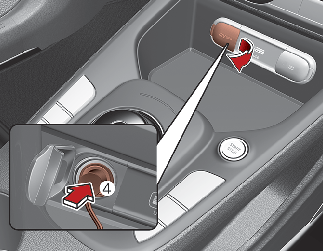
Connect between compressor and the vehicle power outlet using the cable and connectors (4).
 CAUTION
Do not connect another vehicle's Tyre Mobility Kit (TMK) to the power outlet or battery terminal. The unmatched power requirement between the vehicle power outlet and the tyre mobility kit can cause fire or circuit damage within the vehicle and the Tyre Mobility Kit.
-
With the vehicle position on, switch on the compressor and let it run for approximately 5~7 minutes to fill the sealant up to proper pressure. (refer to More Details). The inflation pressure of the tyre after filling is unimportant and will be checked/corrected later.
Be careful not to overinflate the tyre and stay away from the tyre when filling it.
When the tyre and wheel are damaged, do not use Tyre Mobility Kit for your safety.
CAUTIONTyre pressure
Do not attempt to drive your vehicle if the tyre pressure is below 200 kPa (29 psi). This could result in an accident due to sudden tyre failure.
-
Switch off the compressor.
-
Detach the hoses from the sealant bottle connector and from the tyre valve.
Return the TMK to its storage location in the vehicle.

Carbon monoxide
Carbon monoxide poisoning and suffocation is possible if the motor is left running in a poorly ventilated or unventilated location (such as inside a building).