
Lane Keeping Assist operation
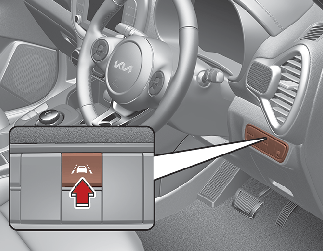
To activate/deactivate Lane Keeping Assist:
With the START/STOP BUTTON in the ON position, LKA turns on automatically. The indicator ( ) in the cluster display will initially illuminate white. If you press Lane Safety button located on the instrument panel
on the lower right hand side of the driver, Lane Keeping Assist will be turned off and the indicator on the cluster display
will go off.
) in the cluster display will initially illuminate white. If you press Lane Safety button located on the instrument panel
on the lower right hand side of the driver, Lane Keeping Assist will be turned off and the indicator on the cluster display
will go off.
The colour of indicator will change depend on the condition of Lane Keeping Assist.
-
White : Sensor does not detect the lane marker or vehicle speed is less than 60km/h(37mph).
-
Green : Sensor detects the lane marker or road edge and function is able to control the steering.
Lane Keeping Assist activation
-
To see Lane Keeping Assist screen on the LCD display in the cluster, Tab to the Driving Assist mode (
 ).
).
-
For further details, refer to More Details.
-
After Lane Keeping Assist is activated, if both lane markers or road edge are detected, vehicle speed is over 60 km/h (37 mph) and all the activation conditions are satisfied, a green steering wheel indicator will illuminate and the steering wheel will be controlled.
 WARNING
Lane Keeping Assist is a function to help prevent the driver from leaving the lane or road edge. However, the driver should not solely rely on the function but always check the road conditions when driving.
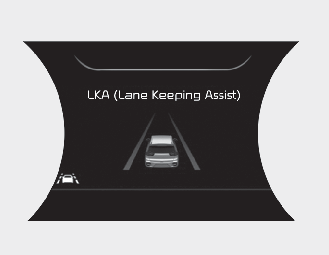
If the speed of the vehicle is over 60 km/h (37 mph) and the function detects lane markers, the colour changes from gray to white.
Warning
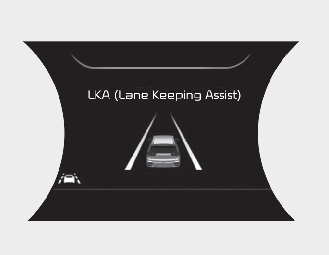
If the vehicle leaves a lane or road edge, the lane marker or road edge you cross will blink on the LCD display and the warning sound is provided.
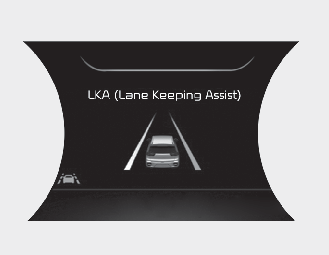
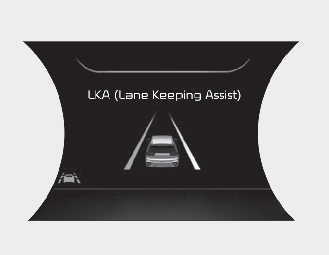
* Haptic specification
If the vehicle leaves a lane, the lane marker you cross will blink on the LCD display with steering wheel vibration warning.
If the driver takes hands off the steering wheel for several seconds whilst Lane Keeping Assist is activated, the function will warn the driver.
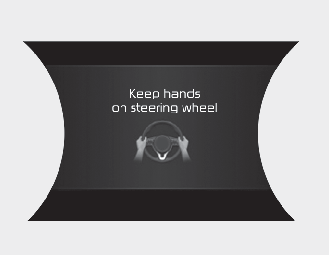
-
The warning message may appear late according to road conditions. Therefore, always have your hands on the steering wheel whilst driving.
-
If you hold the steering wheel lightly, the function would generate hands-off warning because Lane Keeping Assist can treat the situation as you do not grab the wheel.
-
If continuous hands-off occurs continuously, the beeping can be lengthened and continued even if Lane Keeping Assist steer control is released.
-
The driver is responsible for accurate steering.
-
Even though the steering is assisted by the function, the driver may control the steering wheel.
-
Turn off the function and drive the vehicle in below situations.
-
In bad weather.
-
In bad road condition.
-
When the steering wheel needs to be controlled by the driver frequently.
-
When towing a vehicle or trailer.
-
-
The steering wheel may feel heavier when the steering wheel is assisted by the function than when it is not.

-
Even though the steering is assisted by the function, the driver may control the steering.
-
The steering wheel may feel heavier when the steering wheel is assisted by the function than when it is not.
-
You change lanes with the turn signal.
-
Using the turn signal to change lanes.
-
If you change lanes without the turn signal on, the steering wheel might be controlled.
-
-
Lane Keeping Assist can transit to steering assist mode when the car is near to middle of the lane after function on or the lane was changed. Lane Keeping Assist can not assist steering if the vehicle follows lane marker too close continuously before transition to steering assist mode.
-
The control of ESC (Electronic Stability Control) or VSM (Vehicle Stability Management) is activated.
-
The steering will not be assisted when your drive fast on a sharp curve.
-
The steering will not be assisted when vehicle speed is below 60 km/h (37 mph) and over 195 km/h (121 mph).
-
The steering will not be assisted when you change lanes or road edge fast.
-
The steering will not be assisted when you brake suddenly.
-
The steering will not be assisted when the lane is very wide or narrow.
-
The steering will not be assisted when only one side lane marker is detected.
-
There are more than two lane markers such as a construction area.
-
Radius of a curve is too small.
-
When you turn steering wheel suddenly, LKA will be disabled temporarily.
-
Driving on a steep slope or hill.
DRIVER’S ATTENTION
The driver must be cautious in the below situations may not work properly when recognition of the lane marker is poor or limited :
When lane and road condition is poor
-
It is difficult to distinguish the lane marker or road edge from road when the lane marker or road edge is covered with dust or sand.
-
It is difficult to distinguish the colour of the lane marker from road.
-
There is something looks like a lane marker.
-
The lane marker or road edge is indistinct or damaged.
-
The number of lanes increases/ decreases or the lane lines are crossing (Driving through a toll plaza/toll gate, merged/divided lane).
-
There are more than two lane markers.
-
The lane marker is very thick or thin.
-
The lane marker or road edge is not visible due to snow, rain, stain, a puddle or other factors.
-
A shadow is on the lane marker or road edge because of a median strip, guardrail, noise barriers and others.
-
When the lane markers are complicated or a structure substitutes for the lines such as a construction area.
-
There are crosswalk signs or other symbols on the road.
-
The lane suddenly disappears such as at the intersection.
-
The lane marker or road edge in a tunnel is covered with dirt or oil and etc.
-
The lane is very wide or narrow.
When external condition is intervened
-
The brightness of outside changes suddenly when entering/existing a tunnel or passing under a bridge.
-
The headlamps are not on at night or in a tunnel, or light level is low.
-
There is a boundary structure in the roadway.
-
The light of street, sun, oncoming vehicle and so on reflects from the water on the road.
-
When light shines brightly in the reverse direction you drive.
-
Road surface is not even.
-
The distance from the vehicle ahead is very short or the vehicle ahead drives hiding the lane line or road edge.
-
You drive on a steep grade or a sharp curve.
-
The vehicle vibrates heavily.
-
The temperature near inside mirror is very high due to direct sun light and etc.
When front visibility is poor
-
The lens or windscreen is covered by strange materials.
-
The sensor cannot detect the lane because of fog, heavy rain or snow.
-
The windscreen is fogged by humid air in the vehicle.
-
Putting something on the crash pad and etc.
WARNINGLane Keeping Assist is a function to help prevent the driver from leaving the lane. However, the driver should not solely rely on the function but always take the necessary actions for safe driving practices.