
Driver's and passenger's front airbag
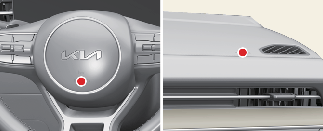
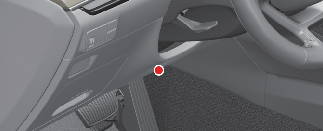
The indication of the system's presence are the letters "AIR BAG" located on the airbag pad cover and driver's knee area on the steering wheel and the passenger's side front panel pad above the glove box.
The Supplemental Restraint System (SRS) consists of airbags installed under the pad covers in the center of the steering wheel and the passenger's side front panel above the glove box.
The purpose of the SRS is to provide the vehicle's driver and/or the front passenger with additional protection than that offered by the seat belt system alone in case of a frontal impact of sufficient severity. The SRS uses sensors to gather information about the driver's and front passenger's seat belt usage and impact severity.
The seat belt buckle sensor determines if the front passenger's seat belt is fastened.
These sensors provide the ability to control the SRS deployment based on whether or not the seat belts are fastened, and how severe the impact is.
The advanced SRS offers the ability to control the airbag inflation with two levels. A first stage level is provided for moderate-severity impacts. A second stage level is provided for more severe impacts.
According to the impact severity and seat belt usage, the SRS Control Module (SRSCM) controls the airbag inflation. Failure to properly wear seat belts can increase the risk or severity of injury in an accident.
Additionally, your vehicle is equipped with an Occupant Detection System (ODS) in the front passenger's seat. The ODS detects the presence of a passenger in the front passenger's seat and will turn off the front passenger's airbag under certain conditions. For more detail, see More Details.

Modification to the seat structure can cause the airbag to deploy at a different level than should be provided.
Manufacturers are required by government regulations to provide a contact point concerning modifications to the vehicle for persons with disabilities, which modifications may affect the vehicle's advanced air bag system. That contact is Kia's toll-free Customer Experience Department at 1-877-KIA-AUTO (1-877-542-2886). However, Kia does not endorse nor will it support any changes to any part or structure of the vehicle that could affect the advanced air bag system, including the occupant detection system.
Replacement/modifications
The front passenger seat, dashboard or door should not be replaced except by an authorized Kia dealer using original Kia parts designed for this vehicle and model. Any other such replacement or modification could adversely affect the operation of the Occupant Detection System and your advanced airbags.
Advanced airbags are combined with pre-tensioner seat belts to help provide enhanced occupant protection in frontal crashes. Front airbags are not intended to deploy in collisions in which sufficient protection can be provided by the seat belt.

Airbags can only be used once – have an authorized Kia dealer replace the airbag immediately after deployment.
Front airbags are not intended to deploy in side-impact, rear-impact or rollover crashes. However, when frontal deployment threshold is satisfied at side-impact, front airbags may deploy. In addition, front airbags will not deploy in frontal crashes below the deployment threshold.
SRS wiring
Do not tamper with or disconnect SRS wiring or other components of the SRS system. Doing so could result in injury, due to accidental deployment of the airbags or by rendering the SRS inoperative.
No attaching objects
No objects (such as crash pad cover, cellular phone holder, cup holder, perfume or stickers) should be placed over or near the airbag modules on the steering wheel, instrument panel, windshield glass, and the front passenger's panel above the glove box. Such objects could cause harm if the vehicle is in a crash severe enough to cause the airbags to deploy.
Do not place any objects over the airbag or between the air bag and yourself.
Additionally, never place or insert any object into any small opening near side airbag labels attached to the vehicle seats.
When the airbag deploys, the object may affect the deployment and result in unexpected accident or bodily harm.