
Rear Cross-Traffic Collision-Avoidance Assist malfunction and limitations
Rear Cross-Traffic Collision-Avoidance Assist malfunction
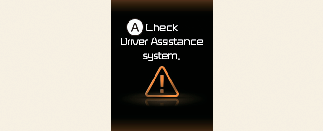
A: Check Driver Assistance system
If Rear Cross-Traffic Collision-Avoidance Assist is not working properly, a warning message will appear on the instrument
cluster for several seconds, and the master ( ) warning light will appear on the instrument cluster.
Have the function be inspected by an authorized Kia dealer. Visit an authorized Kia dealer.
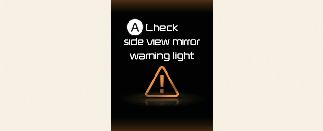
A: Check side-view mirror warning light
When the outside rear-view mirror warning light is not working properly, a warning message will appear on the instrument cluster
for several seconds, and the master () warning light will appear on the instrument cluster.
Have the function be inspected by an authorized Kia dealer.
Rear Cross-Traffic Collision-Avoidance Assist disabled
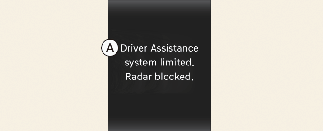
A: Driver Assistance system limited. Radar blocked.
When the rear bumper around the rear-side radar or sensor is covered with foreign material, such as snow, rain, trailer or carrier, it can reduce the detecting performance and temporarily limit or disable Rear Cross-Traffic Collision-Avoidance Assist.
If this occurs, a warning message will appear on the instrument cluster.
Rear Cross-Traffic Collision-Avoidance Assist will operate properly when such foreign material or trailer, etc., is removed.
If Rear Cross-Traffic Collision-Avoidance Assist does not operate properly after it is removed, have the function be inspected by an authorized Kia dealer.

-
Even though a warning message does not appear on the cluster, Rear Cross-Traffic Collision-Avoidance Assist may not operate properly.
-
Rear Cross-Traffic Collision-Avoidance Assist may not operate properly in an open area where any substances are not detected after turning ON your vehicle.

Turn off Rear Cross-Traffic Collision-Avoidance Assist to install or remove a trailer, carrier, or another attachment. Turn on Rear Cross-Traffic Collision-Avoidance Assist when finished.
Limitations of Rear Cross-Traffic Collision-Avoidance Assist
Rear Cross-Traffic Collision-Avoidance Assist may not operate properly, or it may operate unexpectedly under the following circumstances:
-
Departing from areas with overgrown foliage
-
Departing from areas where roads are wet
-
Speed of an approaching vehicle is fast or slow
Braking control may not work, and your attention is required in the following circumstances:
-
The vehicle vibrate severely while driving over a bumpy, uneven road or pothole
-
Driving on a slippery surface such as snow, rain, ice, etc.
-
The tire pressure is low or a tire is damaged
-
Remote Smart Parking Assist is operating (if equipped)

For more details on the limitations of the rear corner radar, refer to More Details.
-
Driving near a vehicle or structure
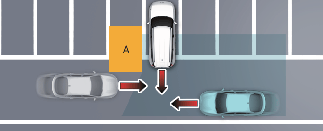
[A]: Structure
Rear Cross-Traffic Collision-Avoidance Assist may be limited when driving near a vehicle or structure, and may not detect a vehicle approaching from the left or right. The function may not warn you or control the brakes when necessary.
Always check your surroundings while backing up.
-
When the vehicle is in a complex parking environment
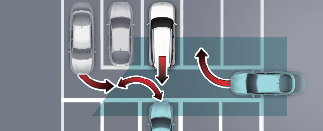
Rear Cross-Traffic Collision-Avoidance Assist may detect vehicles which are parking or pulling out near your vehicle (i.e.,example, a vehicle leaving beside your vehicle, a vehicle parking or pulling out in the rear area, a vehicle approaching your vehicle making a turn, etc.).
The function may unnecessarily warn the driver and control the brake.
Always check your surroundings while backing up.
-
When the vehicle is parked diagonally
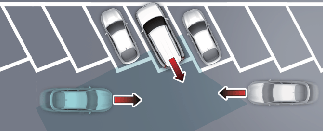
[A]: Vehicle
Rear Cross-Traffic Collision-Avoidance Assist may be limited when backing up diagonally and may not detect the vehicle approaching from the left or right. The function may not warn you or control the brakes when necessary.
Always check your surroundings while backing up.
-
When the vehicle is on or near a slope
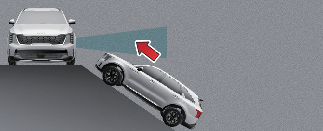
Rear Cross-Traffic Collision-Avoidance Assist may be limited when your vehicle is on an uphill or downhill slope, or near it, and may not detect a vehicle approaching from the left or right. The function may not warn you or control the brakes when necessary.
Always check your surroundings while backing up.
-
Pulling into a parking space where there is a structure
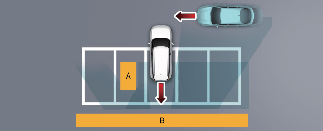
[A]: Structure,
[B]: Wall
Rear Cross-Traffic Collision-Avoidance Assist may detect vehicles passing by in front of you when parking in reverse into a parking space with a wall or structure in the rear or side area. The function may unnecessarily warn the driver and control the brake.
Always check your surroundings while backing up.
-
When the vehicle is parked rearward
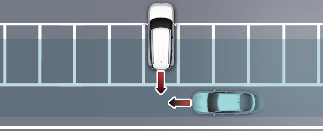
Rear Cross-Traffic Collision-Avoidance Assist may detect vehicles passing by behind you when parking in reverse into a parking space. The function may unnecessarily warn the driver and control the brake.
Always check your surroundings while backing up.
-
When you are towing a trailer or another vehicle, turn off Rear Cross-Traffic Collision-Avoidance Assist for safety reasons.
-
Rear Cross-Traffic Collision-Avoidance Assist may not operate properly if interfered with by strong electromagnetic waves.
-
Rear Cross-Traffic Collision-Avoidance Assist may not operate for 3 seconds after your vehicle is started, or the rear corner radars are initialized.
-
Even if restarting the vehicle with the sensors blocked or malfunctioning, Rear Cross-Traffic Collision-Avoidance Assist may not properly operate as the function maintains the last setting.
This device complies with Industry Canada licence-exempt RSS standard(s).
Operation is subject to the following conditions:
-
This device may not cause interference, and
-
This device must accept any interference, including interference that may cause undesired operation of the device.
-
Changes or modifications not expressly approved by the party responsible for compliance could void the user's authority to operate the device.