

Winter driving
Severe weather conditions in the winter result in greater tyre wear and other problems. To minimise issues related to winter driving, you should follow the suggestions in these sections:
Snowy or icy conditions
To drive your vehicle in deep snow, you may need to use snow tyres or to install tyre chains on your tyres.
If you need snow tyres, select tyres of the same size as the original ones. Failure to do so may adversely affect the safety and handling of your vehicle.
Speeding, rapid acceleration, sudden brake engagement, and sharp turns are potentially very hazardous practices in snowy or icy conditions.
When you decelerate, use regenerative braking system. Sudden brake engagement on snowy or icy roads may cause skidding. Keep a sufficient distance between your vehicle and the vehicle ahead. Engage the brake pedal gently.
Installing tyre chains on the tyres allows you to drive with greater force, but does not prevent side skids.
Tyre chains are not legal in all countries. Check the country laws before using tyre chains.
Snow tyres
If you install snow tyres on your vehicle, make sure they are radial tyres of the same size and load bearing range as the original ones. Install snow tyres on all 4 wheels to balance your vehicle’s handling in all weather conditions. Keep in mind that snow tyres may provide lower traction than your original tyres on dry roads. Drive cautiously even when the roads are clear. Check with the tyre dealer for maximum speed recommendations.
Do not install studded tyres without first checking state, local, and municipal regulations for possible restrictions against their use.
Snow tyre size
Snow tyres should be the same size as your original ones. Otherwise, your vehicle’s safety and handling may be adversely affected.
Tyre chains
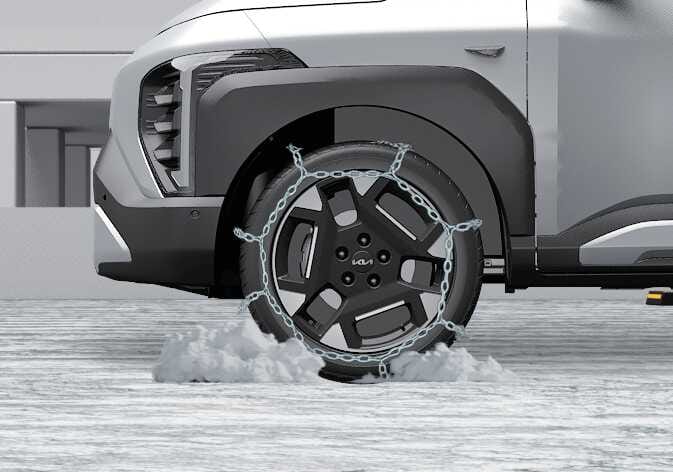 OAYI096017L |
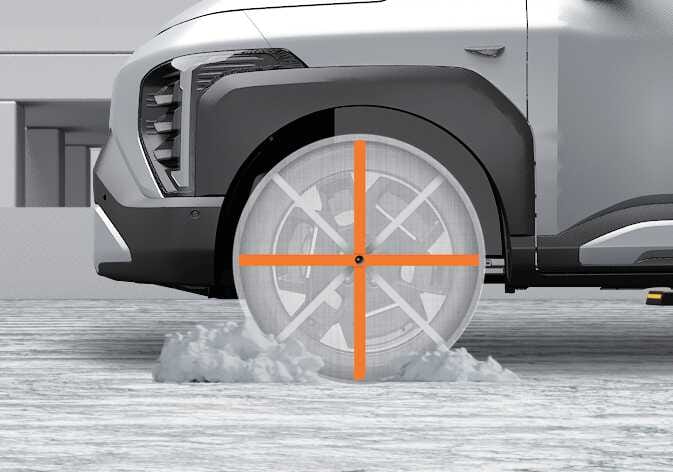 OAYI096019L |
Because radial tyres have thinner sidewalls, they can be damaged if you install certain types of tyre chains on them. Therefore, snow tyres are recommended instead of tyre chains. Do not mount tyre chains on vehicles equipped with aluminium wheels, as they may damage the wheels.
If you must use tyre chains, use only chains suitable for this vehicle, such as SAE S class wire chains less than 12mm (0.47 inches) thick or AutoSock fabric snow chain.
Your warranty does not cover damage to your vehicle caused by improper tyre chain use.
When using tyre chains, attach them to the drive wheels as follows:
-
Wire-type chains for 16 or 17 inch tyres.
-
Fabric-type chains for 16 or 17 inch tyres.
-
FWD vehicles move the front wheel as a power source. Tyre chains must be installed on the front tyres.
-
Drive slowly after installing tyre chains. If you hear noise caused by the chains making contact with your vehicle, slow down until the noise stops. To prevent damage, remove the chains as soon as you begin driving on cleared roads.
-
Wrong sized or improperly installed tyre chains can damage your vehicle’s brake lines, suspension, body, and wheels. When installing tyre chains, follow the manufacturer’s instructions and install them as tightly as possible. Drive at speed below 30 km/h (20 mph) or the speed limit recommended by chain manufacturer, whichever is lower with tyre chains installed.
-
Make sure the tyre chains are the correct size and type for your tyres. Incorrect tyre chains can cause damage to your vehicle’s body and suspension, which may not be covered by your vehicle manufacturer warranty. The tyre chain connecting hooks may be damaged from contacting vehicle components, causing the chains to come loose from the tyres. Make sure the tyre chains are SAE class S certified.
-
Always check the tyre chains for proper installation after driving approximately 0.5-1 km (0.3-0.6 miles). Retighten or reinstall the tyre chains if they are loose.
-
You must use fabric-type chains on 16,17 inch tyres.
Use high quality ethylene glycol coolant
Your vehicle is equipped with high quality ethylene glycol coolant. This is the only type of coolant that should be used because it helps prevent corrosion in the cooling system, lubricates the water pump, and prevents freezing. Be sure to replace or replenish your coolant in accordance with the schedule in the Maintenance section.
Before winter, have your coolant tested to ensure that its freezing point is sufficient for the anticipated temperatures.
Check 12V battery and cables
Winter puts additional burdens on the 12V battery system. Visually inspect the 12V battery and cables as described in the Maintenance section. Have your vehicle inspected by a professional workshop. Kia recommends visiting an authorised Kia dealer or service partner.
To keep locks from freezing
To keep the locks from freezing, squirt an approved de-icer fluid or glycerin into the key opening. If a lock is covered with ice, squirt an approved de-icing fluid onto the ice to remove it. If the lock is frozen internally, you may be able to thaw it out using a heated key. Handle the heated key with care to avoid injury.
Use approved window washer anti-freeze
To keep the water in the window washer system from freezing, add an approved window washer anti-freeze solution according to the instructions on the container. Window washer anti-freeze is available from authorised Kia dealers and most auto parts stores. Do not use coolant or other types of anti-freeze, as these may damage the paint finish.
Don’t let your parking brake freeze
Under some conditions, your parking brake can freeze whilst it is applied. This is most likely to happen when there is an accumulation of snow or ice around or near the rear brakes, or if the brakes are wet. If there is a risk the parking brake may freeze, temporarily apply it with the vehicle in P (Park). Block the rear wheels in advance so that your vehicle will not roll. Then release the parking brake.
Don’t let ice and snow accumulate under your vehicle
Under some conditions, ice and snow can build up under the fenders and interfere with steering. When driving in severe winter conditions where this may happen, periodically check under your vehicle to make sure that ice and snow do not obstruct the movement of the drive wheels and steering components.
Carry emergency equipment
Depending on the severity of the weather, you should carry appropriate emergency equipment. Some of these items include tyre chains, tow straps or chains, a flashlight, emergency flares, sand, a shovel, jumper cables, a window scraper, gloves, a ground cloth, coveralls, a blanket, and so on.