

Driving in sand or mud
-
Maintain slow and constant speed. Operate the accelerator pedal slowly to ensure safe driving (wheel-slip prevention).
-
Keep sufficient distance between your vehicle and the vehicle in front of you.
-
Reduce vehicle speed and always check the road condition.
-
Avoid speeding, rapid acceleration, sudden brake applications, and sharp turns to prevent getting stuck.
-
When the vehicle is stuck in snow, sand or mud, the tires may not operate.
-
This is to protect the transmission and not a malfunction.
Moving the vehicle forcibly to get out of mud or sand can cause damage/overheat of the engine or damage/breakdown of the transmission, differential or 4WD system as well as damage to tires. If excessive wheel slip occurs after entering a sandy/muddy road, the vehicle may fall into the sand/mud. When it happens, put a stone or a tree branch under the tire, and then try to pull out the vehicle, or try to get it unstuck by repeatedly moving forwards and backwards.
Transmission overheated
-
When driving on muddy and sandy roads under the severe condition, the transmission could be overheated.
-
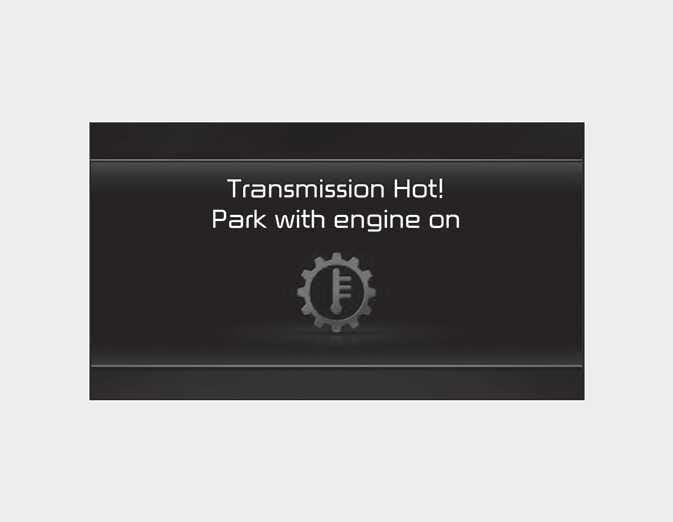
When the transmission is overheated, the safe protection mode engages and the "Transmission Hot! Park with engine on" warning message will appear on the LCD display with a chime.
-
If this occurs, pull over to a safe location, stop the vehicle with the engine running, apply the brakes and shift the vehicle to P (Park), and allow the transmission to cool.
-
If you ignore this warning, the driving condition may become worse. You may experience abrupt shifts, frequent shifts, or jerkiness. To return to the normal driving condition, stop the vehicle and apply the foot brake or shift into P (Park). Then allow the transmission to cool for a few minutes with engine on, before driving off.
-
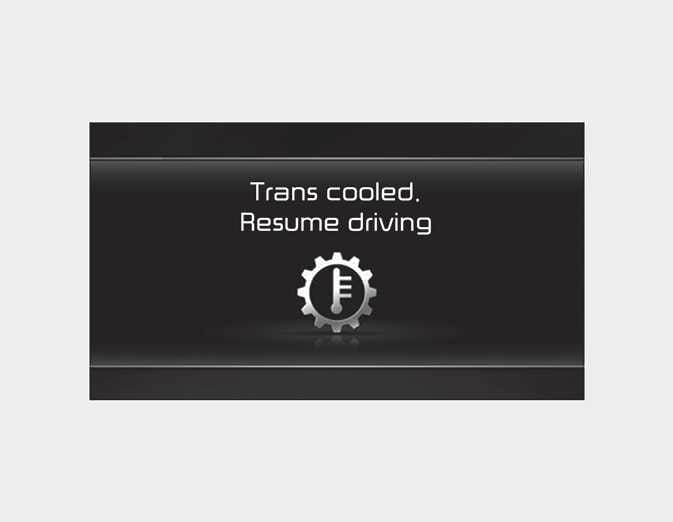
When the message "Trans cooled. Resume driving" appears you can continue to drive your vehicle.
If the warning messages in the LCD display continue to blink, for your safety, have the system checked by a professional workshop. Kia recommends to visit an authorized Kia dealer/ service partner.
Tire Precautions
Always pay attention to tires for AWD (all-wheel drive) vehicles.
When driving in all-wheel drive, driving force is applied to all tires, and the driving performance of the vehicle is greatly affected by the degree of tire wear:
-
When replacing tires, be sure to equip all four tires with the same size, type, tread, brand and load-carrying capacity. Do not use tire and wheel with different size and type from the one originally installed on your vehicle. It can affect the safety and performance of your vehicle, which could lead to steering failure or rollover causing serious injury.
-
Replace the front and rear tire positions every 10,000 km.
-
Each tire should be checked monthly when cold and inflated to inflation pressure recommended by the vehicle manufacturer on the vehicle placard or tire inflation pressure label.
-
For AWD (all-wheel drive) vehicles, install the chains on the front wheels. However, this may damage the AWD system, so keep the travel distance as short as possible.
Refer to Winter driving.
Towing Precautions
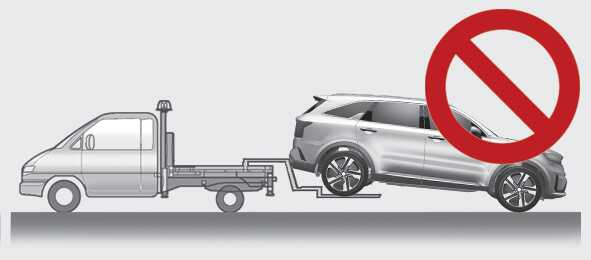
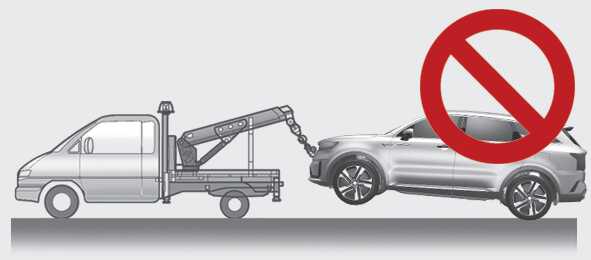
The AWD vehicle should never be towed with the wheels on the ground. Your vehicle must be towed with a wheel lift and dollies or flatbed equipment with all the wheels off the ground.
Refer to Trailer towing.
The AWD vehicle cannot be towed with sling-type equipment. Use wheel lift or flatbed equipment.
Your vehicle is equipped with tires designed to provide safe ride and handling capability. Do not use tires and wheels that are different in size and type from the originally installed ones. It can affect the safety and performance of your vehicle, which could lead to steering failure or rollover and serious injury. When replacing the tires, be sure to equip all four tires with the tire and wheel of the same size, type, tread, brand and load-carrying capacity.
Jacked vehicle
While the full-time AWD vehicle is being raised on a jack, never start the engine or cause the tires to rotate.
There is the danger that rotating tires touching the ground could cause the vehicle to go off the jack and to jump forward.
-
Full-time AWD vehicles must be tested on a special four wheel chassis dynamometer.
NOTENever engage the parking brake while performing these tests.
Dynamometer testing
Keep away from the front of the vehicle while the vehicle is in gear on the dynamometer. This is very dangerous as the vehicle can jump forward and cause serious injury or death.
-
When lifting up the vehicle, do not operate front and rear wheel separately. All four wheels should be operated.
-
If you need to operate the front wheel and rear wheel when lifting up the vehicle, you should release the parking brake.