
Towing without wheel dollies when using a towing service
When towing your vehicle in an emergency without wheel dollies:
-
Set the ignition switch or ENGINE START/STOP button to ACC position.
-
Place the shift lever in N (Neutral).
-
Release the parking brake.

Towing gear position
Failure to shift to N (Neutral) may cause internal damage to the vehicle.
-
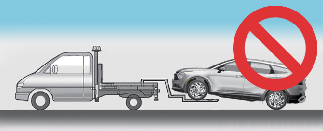
If any of the loaded wheels or suspension components are damaged or the vehicle is being towed with the front wheels on the ground, use a towing dolly under the front wheels.
-
Do not tow the vehicle backwards with the front wheels on the ground, as this may cause damage to the transmission.
2-wheel drive vehicle (front wheel drive)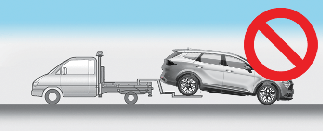
-
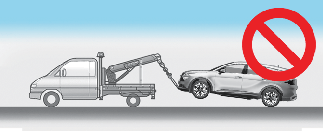
Attaching straps to the chassis, suspension or other parts of the body can cause damage.
-
Do not tow with sling-type equipment. Use wheel lift or flatbed equipment.
-
Do not tow the vehicle with four wheels in contact with the ground if it is the vehicle equipped with Automatic Transmission. Otherwise, the transmission will be seriously damaged. Also, make sure not to tow the vehicle connecting it with other vehicles including camper vans.

-
If you tow the vehicle while the front wheels are touching the ground, the vehicle motor may generate electricity and the motor components may be damaged or a fire may occur.
-
When a vehicle fire occurs due to the battery, there is a risk of a second fire. Contact the fire department when towing the vehicle.
Emergency towing
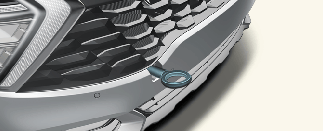
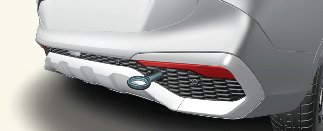
If towing is necessary, have it done by an authorized Kia dealer or a commercial tow truck service.
If a towing service is not available in an emergency, your vehicle may be temporarily towed using a cable or chain secured to the emergency towing hook at the front (or rear) of the vehicle.
Use extreme caution when towing the vehicle with a cable or chain. A driver must be in the vehicle to steer it and operate the brakes.
Towing in this manner may be done only on hard-surfaced roads for a short distance and at low speeds. Also, the wheels, axles, power train, steering and brakes must all be in good condition.
The driver must be in the vehicle for steering and braking operations when the vehicle is being towed. Passengers other than the driver must not be in the vehicle.
Always follow these emergency towing precautions:
-
Place the ignition switch in the ACC position so the steering wheel is not locked.
-
Place the shift button in N (Neutral).
-
Release the parking brake.
-
Depress the brake pedal with more force than normal as you will have reduced braking performance.
-
More steering effort will be required because the power steering system will be disabled.
-
Use a vehicle heavier than your own to tow your vehicle.
-
The drivers of both vehicles should communicate with each other frequently.
-
Before emergency towing, check that the hook is not broken or damaged.
-
Fasten the towing cable or chain securely to the hook.
-
Do not jerk the hook. Apply steady and even force.
-
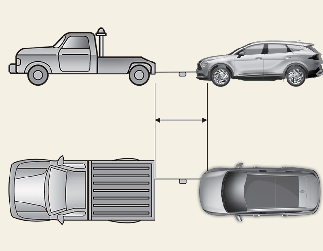
Use a towing cable or chain less than 16 feet (5 m) long. Attach a white or red cloth (about 12 inches (30 cm) wide) in the middle of the cable or chain for easy visibility.
-
Drive carefully so the towing cable or chain remains tight during towing.
-
Before towing, check the automatic transmission for fluid leaks under your vehicle. If the automatic transmission fluid is leaking, flatbed equipment or a towing dolly must be used.

-
Accelerate or decelerate the vehicle in a slow and gradual manner while maintaining tension on the tow rope or chain to start or drive the vehicle, otherwise tow hooks and the vehicle may be damaged.
-
To avoid damage to your vehicle and vehicle components when towing:
-
Always pull straight ahead when using the towing hooks. Do not pull from the side or at a vertical angle.
-
Do not use the towing hooks to pull a vehicle out of mud, sand or other conditions from which the vehicle cannot be driven out under its own power.
-
Limit the vehicle speed to (15 km/h) and drive less than 1 mile (1.5 km) when towing to avoid serious damage to the automatic transmission.
-
Emergency commodity (if equipped)
There are some emergency commodities in the vehicle to help you respond to the emergency situation.
Fire extinguisher
If there is small fire and you know how to use the fire extinguisher, take the following steps carefully.
-
Pull the pin at the top of the extinguisher.
-
Aim the nozzle toward the base of the fire.
-
Stand approximately 2.5 m (8 ft) away from the fire and squeeze the handle to discharge the extinguisher. If you release the handle, the discharge will stop.
-
Sweep the nozzle back and forth at the base of the fire. After the fire appears to be out, watch it carefully since it may re-ignite.
First aid kit
Scissors, bandage and adhesive tape and etc. in the kit is provided.
Triangle reflector
Place the triangle reflector on the road to warn oncoming vehicles.
Tire pressure gauge
To check the tire pressure, take the following steps;
-
Unscrew the inflation valve cap.
-
Press and hold the gauge against the tire valve.
-
A firm non-leaking push will activate the gauge.
-
Read the tire pressure on the gauge to know whether the tire pressure is low or high.
-
-
Adjust the tire pressures to the specified pressure.
-
Reinstall the inflation valve cap.