

Unlock the charging connector in an emergency
 OAYIEV076009L |
If you cannot stop charging the electric vehicle through the charger whilst charging with an AC charger, DC charger, or portable charger, follow the instructions below:
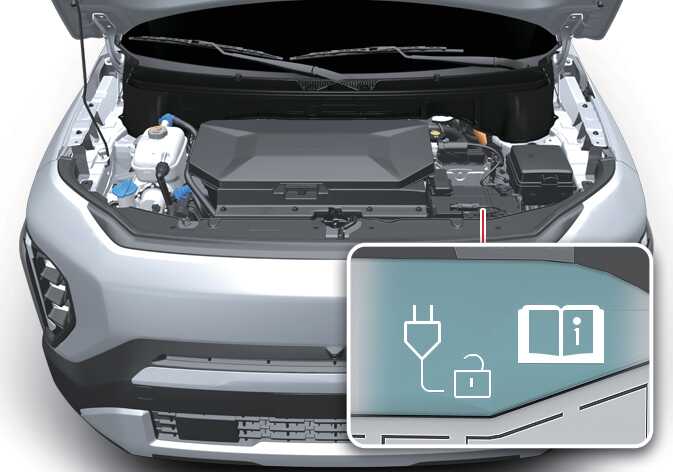
If the charging cable does not detach due to battery discharge and failure of the electric wires, open the bonnet and slightly pull the emergency cable at the left side of the motor compartment as shown image. The charging connector will then unlock.
-
Electromagnetic waves generated from the charger can seriously impact electronic medical devices, such as a pacemaker. When using an electronic medical device, ask your medical team and the device manufacturer whether charging your electric vehicle will impact the operation of your device.
-
Before connecting to the charger and charging inlet, check to make sure there is no water or dust on the charging cable connector and plug, as this might cause a fire or electric shock.
-
Be careful not to touch the charging connector, charging plug, or charging inlet when connecting the charger connector cable to the charging outlet and the charging inlet on the vehicle.
-
To prevent electric shock when charging:
-
Use a waterproof charger.
-
Do not touch the charging connector or charging plug with wet hands. Do not stand in water or snow whilst connecting the charging cable.
-
Be careful when there is lightning.
-
Be careful when the charging connector and plug are wet.
-
-
Immediately stop charging if you detect abnormal conditions (such as smell, smoke, and so on).
-
To prevent electric shock, replace the charging cable if the coating is damaged.
-
Only use a charging cable certified by Kia (if equipped). Using an uncertified cable or a separate extension cable (such as a reel) might cause abnormal operation of electrical outlets and result in fire or explosion.
-
When connecting or removing the charging cable, make sure to hold the charging connector handle. Pulling the cable without using the handle might disconnect or damage the internal wires, which can cause an electric shock or fire.
-
Do not leave the vehicle with the charging door open. An open charging door might indicate that the vehicle door is unlocked, leaving your vehicle subject to theft.
-
Always keep the charging connector, plug, and cable clean and dry.
-
Use the designated charger for charging the electric vehicle. Any other charger might fail to charge the vehicle.
-
Before you charge the battery, turn the vehicle OFF. After you turn the vehicle OFF, you can press the EV button in the POWER ON position if you need to use other vehicle systems.
-
When the vehicle is turned OFF whilst charging, the cooling fan inside the motor compartment might operate automatically. Do not touch the cooling fan whilst the vehicle is charging.
-
To avoid damaging the charging connector, be careful not to drop it.
-
Do NOT use an extension cord with the L1-Trickle charger. Doing so might overheat or damage the charger.
Whilst you charge or right after you charge the high voltage battery, the vehicle uses the air conditioning system to control the high voltage battery temperature. You might hear noise from the air conditioner compressor and cooling fan, which is normal.
Checklist when charging does not start
Check the following if charging does not start after connecting the charger to the vehicle.
-
Check the scheduled charging setting. If the scheduled charging is set, charging is not started after connecting an AC charger or portable charger to the vehicle until the setting conditions are met.
-
Check the operation status of the AC charger, DC charger, and portable charger. Actual method for indicating the operation status may vary in accordance with the charger manufacturer.
-
If a warning sign related to charging appears on the instrument cluster, check its message.
-
If the charging connector and charging inlet are not connected properly, the connector may droop or vibrate. In this case, hold the charging connector handle and push it all the way in.
-
Check the charging status by connecting another charger that has been approved for proper operation.
-
If the vehicle is charged normally using another charger, contact the charger manufacturer for a solution.
-
If the vehicle is not charged even when using another charger, we recommend that your vehicle be inspected by an an authorised Kia dealer or service partner.
-