

Manual Transmission operation
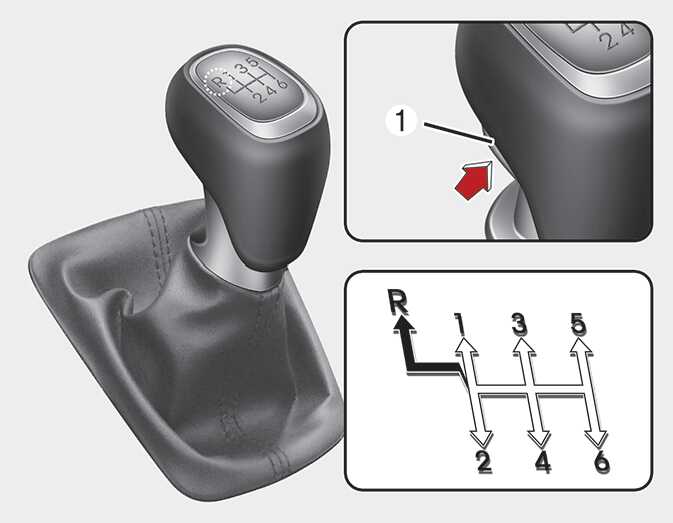
 The shift lever can be moved without pulling the button (1).
 The button (1) should be pressed when moving the shift lever into reverse.
The manual transmission has 6 forward gears.
This shift pattern is imprinted on the shift knob. The transmission is fully synchronized in all forward gears so shifting to either a higher or a lower gear is easily accomplished.
Depress the clutch pedal down fully while shifting, then release it slowly.
If your vehicle is equipped with an ignition lock switch, the engine will not start when starting the engine without depressing the clutch pedal.: (if equipped)
The shift lever must be returned to the neutral position before shifting into R (Reverse).
Push the button located immediately below the shift knob and pull the gearshift lever to the left sufficiently, and then shift into reverse (R) gear position.
Make sure the vehicle is completely stopped before shifting into R (Reverse).
Never operate the engine with the tachometer (rpm) in the red zone.
-
When downshifting from fifth gear to fourth gear, caution should be taken not to inadvertently press the shift lever sideways in such a manner that the second gear is engaged. Such a drastic downshift may cause the engine speed to increase to the point that the tachometer will enter the red-zone. Such over-revving of the engine and transmission may possibly cause engine damage.
-
Do not downshift more than 2 gears or downshift the gear when the engine is running at high speed (5,000 RPM or higher). Such a downshifting may damage the engine, clutch and the transmission.
-
During cold weather, shifting may be difficult until the transmission lubricant is warmed up. This is normal and not harmful to the transmission.
-
If you've come to a complete stop and it's hard to shift into 1st or R(Reverse), leave the shift lever at N(Neutral) position and release the clutch. Press the clutch pedal back down, and then shift into 1st or R(Reverse) gear position.
-
To avoid premature clutch wear and damage, do not drive with your foot resting on the clutch pedal. Also, don’t use the clutch to hold the vehicle stopped on an uphill grade, while waiting for a traffic light, etc.
-
Do not use the shift lever as a handrest during driving, as this can result in premature wear of the transmission shift forks.
-
To prevent possible damage to the clutch system, do not start with the 2nd (second) gear engaged except when you start on a slippery road.
-
Do not overload the vehicle. Driving with the vehicle overloaded could cause abnormal friction heat to the clutch disk and damage the clutch cover and disk.
-
Before leaving the driver’s seat, always set the parking brake fully and shut the engine off.Then make sure the transmission is shifted into 1st gear when the vehicle is parked on a level or uphill grade, and shifted into R (Reverse) on a downhill grade. Unexpected and sudden vehicle movement can occur if these precautions are not followed in the order identified.
-
Do not use the engine brake (shifting from a high gear to lower gear) rapidly on slippery roads.
The vehicle may slip causing an accident.