

Trailer towing: (if equipped)
If you are considering towing with your vehicle, you should first check with your state's Department of Motor Vehicles (DMV) to determine their legal requirements.
Since laws vary the requirements for towing trailers, cars, or other types of vehicles or apparatus may differ. Ask an authorized Kia dealer.
Towing a trailer
If you don't use the correct equipment and drive improperly, you can lose control when you pull a trailer. For example, if the trailer is too heavy, the brakes may not work well - or even at all. You and your passengers could be seriously or fatally injured. Pull a trailer only if you have followed all the steps in this section.
Weight limits
Before towing, make sure the total trailer weight, gross combination weight, gross vehicle weight, gross axle weight and trailer tongue load are all within the limits.
-
The technically permissible maximum load on the rear axle(s) may be exceeded by not more than 15 % and the technically permissible maximum laden mass of your Kia may not exceeded by more than 10 % or 220 lbs (100 kg), whichever value is lower. Do not exceed 60 mph (100 km/h) for category M1 vehicles or 50 mph (80 km/h) for category N1 vehicles.
-
When towing a trailer, the additional load at the trailer coupling device may cause the rear tire maximum load ratings to be exceeded, but should not be more than 15%. Do not exceed 60 mph (100 km/h), and the rear tire pressure should be at least 0.2 bar (20 kPa) above the tire pressure(s) as recommended for normal use (i.e. without a trailer attached).
Pulling a trailer improperly can damage your vehicle and result in costly repairs not covered by your warranty. To pull a trailer correctly, follow the advice in this section.
Your vehicle can tow a trailer. To identify what your Kia trailering capacity is for your vehicle, refer to Weight of the trailer.
Remember that trailering is different than just driving your vehicle by itself. Trailering means changes in handling, durability, and fuel economy. Successful, safe trailering requires correct equipment, and it must be used properly.
This section contains many time tested, important trailering tips and safety rules. Many of these are important safety. Read this section carefully before you pull a trailer.
Load-pulling components such as the engine, transmission, wheel assemblies, and tires are forced to work harder against the load of the added weight. The engine is required to operate at relatively higher speeds and under greater loads. This additional burden generates extra heat. The trailer also adds considerable wind resistance, increasing pulling requirements.
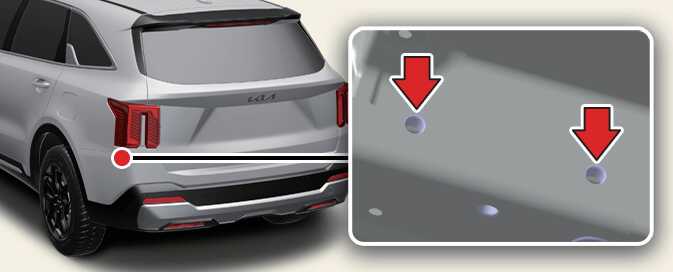
Location of trailer mounting
The mounting holes for hitches are located on both sides of the underbody behind the rear tires.