

If you do decide to pull a trailer
Important points if you decide to pull a trailer:
-
Consider using a sway control. You can ask a hitch dealer about sway control.
-
Do not do tow during its first 1,200 miles (2,000 km) in order to allow the engine to properly break-in. Failure to heed this caution may result in serious engine or transmission damage.
-
When towing a trailer, consult an authorized Kia dealer on additional requirements such as a towing kit, etc.
-
Always drive your vehicle at a moderate speed (less than 60 mph (100 km/h)).
-
On a long uphill grade, do not exceed 45 mph (70 km/h) or the posted towing speed limit, whichever is lower.
-
The chart contains important considerations that have to do with weight:
|
Item |
Smartstream G2.5 GDi |
Smartstream G2.5 T-GDi |
||||
|---|---|---|---|---|---|---|
|
Standard |
X-Line |
X-Pro |
||||
|
Maximumtrailer weight |
With brake system |
Standard |
2,000 lbs. (907 kg) |
2,000 lbs. (907 kg) |
2,000 lbs. (907 kg) |
2,000 lbs. (907 kg) |
|
Package |
- |
2,000 lbs. (907 kg) |
3,500 lbs. (1,588 kg) |
4,500 lbs. (2,041 kg) |
||
|
Without brake system |
1,650 lbs. (750 kg) |
1,650 lbs. (750 kg) |
1,650 lbs. (750 kg) |
1,650 lbs. (750 kg) |
||
|
Maximum tongue weight |
280 lbs. (127 kg) |
351 lbs. (159 kg) |
351 lbs. (159 kg) |
351 lbs. (159 kg) |
||
Weight of the trailer
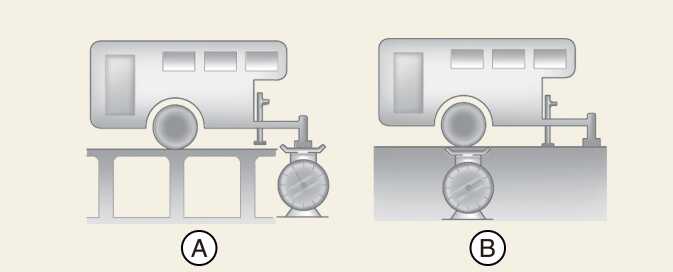
A: Tongue Load
B: Total Trailer Weight
The maximum safe weight should never exceed the maximum trailer weight with trailer brakes. Even that may be too heavy.
It depends on how you plan to use your trailer. For example, speed, altitude, road grades, outside temperature and how often your vehicle is used to pull a trailer are all important. The ideal trailer weight can also depend on any special equipment that you have on your vehicle.
Weight of the trailer tongue
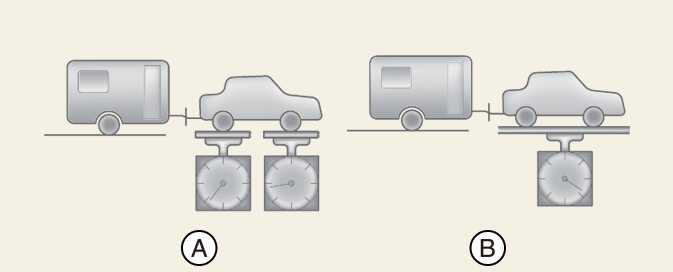
A: Gross Axle Weight (GVW)
B: Gross Vehicle Weight
The tongue load of any trailer is an important weight to measure because it affects the total GVW of your vehicle. This weight includes the curb weight of your Kia, any cargo you may carry and the people who will be riding in your Kia. If you tow a trailer, you must add the tongue load to the GVW because your vehicle will also be carrying that weight.
The trailer tongue should weigh a maximum of 10 % of the total loaded trailer weight, within the limits of the maximum trailer tongue load permissible.
After you've loaded your trailer, weigh the trailer and then the tongue, separately, to see if the weights are proper. If they aren't, you may be able to correct them simply by moving some items around in the trailer.
Trailer
-
Never load a trailer with more weight in the rear than in the front. The front should be loaded with approximately 60% of the total trailer load; the rear should be loaded with approximately 40% of the total trailer load.
-
Never exceed the maximum weight limits of the trailer or trailer towing equipment. Improper loading can result in damage to your vehicle and/or personal injury. Check weights and loading at a commercial scale or highway patrol office equipped with scales.
-
An improperly loaded trailer can cause loss of control.