
Limitations of Forward Collision-Avoidance Assist
In certain situations, the camera may not be able to detect the vehicle ahead. In these cases, Forward Collision-Avoidance Assist may not operate normally. The driver must pay careful attention in the following situations where Forward Collision-Avoidance Assist operation may be limited.
Limitations of the sensors
The sensor may be limited when:
-
The sensor is covered with foreign substances.
-
It heavily rains or snows.
-
The vehicle in front has a narrow body. (i.e. motor cycle and bicycle)
-
The sensor view is unclear due to the backlight, the reflected light, or darkness.
-
The sensor cannot contain the full image of the vehicle in front.
-
The vehicle in front is a special vehicle, such as a heavily-loaded truck or a trailer.
-
The outside brightness changes suddenly, such as entering/exiting the tunnel.
-
The vehicle driving is unstable.
-
The camera sensor recognition is limited.
-
The sensor's field of view is not well illuminated (either too dark or too much reflection or too much backlight that obscures the field of view)
-
The vehicle in front is driving erratically
-
The vehicle is driven near areas containing metal substances such as a construction zone, railroad, etc.
-
Backlight is reflected in the direction of the vehicle (including front light from the vehicle ahead)
-
Moisture on the windshield is not completely removed or frozen.
-
The weather is misty.
-
The vehicle in front does not turn ON the rear lights, does not have rear lights, has asymmetric rear lights, or has rear lights out of angle.
-
The vehicle is on unpaved or uneven rough surfaces, or roads with sudden gradient changes.
-
The vehicle is moving under ground level or inside a building.
-
A sudden change in the sensor recognition takes place while passing through the speed bump,
-
The vehicle is severely shaken due to adverse road conditions.
-
Driving around circular intersection with a vehicle in front,
-
The front of the camera lens is contaminated by front glass tinting, film, water repellent coating, damage on glass, foreign matter (sticker, insect, etc.)
-
The camera or camera lens is damaged.
-
The headlights of the vehicle are not used at night or in the tunnel section, or the light is too weak.
-
The street light or the light of the vehicle coming from the opposite is reflected or when sunlight is reflected by the water on the road surface.
-
The back light is projected in the direction of the vehicle's motion (including the headlights of vehicles)
-
Road sign, shadow on the road, tunnel entrance, toll gate, partial pavement
-
The windshield has moisture on its surface or if windshield freezes,
-
Driving in the fog.
-
Objects are out of the sensing range of the camera.
Driving on a curved road
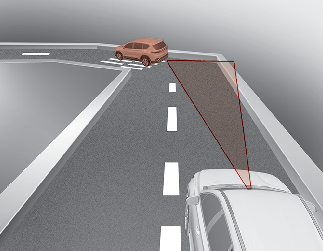
The performance of Forward Collision-Avoidance Assist may be limited when driving on a curved road.
The front view camera recognition function may not detect the vehicle traveling in front on a curved road. This may result in no alarm and braking when necessary.
Always pay attention to road and driving conditions, and if necessary, depress the brake pedal to reduce your driving speed in order to maintain a safe distance.
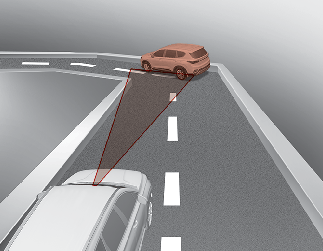
Forward Collision-Avoidance Assist may recognize a vehicle in the next lane or outside the lane when driving on a curved road. If this occurs, the function may unnecessarily alarm the driver and apply the brake.
Always pay attention to road and driving conditions, while driving.
Driving on a sloped road
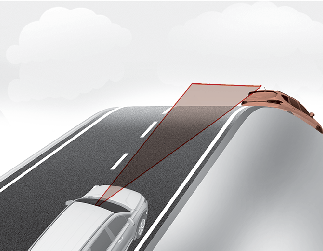
The performance of Forward Collision-Avoidance Assist may be decreased while driving upward or downward on a slope.
The front view camera recognition may not detect the vehicle in front. This may result in unnecessary alarm and braking or no alarm and braking when necessary.
When the function suddenly recognizes the vehicle in front while passing over a slope, you may experience sharp deceleration.
Always keep your eyes forward while driving upward or downward on a slope, and, if necessary, depress the brake pedal to reduce your driving speed in order to maintain distance.
Changing lanes
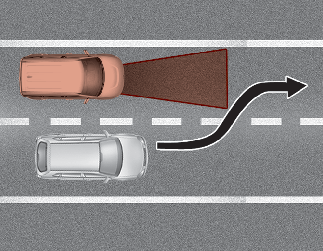
When a vehicle changes lanes in front of you, Forward Collision-Avoidance Assist may not immediately detect the vehicle, especially if the vehicle changes lanes abruptly. In this case, you must maintain a safe braking distance, and if necessary, depress the brake pedal to reduce your driving speed in order to maintain a safe distance.
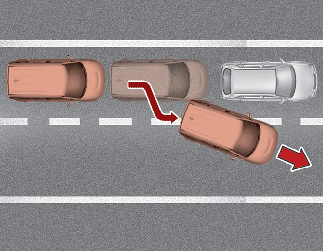
When driving in stop-and-go traffic, and a stopped vehicle in front of you merges out of the lane, Forward Collision-Avoidance Assist may not immediately detect the new vehicle that is now in front of you. In this case, you must maintain a safe braking distance, and if necessary, depress the brake pedal to reduce your driving speed in order to maintain a safe distance.
Recognizing the vehicle
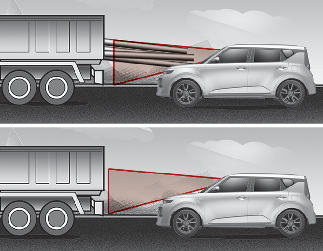
When the vehicle in front has heavy loading extended rearward, or when the vehicle in front has higher ground clearance, it may induce a hazardous situation. Always pay attention to road and driving conditions, while driving and, if necessary, depress the brake pedal to reduce your driving speed in order to maintain distance.

-
Do not use the Forward Collision-Avoidance Assist when towing a vehicle. Application of Forward Collision-Avoidance Assist while towing may adversely affect the safety of your vehicle or the towing vehicle.
-
Use extreme caution when the vehicle in front of you has cargo that extends rearward from the cab, or when the vehicle in front of you has higher ground clearance.
-
Never try to test the operation of Forward Collision-Avoidance Assist. Doing so may cause severe injury or death.
-
Forward Collision-Avoidance Assist is designed to detect and monitor the vehicle ahead in the roadway through camera recognition. It is not designed to detect pedestrians, bicycles, motorcycles, or smaller wheeled objects such as luggage bags, shopping carts, or strollers.
-
If the front glass or camera have been replaced or repaired, have your vehicle inspected by an authorized Kia dealer.

In some instances, Forward Collision-Avoidance Assist may be canceled when subjected to electromagnetic interference.