
Starting the engine

-
Always wear appropriate shoes when operating your vehicle. Unsuitable shoes (high heels, ski boots, etc.) may interfere with your ability to use the brake and accelerator pedal.
-
Do not start the vehicle with the accelerator pedal depressed. The vehicle can move and lead to an accident.
-
Wait until the engine rpm is normal. The vehicle may suddenly move if the brake pedal is released when the rpm is high.

Kick down mechanism (if equipped)
If your vehicle is equipped with a kick down mechanism in the accelerator pedal, it prevents you from driving at full throttle unintentionally by making the driver require increased effort to depress the accelerator pedal. However, if you depress the pedal more than approximately 80%, the vehicle can be at full throttle and the accelerator pedal will be easier to depress. This is not a malfunction but a normal condition.
Starting the petrol engine
-
Carry the smart key or leave it inside the vehicle.
-
Make sure the parking brake is firmly applied.
-
Manual Transmission - Depress the clutch pedal fully and shift the transmission into Neutral. Keep the clutch pedal and brake pedal depressed whilst starting the engine.
Automatic Manual Transmission - Automated Manual Transmission - Place the shift lever in N (Neutral). Depress the brake pedal fully. The engine cannot be started unless the shift lever is N (Neutral) position.
Automatic Transmission - Place the transmission shift lever in P (Park). Depress the brake pedal fully.
You can also start the engine when the shift lever is in the N (Neutral) position.
-
Press the ENGINE START/STOP button.
It should be started without depressing the accelerator.
-
Do not wait for the engine to warm up whilst the vehicle remains stationary.
Start driving at moderate engine speeds. (Steep accelerating and decelerating should be avoided.)
Manual transmission
-
When starting the vehicle, keep the clutch and brake pedal depressed, check if the rpm is within the appropriate range, and place the shift lever into the required position.
-
Release the parking brake, take your foot off the clutch pedal, depress the accelerator pedal and slowly start the vehicle.
 CAUTION
Do not turn the ignition switch to the START position with the engine running. It may damage the starter.
-
Even if the smart key is in the vehicle, if it is far away from you, the engine may not start.
-
When the ENGINE START/STOP button is in the ACC position or above, if any door is opened, the system checks for the smart key. If the smart key is not in the vehicle, the “
 ” indicator will blink or the warning "Key is not in vehicle" will illuminate on the LCD display. And if all doors are closed,
the chime will sound for 5 seconds. The indicator or warning will turn off whilst the vehicle is moving. Always have the smart
key with you.
” indicator will blink or the warning "Key is not in vehicle" will illuminate on the LCD display. And if all doors are closed,
the chime will sound for 5 seconds. The indicator or warning will turn off whilst the vehicle is moving. Always have the smart
key with you.
The engine will start, only when the smart key is in the vehicle. Never allow children or any person who is unfamiliar with the vehicle touch the ENGINE START/STOP button or related parts.
If the engine stalls whilst the vehicle is in motion, do not attempt to move the shift lever to the P (Park) position. If the traffic and road conditions permit, you may put the shift lever in the N (Neutral) position whilst the vehicle is still moving and press the ENGINE START/STOP button in an attempt to restart the engine.
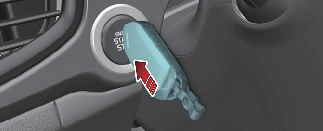
-
If the battery is weak or the smart key does not work correctly, you can start the engine by pressing the ENGINE START/STOP button with the smart key.
-
When the brake switch fuse is blown, you can't start the engine normally. Replace the fuse with a new one. If it is not possible, you can start the engine by pressing the ENGINE START/STOP button for 10 seconds whilst it is in the ACC position. The engine can start without depressing the brake pedal. But for your safety always depress the brake pedal before starting the engine.
Do not press the ENGINE START/STOP button for more than 10 seconds except when the stop lamp fuse is blown.