

AWD precautions
Tyres
Always pay attention to tyres for AWD vehicles.
AWD applies driving force to all four wheels, which means the condition of the tyres greatly affects driving performance:
-
When replacing tyres, be sure all 4 tyres are of the same size, type, tread, brand, and load-carrying capacity. Do not equip your vehicle with tyres of a different size or type than what was originally installed on your vehicle. This can affect the safety and performance of your vehicle, which could lead to steering failure or rollover and cause serious injury.
-
Rotate the front and rear tyre positions every 10,000 km (6,000 miles).
-
When it is cold outside, you should check each tyre monthly and maintain the inflation pressure recommended on your Kia placard or tyre inflation pressure label.
-
Install chains on all four tyres of your AWD vehicle, and keep your travel distance as short as possible to prevent damage to the AWD system. For more information, refer to Winter driving.
Towing
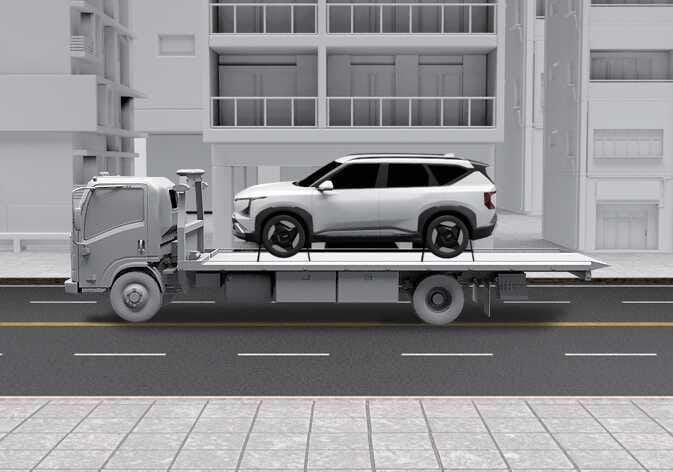 OOV065009 |
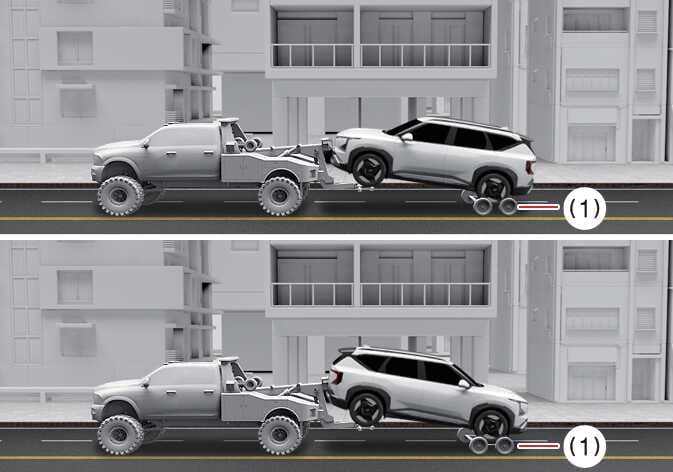 OOV065010_2 |
-
Wheel dollies
The AWD vehicle should never be towed with the wheels on the ground. Always use wheel dollies or flatbed. If not, the power electric system and the AWD system could be seriously damaged.
For more information, refer to Towing.
Vehicle inspection
-
When the vehicle is on a lift, do not operate the front and rear wheels separately. Operate all four wheels together.
-
Never apply the parking brake whilst running the vehicle on a lift, as this might damage the AWD system.
Your vehicle is equipped with tyres that make handling and riding in your vehicle safer. Do not use tyres or wheels that are different in size and type from the original ones. This can affect the safety and performance of your vehicle, which could lead to steering failure or a rollover and result in serious injury. When replacing the tyres, be sure that all four tyres and wheels are the same size, type, tread, and brand and have the same load-carrying capacity.
Jacked vehicle
Whilst AWD vehicle is being raised on a jack, never start the engine or cause the tyres to rotate. If rotating tyres touch the ground, your vehicle could move the jack and jump forward.
AWD vehicle cannot be towed with sling-type equipment. Use a wheel lift or flatbed equipment.
Dynamometer testing
AWD vehicles must be tested with a special 4-wheel chassis dynamometer.
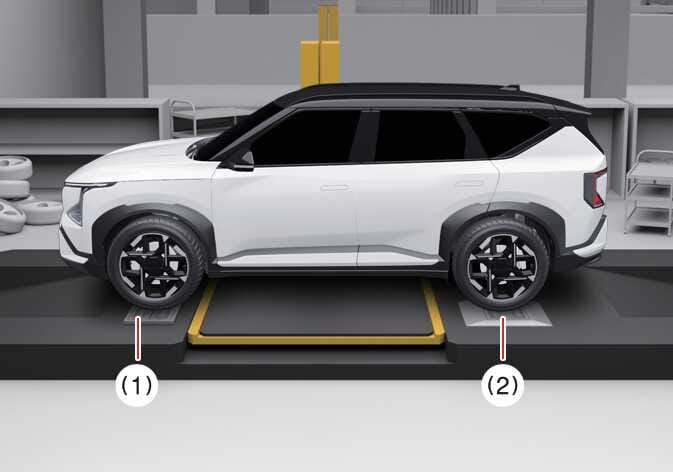 OOVGT065001 |
|
If you must use a 2WD roll tester, perform the following procedure:
-
Check the recommended tyre pressure for your vehicle.
-
Place the driven wheels on the roll tester (1) for a speedometer test.
-
Release the parking brake.
-
Place the non-driven wheels on the temporary free roller (2).
Dynamometer testing
-
Do not use tyres and wheels of a different size and type from the ones originally installed on your vehicle. Doing so can affect the safety and performance of your vehicle, leading to steering failure or a rollover and causing serious injury.
-
Never start or run AWD vehicle whilst it is raised on a jack. The vehicle can slip or roll off the jack, causing serious injury or death to you or those nearby.
-
Keep away from the front of the vehicle whilst it is in gear on the dynamometer. The vehicle can jump forward and cause serious injury or death.
Never apply the parking brake whilst performing these tests.