
Limitations of Navigation-based Smart Cruise Control
Navigation-based Smart Cruise Control may not operate normally under the following circumstances:
-
The navigation is not working properly.
-
The navigation is not updated to include the latest information about road curvature and changes.
-
Speed limit and road information in the navigation is not updated
-
The map information and the actual road is different because of real-time GPS data or map information error
-
The navigation searches for a route while driving
-
GPS signals are blocked in areas such as a tunnel
-
A road that divides into two or more roads and joins again
-
The driver goes off course the route set in the navigation
-
The route to the destination is changed or canceled by resetting the navigation (including TPEG change)
-
The navigation cannot detect the current vehicle position (ex: elevated roads including overpass adjacent to general roads or nearby roads exist in a parallel way)
-
The vehicle enters a service station or rest area
-
The speed limit of some sections changes depending on the road situations
-
Android Auto or Car Play is operating
-
The navigation is being updated while driving
-
The navigation is being restarted while driving
-
There is bad weather, such as heavy rain, heavy snow, etc.
-
Driving on a road under construction
-
Driving on a road that is controlled
-
Driving on a road that is sharply curved
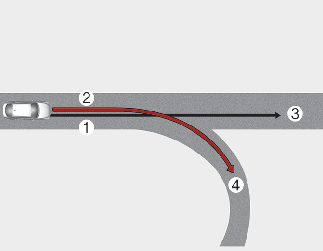
[1]: Driving route, [2]: Set route, [3]: Main road, [4]: Branch line
-
When there is a difference between the navigation set route (branch line) and the driving route (main road), Highway Auto Curve Slowdown function may not operate until the driving route is recognized as the main road.
-
When the vehicle's driving route is recognized as the main road by maintaining the main road instead of the navigation set route, Highway Auto Curve Slowdown function will operate. Depending on the distance to the curve and the current vehicle speed, vehicle deceleration may not be sufficient or may decelerate rapidly.
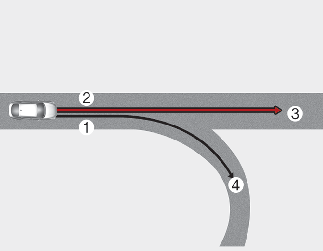
[1]: Driving route, [2]: Main road, [3]: Set route, [4]: Branch line
-
When there is a difference between the navigation route (main road) and the driving route (branch line), Highway Auto Curve Slowdown function may temporarily operate due to the navigation information of the highway curve section.
-
When it is judged that you are driving out of the route by entering the highway interchange and junction, Highway Auto Curve Slowdown function will not operate.
-
If there is no destination set on the navigation, Highway Auto Curve Slowdown function will operate based on the curve information on the main road.
-
Even if you depart from the main road, Highway Auto Curve Slowdown function may temporarily operate due to navigation information of the highway curve section.

-
Navigation-based Smart Cruise Control is not a substitute for safe driving practices, but a convenience function. Always have your eyes on the road, and it is the responsibility of the driver to avoid violating traffic laws.
-
The navigation's speed limit information may differ from the actual speed limit information on the road. It is the driver's responsibility to check the speed limit on the actual driving road or lane.
-
Highway Auto Curve Slowdown and Set Speed Auto Change function will automatically cancel when you leave the main road of the highway. Always pay attention to road and driving conditions while driving.
-
Navigation-based Smart Cruise Control may not operate due to the existence of leading vehicles and the driving conditions of the vehicle. Always pay attention to road and driving conditions while driving.
-
When you are towing a trailer or another vehicle, we recommend that Navigation-based Smart Cruise Control is turned off due to safety reasons.
-
After you pass through a tollgate on a highway, Navigation-based Smart Cruise Control operates based on the first lane. If you enter one of the other lanes, the function might not properly decelerate.
-
The vehicle will accelerate if the driver depresses the accelerate pedal while Navigation-based Smart Cruise Control is operating, and function will not decelerate the vehicle. If not depressing the accelerator pedal sufficiently, the vehicle speed may decrease.
-
If the driver accelerates and releases the accelerator pedal while the Navigation-based Smart Cruise Control is operating, the vehicle may not decelerate sufficiently or may rapidly decelerate to a safe speed.
-
If the curve is too large or too small, Navigation-based Smart Cruise Control may not operate.

-
When the function is activated, the vehicle decelerates automatically before reaching the curved road according to its curvature, and the driving speed returns to the speed set by Smart Cruise Control after passing the curved section.
-
The speed information on the cluster and navigation may differ.
-
The time gap could occur between the navigation's guidance and when Navigation-based Smart Cruise Control operation starts and ends.
-
Even if you are driving at a speed lower than Smart Cruise Control set speed, acceleration may be limited by the speeding cameras and curve sections ahead.
-
If Navigation-based Smart Cruise Control is operating while leaving the main road to enter an interchange, junction, rest area, etc., the function may operate for a certain period of time.
-
Deceleration by Navigation-based Smart Cruise Control may not be sufficient due to road conditions such as uneven road surfaces, narrow lanes, etc.