
Limitations of Rear Cross-Traffic Collision Warning/Rear Cross-Traffic Collision-Avoidance Assist
-
The vehicle drives in inclement weather such as heavy rain or snow.
-
The sensor is covered with rain, snow, mud, etc.
-
The rear bumper where the sensor is located is covered with a foreign object such as a bumper sticker, a bumper guard, a bike rack, etc.
-
The rear bumper is damaged, or the sensor is out of the original default position.
-
The vehicle height gets lower or higher due to heavy loading in a trunk, abnormal tire pressure, etc.
-
When the temperature of the rear bumper is high.
-
When the sensors are blocked by other vehicles, walls or parking-lot pillars.
-
The vehicle drives on a curved road.
-
The road pavement (or the peripheral ground) abnormally contains metallic components (i.e., possibly due to subway construction).
-
There is a fixed object near the vehicle, such as a guardrail.
-
While going down or up a steep road where the height of the lane is different.
-
Driving on a narrow road where trees or grass or overgrown.
-
Driving in rural areas where the sensor does not detect another vehicle for an extended period of time.
-
Driving on a wet road.
-
Driving on a road where the guardrail or wall is in double structure.
-
A big vehicle is near such as a bus or truck.
-
When the other vehicle approaches very close.
-
When the other vehicle passes at a very fast speed.
-
While changing lanes.
-
If the vehicle has started at the same time as the vehicle next to you and has accelerated.
-
When the vehicle in the next lane moves two lanes away from you OR when the vehicle two lanes away moves to the next lane from you.
-
A motorcycle or bicycle is near.
-
A flat trailer is near.
-
If there are small objects in the detecting area such as a shopping cart or a baby stroller.
-
If there is a low height vehicle such as a sports car.
-
The brake pedal is depressed.
-
ESC is activated.
-
ESC malfunctions.
-
The tire pressure is low or a tire is damaged.
-
The brake is reworked.
-
The vehicle sharply stops.
-
Temperature is extremely low around the vehicle.
-
The vehicle severely vibrates while driving over an uneven/bumpy road, or concrete patch.
-
The vehicle drives on a slippery surface due to snow, water puddle, or ice.
Backing up where there is a vehicle or structure near
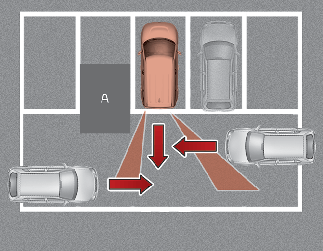
[A]: Structure
The function may not operate properly when there is a vehicle or structure near the vehicle.
In certain instances, the function may not detect the vehicle approaching from behind and the warning or brake may not operate properly.
Always pay attention to your surroundings while backing up.
When the vehicle is in a complex parking environment
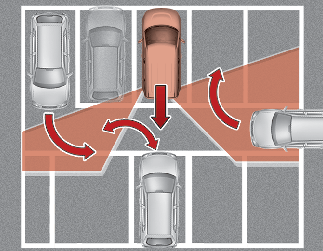
The function may not operate properly when the vehicle is in a complex parking environment.
In certain instances, the function may not be able to exactly determine the risk of collision for the vehicles which are parking or pulling out near your vehicle (e.g., a vehicle escaping beside your vehicle, a vehicle parking or pulling out in the rear area, a vehicle approaching your vehicle making a turn, etc.).
If this occurs, the warning or brake may not operate properly.
When the vehicle is parked diagonally
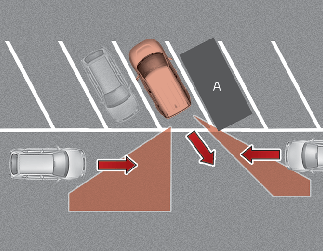
[A]: Vehicle
The function may not operate properly when the vehicle is parked diagonally.
In certain instances, when the diagonally parked vehicle is pulled out of the parking space, the function may not detect the vehicle approaching from the rear left/right of your vehicle. In this case, the warning or brake may not operate properly.
Always pay attention to your surroundings while backing up.
When the vehicle is on/near a slope
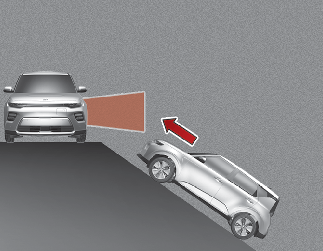
The function may not operate properly when the vehicle is on/near a slope.
In certain instances, the function may not detect the vehicle approaching from the rear left/right and the warning or brake may not operate properly.
Always pay attention to your surroundings while backing up.
Pulling into the parking space where there is a structure
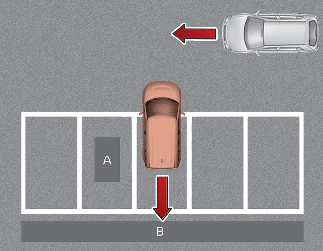
[A]: Structure, [B]: Wall
The function may not operate properly when pulling in the vehicle to the parking space where there is a structure at the back or side of your vehicle.
In certain instances, when backing into the parking space, the function may not detect the vehicle moving in front of your vehicle. In this case, the warning or brake may not operate properly.
Always pay attention to your surroundings while backing up.
When the vehicle is parked rearward
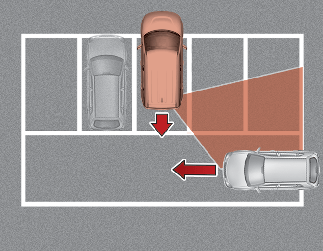
If the vehicle is parked rearward and the sensor detects the another vehicle in the rear area of the parking space, the system can warn or control braking.
Always pay attention to your surroundings while backing up.