
Distance to Empty
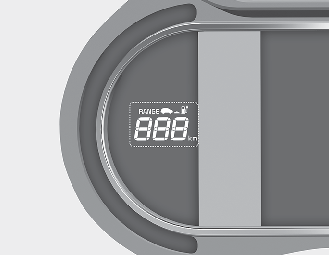
You can check the distance the vehicle can be driven with the current battery amount.
When destination is not set
-
Distance to empty may depend on many factors such as the charge amount of the high voltage battery, weather, temperature, durability of the battery, geographical features, and driving style. When the outside temperature drops, such as in winter, the distance to empty may decrease due to battery performance degradation.
When the outside temperature drops, such as in winter, the distance to empty may decrease due to battery performance degradation.
-
Natural degradation may occur with the high voltage battery depending on the number of years the vehicle is used. This may reduce the distance to empty.
-
On average, a vehicle can drive approximately 385 km (Cruise-type)/246 km (City-type) or 239 miles (Cruise-type)/153 miles (City-type). However, the distance to empty can be changed from 280-500 km (174-310 miles) for Cruise-type and 170-320 km (106-199 miles) for City-type depending on operation of the air conditioner/ heater and other various vehicle conditions.
When using the heater during cold weather or driving at high speed, the high voltage battery consumes a lot more electricity. This may reduce the distance to empty significantly.
-
The vehicle can stop shortly after the "---" has been displayed. When it is displayed, drive to a safe place to stop the vehicle. (The available range varies depending on driving speed, heater/air conditioner, weather, driving style, and other factors.)
-
Distance to empty that is displayed on the instrument cluster after completing a recharge may vary significantly depending on previous operating patterns. When previous driving patterns include high speed driving, resulting in the high voltage battery using more electricity than usual, the estimated distance to empty is reduced. When the high voltage battery uses little electricity in ECO mode, the estimated distance to empty increases.
When destination is set
When the destination is set, the distance to empty may change. The distance to empty is recalculated using the information of the destination.
However, the distance to empty may vary significantly based on traffic conditions, driving habits, and condition of the vehicle.