

Trailer towing: (if equipped)
If you are considering towing with your vehicle, you should first check with the country's department of motor vehicles to determine their legal requirements.
Since laws vary, the requirements for towing trailers, other vehicles, and apparatus may differ. Kia recommends that you ask an authorised Kia dealer/service partner.
Your vehicle can tow a trailer. To identify what the vehicle trailering capacity is for your vehicle, refer to Reference weight when towing a trailer.
Remember that trailer towing is different from simply driving your vehicle by itself. Trailering means changes in handling, durability, and energy economy. Successful, safe trailer towing requires correct equipment, which has to be used properly.
This section contains many time-tested and important trailer-towing tips and safety rules. Many of these are important for your safety and that of your passengers. Please read this section carefully before towing a trailer.
-
If you don't use the correct equipment and drive improperly, you can lose control when you pull a trailer. For example, if the trailer is too heavy, the brakes may not work well or even at all. You and your passengers could be seriously or fatally injured. Pull a trailer only if you have followed all the steps in this section.
-
Before towing, make sure the total trailer weight, gross combination weight, gross vehicle weight, gross axle weight and trailer tongue load are all within the limits.
Pulling a trailer improperly can damage your vehicle and result in costly repairs not covered by your warranty. To pull a trailer correctly, follow the advice in this section.
-
Location of trailer mounting
-
The mounting hole for hitches are located on both sides of the underbody behind the rear tyres.
Figure 1. For passenger van 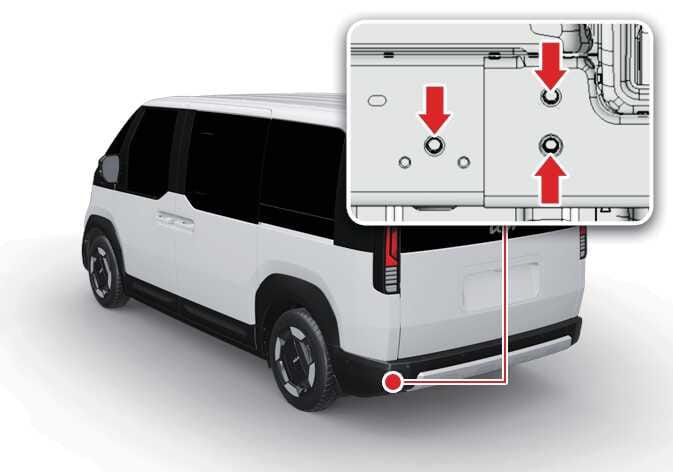 OSW045044L
Figure 2. For cargo van 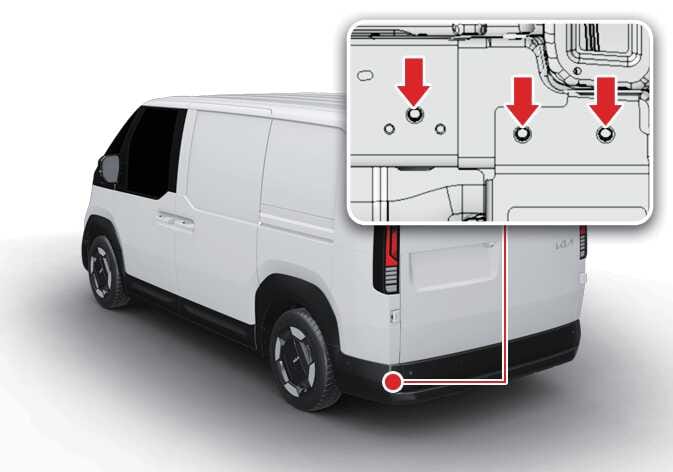 OSW045045L
-
-
For Europe
-
The technically permissible maximum load on the rear axle(s) may be exceeded by not more than 15% and the technically permissible maximum laden mass of the vehicle may be exceeded by not more than 10% or 100 kg (220.4 lbs), whichever value is lower. In this case, do not exceed 100 km/h (62.1 mph).
-
When towing a trailer, the additional load imposed at the trailer coupling device may cause the rear tyre maximum load ratings to be exceeded, but not by more than 15%. In such a case, do not exceed 100 km/h, and the rear tyre pressure should be at least 20 kPa (0.2 bar) above the tyre pressure(s) as recommended for normal use (i.e. without a trailer attached).
-
Hitches
It is important to have the correct hitch equipment. Crosswinds, large trucks going by, and rough roads are just a few reasons why you will need the right hitch. Here are some rules to follow:
-
Do you have to make any holes in the body of your vehicle when you install a trailer hitch? If you do, be sure to seal the holes when removing the hitch later.
If you don't seal them, dirt and water can get into your vehicle.
-
The bumpers on your vehicle are not intended for hitches. Do not attach rental hitches or other bumper-type hitches. Use only a frame-mounted hitch that does not attach to the bumper.
-
Any part of the rear number plate or lighting devices of the vehicle must not be obscured by the mechanical coupling device. If the rear number plate and/or lighting devices can be obscured partially by any part of the mechanical coupling device, mechanical coupling devices that can not be easily removed or repositioned without use of any tools, except an easily operated (i.e. an effort not exceeding 20 N·m) release key which is supplied by the manufacturer of the coupling device, are not permitted for use. Please note that the mechanical coupling device that is fitted and not in use must always be removed or repositioned if the rear number plate and/or rear lighting devices are obscured by any part of the mechanical coupling device.
-
Kia trailer hitch accessory is available at an authorised Kia dealer/service partner.
Safety chains
You should always attach chains between your vehicle and your trailer. Cross the safety chains under the tongue of the trailer so that the tongue will not drop to the road if it becomes separated from the hitch.
Instructions about safety chains may be provided by the hitch manufacturer or by the trailer manufacturer. Follow the manufacturer's recommendation for attaching safety chains. Always leave just enough slack so you can turn with your trailer. Never allow safety chains to drag on the ground.
Trailer brakes
If your trailer is equipped with a braking system, make sure it conforms to the country's regulations, and that it is properly installed and it is operating correctly.
If your trailer weighs more than the maximum trailer weight without trailer brakes loaded, then it needs its own brakes, and those trailer brakes must be adequate. Be sure to read and follow the instructions for the trailer brakes so that you will be able to install, adjust, and maintain them properly.
-
Do not tap into your vehicle's brake system.
Do not use a trailer with its own brakes unless you are absolutely certain that you have properly set up the brake system. This is not a task for amateurs. Use an experienced, competent trailer shop for this work.
Maintenance when towing a trailer
Your vehicle will need to be serviced more often if you regularly pull a trailer. Important items to pay particular attention to include reducer fluid, axle lubricant and cooling system fluid. Brake condition is another important item to check frequently. Each item is covered in this manual, and the Index will help you find them quickly. If you are towing a trailer, it is a good idea to review these sections before starting your trip.
Do not forget to maintain your trailer and hitch as well. Make sure you are aware of the maintenance schedule specified for your trailer, and that you carry out its periodic checks. Preferably, conduct your checks at the start of each day's driving. Most importantly, all hitch nuts and bolts should be tight.
-
Due to higher load during trailer usage, overheating might occur in hot days or during uphill driving.
-
When towing, check the reducer fluid more frequently.