

Brake system
Your vehicle has power-assisted brakes, parking brake, and various braking systems for safe driving.
Power brakes
Your vehicle has power-assisted brakes that adjust automatically through normal usage. If the vehicle is not on or is turned off whilst driving, the power assist for the brakes will not work. You can still stop your vehicle by applying greater force to the brake pedal than typical. The stopping distance will be longer than with power brakes.
When the vehicle is not on, the reserve brake power is partially depleted each time the brake pedal is applied. Do not pump the brake pedal when the power assist has been interrupted.
Pump the brake pedal only when necessary to maintain steering control on slippery surfaces.
Wet brakes may impair the vehicle's ability to safely slow down; the vehicle may also pull to one side when the brake is applied. Applying the brakes lightly will indicate whether they have been affected in this way. Always test your brakes in this fashion after driving through deep water. To dry the brakes, apply them lightly whilst maintaining a safe speed until brake performance returns to normal.
Avoid continuous application of the brakes when descending a long or steep hill. Continuous brake application will cause the brakes to overheat and could result in a temporary loss of braking performance.
-
Do not drive with your foot resting on the brake pedal. This will create abnormally high brake temperatures which can cause excessive brake lining and pad wear.
-
Do not depress the brake pedal continuously without the DRIVE READY indicator ON. The battery may discharge.
-
When depressing the brake pedal in poor weather conditions your vehicle may make a squealing sound. This is not a brake malfunction but a normal condition.
-
When driving on a recently deiced road, the vehicle may make noise from the brake or tyre. Under safe traffic conditions, repeatedly depress the brake pedal to remove the deicing chemicals on the brake disc and pad.
In the event of brake failure
If the brakes fail to operate whilst the vehicle is in motion, you can make an emergency stop with the parking brake. The stopping distance, however, will be much greater than normal.
Avoid applying the parking brake to stop the vehicle whilst it is moving except in an emergency. Applying the parking brake whilst the vehicle is moving at normal speeds can cause a sudden loss of control. If you must use the parking brake to stop the vehicle, use caution.
Brake over accelerator
In the event the accelerator pedal becomes stuck or entrapped, apply steady and firm pressure to the brake pedal to slow the vehicle and reduce motor power. If you experience this condition, take the following steps:
-
Apply the brake and bring your vehicle to a safe stop.
-
Shift to P (Park), turn the vehicle off and apply the parking brake.
-
Inspect the accelerator pedal for any interference.
If none are found and the condition persists, have your vehicle towed to a professional workshop and inspected. Kia recommends that you visit an authorised Kia dealer/service partner.
Disc brake wear indicator
When your brake pads are worn and new pads are required, you will hear a high-pitched warning sound from your front or rear brakes. This sound may or may not occur whenever you depress the brake pedal. Always replace the front or rear brake pads as pairs.
Do not ignore high-pitched wear sounds from your brakes. If you ignore this audible warning, you will eventually lose braking performance which could lead to a serious accident.
Do not continue to drive with worn brake pads. It pads can damage the braking system and result in costly brake repairs and can also lead to a serious accident.
Brake dust may accumulate on the wheels, even under normal driving conditions. Some dust is inevitable as the brakes wear and contribute to brake noise.
Brake disc cleaning (BDC)
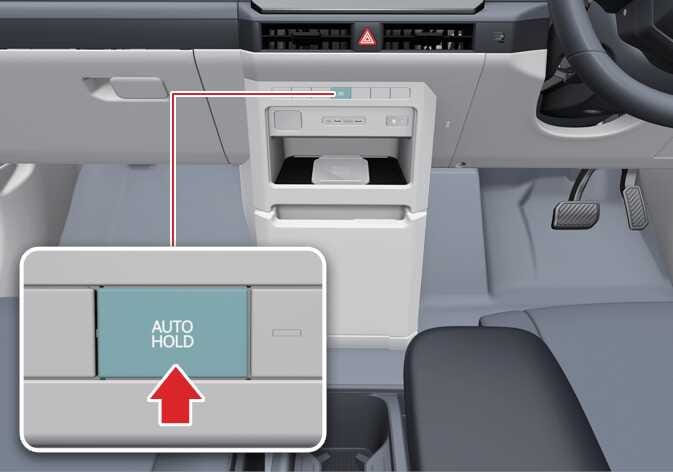 OSW045026R |
If surface rust forms on the brake discs or a squealing noise is heard, use the Brake Disc Cleaning function to remove rust and reduce noise.
-
Press and hold the AUTO HOLD button for more than 3 seconds. The system starts when a warning message appears on the instrument cluster.
-
The regenerative braking system is limited temporarily. The system applies the brakes approximately 10 times whilst driving to remove rust and eliminate squeal from the brake discs.
-
BDC turns off automatically after the operation is complete. You can also cancel it manually by pressing and holding the AUTO HOLD button for more than 3 seconds.
Whilst BDC is active, the regenerative braking system is limited, which may reduce electric energy efficiency.