
Automatic transmission operation
The automatic transmission has 8 forward speeds and one reverse speed. The individual speeds are selected automatically, depending on the position of the shift lever.

The first few shifts on a new vehicle, if the battery has been disconnected, may be somewhat abrupt. This is a normal condition, and the shifting sequence will adjust after shifts are cycled a few times by the TCM (Transmission Control Module) or PCM (Powertrain Control Module).
For smooth operation, depress the brake pedal and the lock release button when shifting from N (Neutral) to a forward or reverse gear.

Leaving Vehicle
Before leaving the driver’s seat, always make sure the shift lever is in the P (Park) position; then set the parking brake fully and shut the engine off. Do not use the P position in place of the parking brake. Always make sure the shift lever is locked in the P position and set the parking brake fully. Unexpected and sudden vehicle movement can occur if these precautions are not followed.

Transmission
To avoid damage to your transmission, do not accelerate the engine in R (Reverse) or any forward gear position with the brakes on. The transmission may be damaged if you shift into P (Park) while the vehicle is in motion.
When stopped on an incline, do not hold the vehicle with the engine power. Use the service brake or the parking brake.
Transmission ranges
The indicator in the instrument cluster displays the shift lever position when the ENGINE START/STOP button is in the ON position.
P (Park)
Always come to a complete stop before shifting into P (Park). This position locks the transmission and prevents the drive wheels from rotating.
Shifting into P (Park) while the vehicle is in motion will cause the drive wheels to lock and will cause you to lose control of the vehicle.
R (Reverse)
Use this position to drive the vehicle backward.
Shifting
Always come to a complete stop before shifting into or out of R (Reverse); you may damage the transmission if you shift into R (Reverse) while the vehicle is in motion, except as explained refer to More Details.
N (Neutral)
The wheels and transmission are not engaged. The vehicle will roll freely even on the slightest incline unless the parking brake or service brakes are applied.
Parking In Neutral
-
With the exception of parking in neutral gear, always park the vehicle in [P] (Park) for safety and apply the parking brake.
-
Before parking in [N] (Neutral) gear, make sure the parking ground is level and flat. Do not park in [N] gear on any slopes or gradients. If parked and left in [N], the vehicle may move and cause serious damage or injury.
-
After the ENGINE START/STOP button has been turned off, the EPB (Electronic Parking Brake) cannot be released.
-
For EPB (Electronic Parking Brake) equipped vehicles with [AUTO HOLD] function used while driving, if the ENGINE START/STOP button has been turned [OFF], the EPB (Electronic Parking Brake) will be engaged automatically. Therefore, [AUTO HOLD] function should be turned off before the ENGINE START/STOP button is turned off.
Starter
If the engine stalls while the vehicle is in motion, do not attempt to move the shift lever to the P (Park) position. If the traffic and road conditions permit, you may put the shift lever in the N (Neutral) position while the vehicle is still moving and press the ENGINE START/STOP button in an attempt to restart the engine.
D (Drive)
This is the normal forward driving position. The transmission will automatically shift through an 8-gear sequence, providing the best fuel economy and power.
For extra power when passing another vehicle or climbing grades, depress the accelerator fully, at which time the transmission will automatically downshift to the next lower gear.
Manual mode
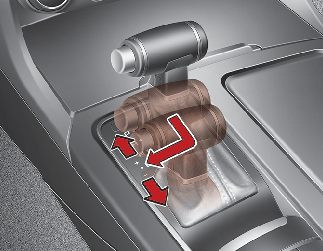
Whether the vehicle is stationary or in motion, manual mode is selected by pushing the shift lever from the D (Drive) position into the manual gate. To return to D (Drive) range operation, push the shift lever back into the main gate.
In manual mode, moving the shift lever backwards and forwards will allow you to make gearshifts rapidly. In contrast to a manual transmission, the manual mode allows gearshifts with the accelerator pedal depressed.
Up (+) : Push the lever forward once to shift up one gear.
Down (-) : Pull the lever backwards once to shift down one gear.
-
In manual mode, the driver must execute upshifts in accordance with road conditions, taking care to keep the engine speed below the red zone.
-
In manual mode, only the 8 forward gears can be selected. To reverse or park the vehicle, move the shift lever to the R (Reverse) or P (Park) position as required.
-
In manual mode, downshifts are made automatically when the vehicle slows down. When the vehicle stops, 1st gear is automatically selected.
-
In manual mode, when the engine rpm approaches the red zone, shift points are varied to upshift automatically.
-
To maintain the required levels of vehicle performance and safety, the system may not execute certain gearshifts when the shift lever is operated.
-
When driving on a slippery road, push the shift lever forward into the + (up) position. This causes the transmission to shift into the higher gears which is better for smooth driving on a slippery road. Push the shift lever to the - (down) side to shift back to the 1st gear.
Paddle shifter
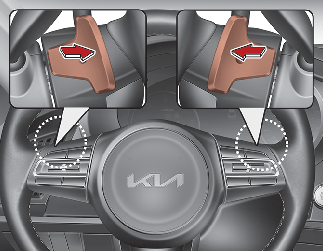
The paddle shifter is available when the shift lever is in the D (Drive) position.
Pull the [+] or [-] paddle shifter once to shift up or down one gear and the system changes from automatic mode to manual mode.
The system changes from manual mode to automatic mode in one of the following situations.
-
The [+] paddle has been pulled and held for more than 1 second.
-
The accelerator pedal has been depressed gently for more than 6 seconds.
-
The vehicle speed is lower than 7 km/h (4 mph).
-
The shift lever has been moved to manual mode and then returned to D (Drive) position.
However, manual mode is not changed to automatic mode in (2) when SPORT mode or SPORT of powertrain in CUSTOM mode is selected in the drive mode integrated control system.
If the [+] and [-] paddle shifters are pulled at the same time, gear shift may not occur.
Shift lock system
For your safety, the automatic transmission has a shift lock system which prevents shifting the transmission from P (Park) into R (Reverse) unless the brake pedal is depressed.
To shift the transmission from P (Park) into R (Reverse):
-
Depress and hold the brake pedal.
-
Start the engine or turn the ENGINE START/STOP button to the ON position.
-
Move the shift lever.
If the brake pedal is repeatedly depressed and released with the shift lever in the P (Park) position, a chattering noise & vibration near the shift lever may be heard. It is a normal condition.
Shifting from park
Always fully depress the brake pedal before and while shifting out of the P (Park) position into another position to avoid inadvertent motion of the vehicle which could injure persons in or around the vehicle.
Shift-lock override
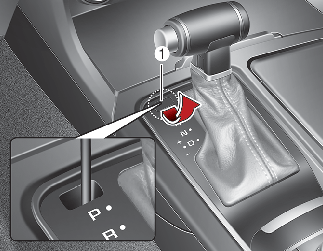
If the shift lever cannot be moved from the P (Park) position into R (Reverse) position with the brake pedal depressed, continue depressing the brake, then do the following:
-
Place the ENGINE START/STOP button in the OFF position.
-
Apply the parking brake.
-
Carefully remove the cap (1) covering the shift-lock release access hole.
-
Insert a tool (e.g. flathead screwdriver) into the access hole and press down on the tool.
-
Move the shift lever.
-
Remove the tool from the shiftlock override access hole then install the cap.
-
We recommend that the system be inspected by an authorized Kia dealer.
ENGINE START/STOP button interlock system
The ENGINE START/STOP button will not change to the OFF position unless the shift lever is in the P (Park) position.