
Automatic transmission operation
The automatic transmission has 8 forward speeds and one reverse speed.
The individual speeds are selected automatically in the D (Drive) position.

To reduce the risk of serious injury or death:
-
ALWAYS check the surrounding areas near your vehicle for people, especially children, before shifting a vehicle into D (Drive) or R (Reverse).
-
Before leaving the driver’s seat, always make sure the shift lever is in the P (Park) position, then set the parking brake, and place the ENGINE START/STOP button in the OFF position. Unexpected and sudden vehicle movement can occur if these precautions are not followed.
-
Do not use engine braking (rapidly shifting from a high gear to lower gear) on slippery roads. The vehicle may slip causing an accident.
Transmission ranges
The indicator in the instrument cluster displays the shift lever position when the ENGINE START/STOP button is in the ON position.
However, if the gear is in N (Neutral) or P (Park), the position is displayed on the instrument cluster when the ENGINE START/STOP button is in the OFF or ACC position.

Transmission
To avoid damage to your transmission, do not accelerate the engine in R (Reverse) or any forward gear position with the brakes on. The transmission may be damaged if you shift into P (Park) while the vehicle is in motion.
P (Park)
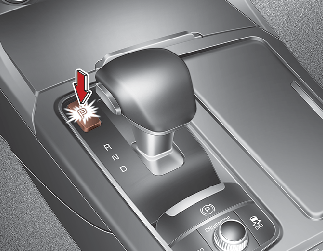
Always come to a complete stop before shifting into P (Park).
To shift the gear from R (Reverse), N (Neutral), D (Drive) or Manual mode to P (Park), press the [P] button.
If you turn off the engine in D (Drive) or R (Reverse), the shifting automatically changes to P (Park).
When you park the vehicle, press the [P] button while depressing the brake pedal and then apply the parking brake.
To reduce rollaway risk, do not use the P (Park) position in place of the parking brake.
-
Shifting into P (Park) while the vehicle is in motion may cause you to lose control of the vehicle.
-
Do not use the P (Park) position in place of the parking brake.
R (Reverse)
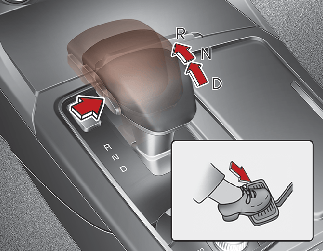
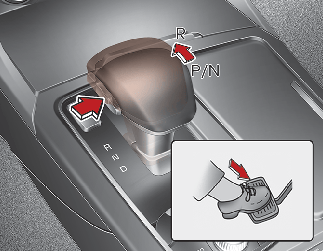
Use this position to drive the vehicle backward.
To move the shift lever to R (Reverse), press the [UNLOCK] button while depressing the brake pedal and then move the shift lever forward.
N (Neutral)
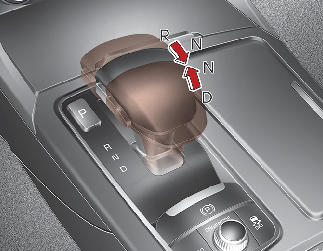
The wheels and transmission are not engaged.
Use N (Neutral) if you need to restart a stalled engine, or if it is necessary to stop with the engine ON. Shift into P (Park) if you need to leave your vehicle for any reason.
Always depress the brake pedal when you are shifting from N (Neutral) to another gear.
To turn off the engine, re-press the ENGINE START/STOP button to the ON position, press the [P] button, and press the ENGINE START/STOP button to the OFF position.
When either the driver's door or the front passenger's door is opened with the ENGINE START/STOP button in the ACC position and the shift lever in N (Neutral) position, the engine is automatically turned OFF and the transmission automatically changes to the P (Park) position.
-
To avoid inadvertent vehicle movement, do not shift into gear unless your foot is firmly on the brake pedal.
-
Do not permit your vehicle to idle in the N (Neutral) position for an extended period of time as this will preclude the wheels and the transmission from engaging. While parking the vehicle with the engine running, depress the brake pedal, shift the vehicle to the P (Park) position and apply the parking brake.
-
Do not drive with the shift lever in N (Neutral). The engine brake will not work and may lead to an accident.
D (Drive)
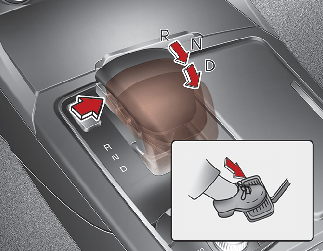
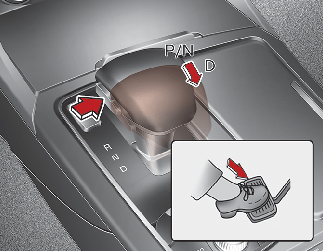
This is the normal driving position.The transmission will automatically shift through a 8-gear sequence, providing the best fuel economy and power.
For extra power when passing another vehicle or driving uphill, depress the accelerator pedal further until you feel the transmission downshift to a lower gear.
To shift into D (Drive), depress the brake pedal and press the [UNLOCK] button on the shift lever. Move the shift lever backward.
To shift into D (Drive) from N (Neutral), you must depress the brake pedal.

Always come to complete stop before shifting into D (Drive).
When moving the shift lever to N (Neutral) position, a normal mechanical sound will occur.
For EPB (Electronic Parking Brake) equipped vehicles with [AUTO HOLD] function used while driving, if the ENGINE START/STOP button has been turned [OFF], the electronic parking brake will be engaged automatically. Therefore, [AUTO HOLD] function should be turned off before the ENGINE START/STOP button is turned off.
-
With the exception of parking in neutral gear, always park the vehicle in [P] (Park) for safety and apply the parking brake.
-
Before parking in [N] (Neutral) gear, first make sure the parking ground is level and flat. Do not park in [N] gear on any slopes or gradients. If parked and left in [N], the vehicle may move and cause serious damage or injury.
After the ENGINE START/STOP button has been turned off, the electronic parking brake cannot be disengaged.
Paddle shifter (Manual mode)
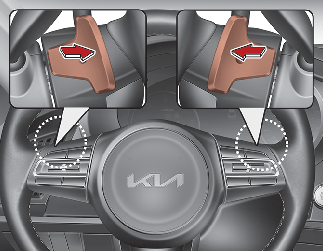
The paddle shifter is available when the shift lever is in the D (Drive) position.
Pull the [+] or [-] paddle shifter once to shift up or down one gear and the system changes from automatic mode to manual mode.
The system changes from manual mode to automatic mode in one of the following situations.
-
The [+] paddle has been pulled and held for more than 1 second.
-
The accelerator pedal has been depressed gently for more than 6 seconds.
-
The vehicle speed is lower than 7 km/h (4 mph).
-
The shift lever has been pulled down and released.
However, manual mode is not changed to automatic mode in (2) when SPORT mode or SPORT of powertrain in CUSTOM mode is selected in the drive mode integrated control system.
If the [+] and [-] paddle shifters are pulled at the same time, gear shift may not occur.
Shift-lock system
For your safety, the automatic transmission has a shift-lock system which prevents shifting the transmission from P (Park) into R (Reverse) or D (Drive) unless the [UNLOCK] button is pressed while depressing the brake pedal.
To shift the transmission from P (Park) into R (Reverse) or D (Drive):
-
Depress and hold the brake pedal.
-
Start the engine or place the ENGINE START/STOP button in the ON position.
-
Move the shift lever to R (Reverse) or D (Drive) while pressing the [UNLOCK] button.
When the battery is discharged:
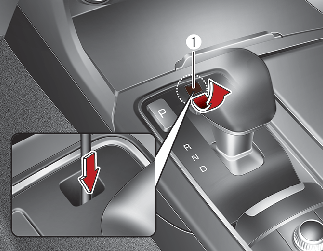
You can move the shift lever, when the battery is discharged. However, it will not change the gear from P (Parking) to N (Neutral) or others.
In emergencies, do the following to move the shift lever to N (Neutral) on a level ground.
-
Connect the cables between the jump-starting terminals inside the engine compartment and the battery terminals of another vehicle/supplementary battery.
For more information refer to More Details.
-
Release the parking brake with the ENGINE START/STOP button in the ON position.
-
Press the ENGINE START/STOP button to the OFF position.
-
Remove the cap-cover (1) and insert a tool (e.g. flathead screwdriver) into the access hole and press down on the tool while depressing the brake pedal. Then, the gear will change to the N (Neutral) position. It should be pressed within 3 minutes after turning OFF the engine.
In situations where the gear needs to be changed from P (Park) to N (Neutral) when the ENGINE START/STOP button is in the OFF position, refer to step 4.
The actuators work to shift the gear into the N (Neutral) or P (Parking) and make a normal mechanical sound.