
Engine coolant
The high-pressure cooling system has a reservoir filled with year round antifreeze coolant. The reservoir is filled at the factory.
Check the antifreeze protection and coolant level at least once a year, at the beginning of winter, and before traveling to a colder climate.

-
When the engine overheats from low engine coolant, suddenly adding engine coolant may cause cracks in the engine. To prevent damage, add engine coolant slowly in small quantities.
-
Do not drive with no engine coolant. It may cause water pump failure and engine seizure, etc.

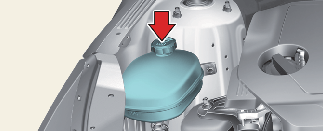
Engine coolant reservoir cap

Recommended coolant
When adding coolant, use only deionized water or soft water for your vehicle and never mix hard water in the coolant filled at the factory. An improper coolant mixture can result in serious malfunction or damage.
-
Do not use alcohol or methanol coolant or mix them with the specified coolant.
-
The engine in your vehicle has aluminum engine parts and must be protected by an ethylene-glycol with phosphate-based coolant to prevent corrosion and freezing.
-
Do not use a solution that contains more than 60% antifreeze or less than 35% antifreeze, which would reduce the effectiveness of the solution.
-
The cooling circuit of a vehicle equipped with a heat pump system may freeze in extremely low temperature when the concentration of the antifreeze liquid is below 45%.
For mixture percentage, refer to the following table.
|
Ambient Temperature |
Mixture Percentage (volume) |
|
|---|---|---|
|
Antifreeze |
Water |
|
|
5 °F (-15 °C) |
35 |
65 |
|
-13 °F (-25 °C) |
40 |
60 |
|
-31 °F (-35 °C) |
50 |
50 |
|
-49 °F (-45 °C) |
60 |
40 |
Engine coolant reservoir cap
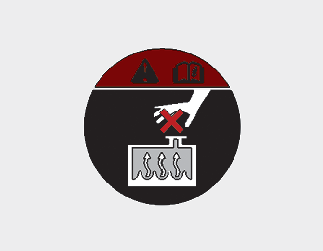
Do not remove the engine coolant reservoir cap when the engine and engine coolant reservoir are hot. Scalding hot coolant and steam may blow out under pressure which may result in serious injury.

Make sure the engine coolant reservoir cap is properly closed after refill or coolant.
The engine could be overheated while driving.
-
Check if the engine coolant reservoir cap label is straight In front.
Engine room front view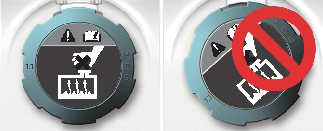
-
Make sure that the tiny protrusions inside the coolant cap are securely interlocked.
Engine room rearview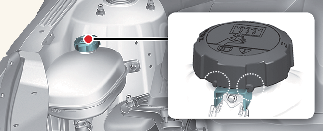
- Contains Topics
- Checking the coolant level
- Changing the coolant