
Seat belt - 3-point system with emergency locking retractor
Fastening the your seat belt:
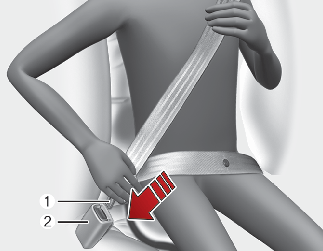
-
Pull it out of the retractor and insert the metal tab (1) into the buckle (2).
There will be an audible "click" when the tab locks into the buckle.
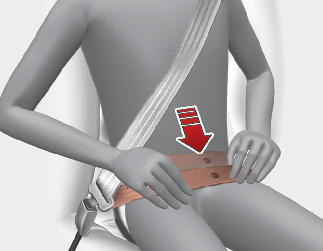
The rear seat belt should be locked into the buckle on each seat cushion to be properly fastened.
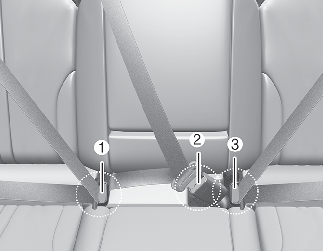
-
Rear right seat belt fastening buckle
-
Rear center seat belt fastening buckle
-
Rear left seat belt fastening buckle

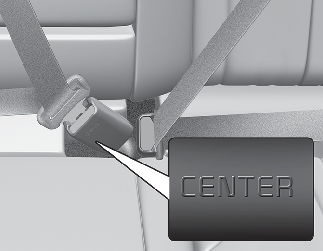
Prior to fastening the rear seat belts, ensure the latch matches the seat belt buckle. Forcefully fastening the left or right seat belt to the center buckle can result in an improper fastening scenario that will not protect you in an accident.
When using the rear center seat belt, the buckle with the "CENTER" mark must be used.
You should place the lap belt portion as low as possible and snugly across your hips. If the lap belt is located too high on your waist, it may increase the chance of injury in the event of a collision.
The arm closest to the seat belt buckle should be over the belt while the other arm should be under the belt as shown in the illustration. Never wear the seat belt under the arm closest to the door.
The seat belt automatically adjusts to the proper length only after the lap belt portion is adjusted manually so that it fits snugly around your hips. If you lean forward in a slow, easy motion, the belt will extend and let you move around. If there is a sudden stop or impact, however, the belt will lock into position. It will also lock if you try to lean forward too quickly.

If you are not able to pull out the seat belt from the retractor, firmly pull the belt out and release it. Then you will be able to pull the belt out smoothly.
Stowing the rear seat belt
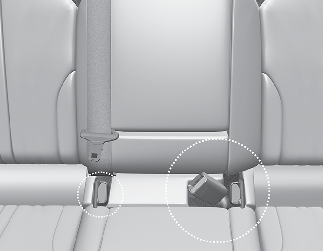
The rear seat belt buckles can be stowed in the pocket between the rear seatback and cushion when not in use.
-
Route the seat belt webbing through the rear seat belt guides. It will help keep the belts from being trapped behind or under the seats.
-
After inserting the seat belt, tighten the belt webbing by pulling it up.

When pulling out to wear the seat belt, the tongue should be slowly pulled out of the seat belt guide so that the seat belt guide does not come off the trim.
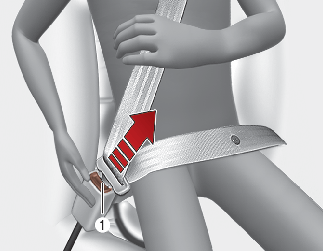
Releasing the seat belt:
-
Press the release button (1) in the locking buckle.
When it is released, the belt should automatically draw back into the retractor.
If this does not happen, check the belt to be sure it is not twisted, then try again.
Adjusting the height of shoulder belt
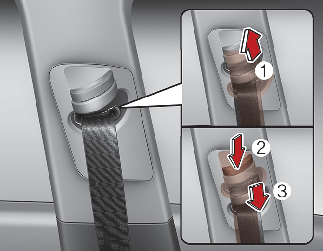
The height of the adjusting seat belt should not be too close to your neck. The shoulder portion should be adjusted so that it lies across your chest and midway over your shoulder near the door and not your neck.
To adjust the height of the seat belt anchor, lower or raise the height adjuster into an appropriate position.
-
To raise the height adjuster, pull it up (1).
-
To lower it, push it down (3) while pressing the height adjuster button (2).
Release the button to lock the anchor into position. Try sliding the height adjuster to make sure that it has locked into position.
Improperly positioned seat belts can cause serious injuries in an accident.
Shoulder belt positioning
Verify the shoulder belt anchor is locked into position at the appropriate height. Never position the shoulder belt across your neck or face. Improperly positioned seat belts can cause serious injuries in an accident.
Seat belt replacement
Replace your seat belts after being in an accident. Failure to replace seat belts after an accident could leave you with damaged seat belts that will not provide protection in the event of another collision.