

Emergency Steering (Evasive steering assist)
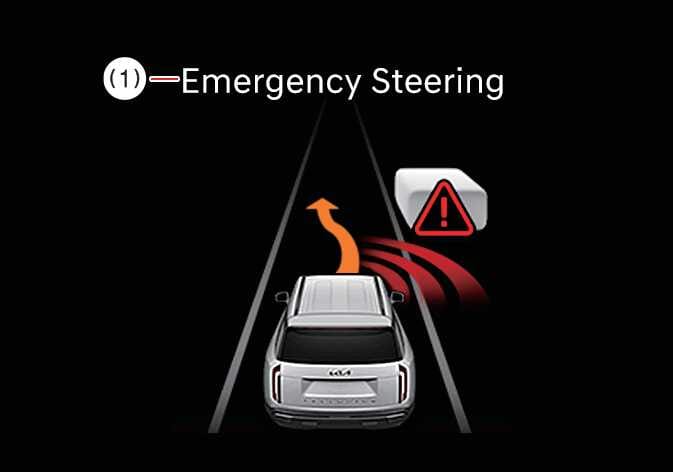 OLQ2A005009 |
|
Emergency Steering can alert you with Emergency steering warning light blinking ( ), a warning message, an audible warning, and steering wheel vibration.
If there is a risk of a collision with a pedestrian, cyclist, or motorcyclist ahead of your vehicle and you have already exceeded the Emergency Braking speed limit, Emergency Steering can activate to help you avoid a collision.
Emergency Steering may activate under the following conditions:
-
Your driving speed is approximately 40-47 mph (65-75 km/h).
-
The pedestrian, bicyclist, or motorcycle is moving in the same or opposite direction as your vehicle.
-
Both lane markings are detected.
-
Driving on a straight road.
-
There is no risk of a secondary collision.
-
When Emergency Steering is operating, the steering wheel may turn automatically.
-
Emergency Steering automatically ends when risk factors disappear. Adjust the steering wheel as needed.
-
Emergency Steering may deactivate during operation if the steering wheel is held tightly or steered in the opposite direction.
-
When steering is assisted to avoid a collision with another vehicle, a pedestrian, or a cyclist, Evasive steering assist will deactivate if potential collisions are detected with other vehicles, motorcyclist, pedestrians, or cyclists.
-
Evasive steering assist may not operate if there is insufficient space to avoid a collision.
-
When driving at night, the performance of powered two-wheeler recognition is decreased, so the Forward Collision-Avoidance Assist system may be temporarily limited or may not work.
For more information about warning messages, refer to Collision Warning.
-
For your safety, change the settings only after parking the vehicle at a safe location.
-
Forward Collision-Avoidance Assist does not operate in all situations and cannot avoid all collisions.
-
You are responsible for controlling the vehicle. Do not depend on Forward Collision-Avoidance Assist. Maintain a safe braking distance and manually engage the brake pedal to reduce driving speed or stop the vehicle.
-
Never deliberately drive toward people or objects to test Forward Collision-Avoidance Assist. It may cause serious injury or death.
-
Forward Collision-Avoidance Assist may not operate if you manually brake to avoid collision.
-
Depending on the road and driving conditions, Forward Collision-Avoidance Assist may warn you late or not at all.
-
During Forward Collision-Avoidance Assist operation, the vehicle may stop suddenly, which can cause loose objects to shift and possibly injure passengers. Always fasten seat belts and secure loose objects.
-
Forward Collision-Avoidance Assist may not display a warning message or generate an audible warning if any other function’s warning message is displayed or any other function’s audible warning is generated at the same time.
-
You may not hear the warning sound of Forward Collision-Avoidance Assist if you are in noisy surroundings.
-
Depending on road conditions and surroundings, Forward Collision-Avoidance Assist may turn OFF or operate improperly or unnecessarily.
-
Emergency Braking activated by Forward Collision-Avoidance Assist may end automatically if you brake hard or turn the steering wheel sharply.
-
Your surroundings may affect the speed or detection range of Forward Collision-Avoidance Assist, and result in the function being temporarily limited or disabled.
-
Forward Collision-Avoidance Assist takes into account the oncoming vehicle’s direction, speed, and surroundings to judge risk.
-
Forward Collision-Avoidance Assist may not activate when driving at a high speed or when there is a significant difference in speed between your vehicle and oncoming vehicles.
-
If the system determines that a collision with surrounding vehicles is likely, the Lane Change Oncoming, Lane Change Side, and Evasive Steering Assist functions will provide warnings only and not steering control.
-
When a collision is imminent, Forward Collision-Avoidance Assist may activate brake assist if you do not brake enough to avoid the collision.
-
The images or colors may display differently depending on the specifications of the instrument cluster or theme.
-
If the interior camera detects an abnormal driver condition, the Forward Collision-Avoidance Assist may activate earlier than usual.: (if equipped)