

Limitations of Rear Cross-Traffic Collision-Avoidance Assist
Rear Cross-Traffic Collision-Avoidance Assist may operate abnormally or unexpectedly under the following circumstances:
-
You are departing from areas with overgrown foliage.
-
You are departing from areas where roads are wet.
-
The speed of an approaching vehicle is fast or slow.
-
The rear-side radar is obstructed by the vehicle itself, pillars, walls, or other objects.
-
Exiting simultaneously with a neighboring vehicle, causing the rear-side radar to be obstructed.
Braking control may not work, and your attention is required in the following circumstances:
-
The vehicle vibrates severely while you drive over a bumpy, uneven road or pothole.
-
You drive on a slippery surface such as snow, rain, ice, and so on.
-
The tire pressure is low or a tire is damaged.
-
Remote Smart Parking Assist is operating (if equipped).
-
The brakes are modified
For more information about the rear corner radar, refer to Blind-spot Collision-avoidance Assist (BCA).
-
You are driving near a vehicle or structure
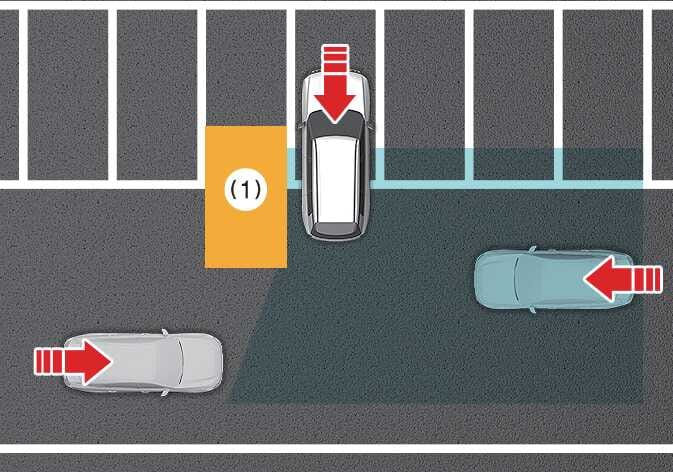 OLQ2A105060
-
Structure
Rear Cross-Traffic Collision-Avoidance Assist may be limited when you drive near a vehicle or structure, and it may not detect a vehicle approaching from the left or right. The function may not warn you or control the brakes when necessary.
Always check your surroundings while backing up.
-
-
The vehicle is in a complex parking environment
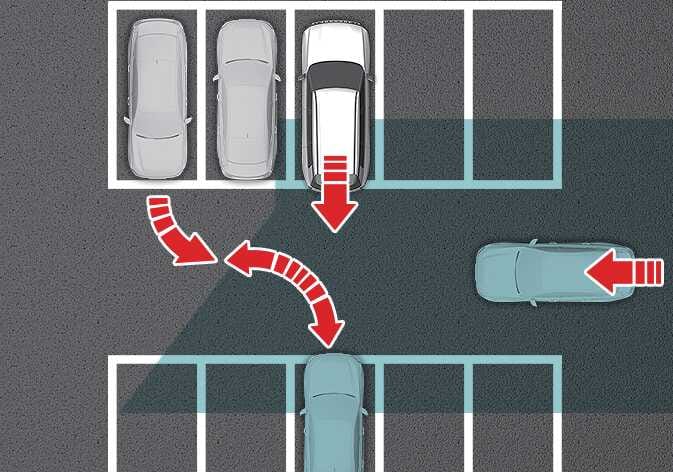 OLQ2A105061
Rear Cross-Traffic Collision-Avoidance Assist may detect vehicles that are parking or pulling out near your vehicle (for example, a vehicle leaving from beside your vehicle, a vehicle parking or pulling out behind your vehicle, a vehicle that is approaching your vehicle making a turn, and so on).
The function may unnecessarily warn you and control the brake.
Always check your surroundings while backing up.
-
The vehicle is parked diagonally
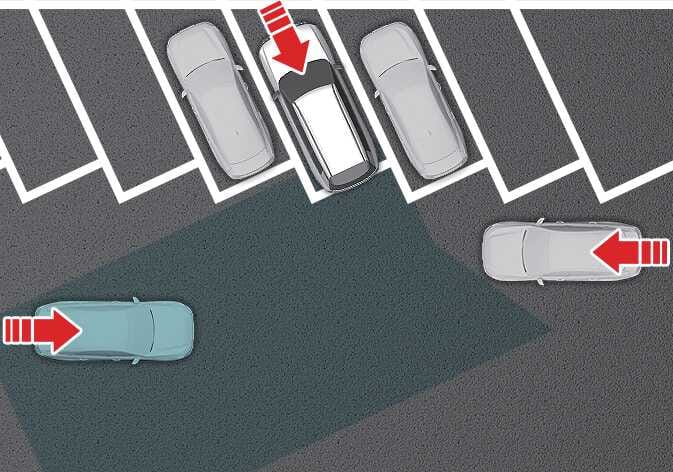 OLQ2A105062
Rear Cross-Traffic Collision-Avoidance Assist may be limited when you back up diagonally and may not detect a vehicle approaching from the left or right. The function may not warn you or control the brakes when necessary.
Always check your surroundings while backing up.
-
The vehicle is on or near a slope
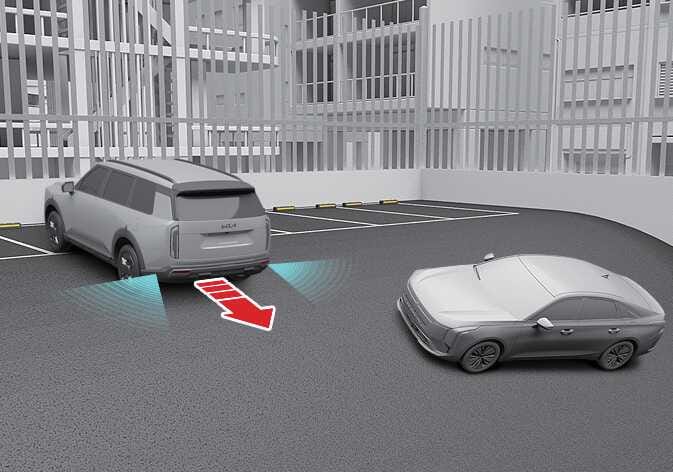 OLQ2A105063
Rear Cross-Traffic Collision-Avoidance Assist may be limited when your vehicle is on or near an uphill or downhill slope, and it may not detect a vehicle approaching from the left or right. The function may not warn you or control the brakes when necessary.
Always check your surroundings while backing up.
-
You are pulling into a parking space where there is a structure
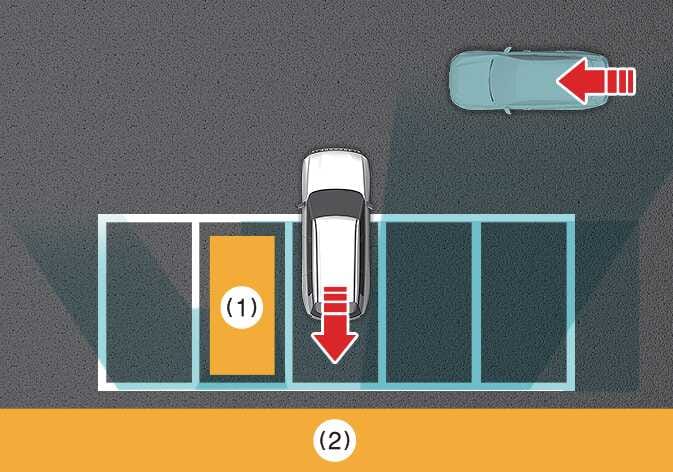 OLQ2A105064
-
Structure
-
Wall
Rear Cross-Traffic Collision-Avoidance Assist may detect vehicles passing ahead of you when you park in reverse into a parking space with a wall or structure in the rear or side area. The function may unnecessarily warn you and control the brake.
Always check your surroundings while backing up.
-
-
The vehicle is parked backward
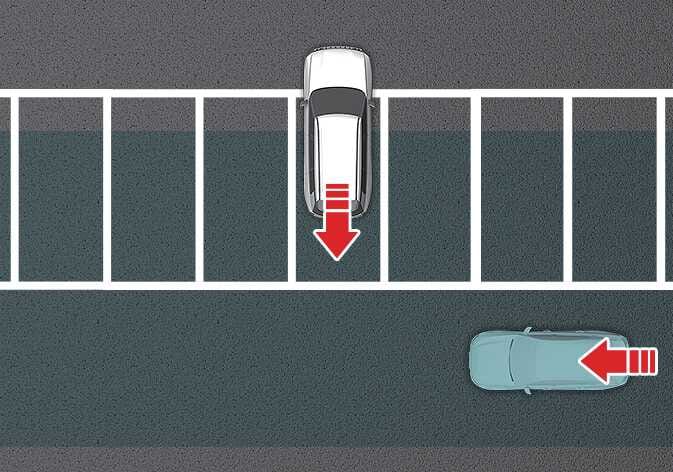 OLQ2A105065
Rear Cross-Traffic Collision-Avoidance Assist may detect vehicles passing behind you when you park in a parking space in reverse. The function may unnecessarily warn you and control the brake.
Always check your surroundings while backing up.
-
When you are towing a trailer or another vehicle, turn OFF Rear Cross-Traffic Collision-Avoidance Assist for safety reasons.
-
Rear Cross-Traffic Collision-Avoidance Assist may not operate properly if there is strong electromagnetic interference.
-
Rear Cross-Traffic Collision-Avoidance Assist may not activate for 3 seconds after you start your vehicle or initialize the rear corner radars.
-
Even if you restart the vehicle with the sensors blocked or malfunctioning, Rear Cross-Traffic Collision-Avoidance Assist may not operate properly, as the function maintains its last setting.