

Tire sidewall labeling
This information identifies and describes the fundamental characteristics of the tire and provides the Tire Identification Number (TIN) for safety standard certification.
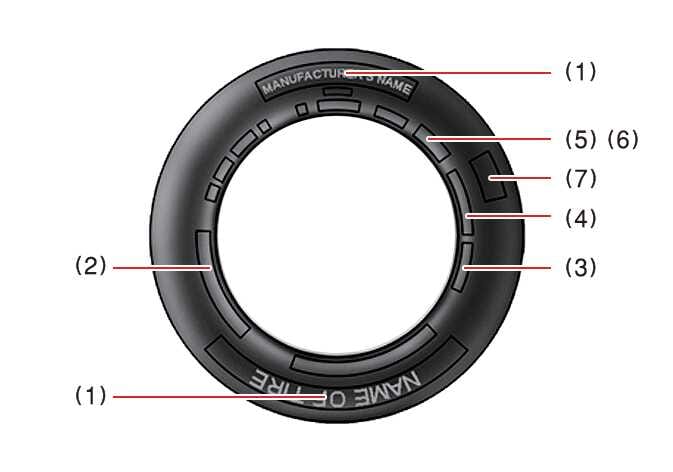 KIAPB032 |
The TIN can be used to identify the tire in case of a recall.
1. Manufacturer or brand name
The sidewall shows the manufacturer or brand name.
2. Tire size designation
A tire’s sidewall is marked with a tire size designation. You will need this information when selecting replacement tires for your vehicle. The following example explains what the letters and numbers in the tire size designation mean.
(These numbers are provided as an example only; your tire size designation could vary depending on your vehicle.)
Example tire size designation:
P255/45R20 105V
-
P: Applicable vehicle type (tires marked with the prefix P are intended for use on passenger vehicles or light trucks; however, not all tires have this marking).
-
255: Tire width in millimeters.
-
45: Aspect ratio (the tire’s section height as a percentage of its width).
-
R: Tire construction code (Radial).
-
20: Rim diameter in inches.
-
105: Load Index (a numerical code associated with the maximum load the tire can carry).
-
V: Speed Rating Symbol. See the speed rating chart in this section for additional information.
Wheels are also marked with important information that you need if you ever have to replace one. The following example explains what the letters and numbers in the wheel size designation mean.
Example wheel size designation:
8.5JX20
-
8.5: Rim width in inches.
-
J: Rim contour designation.
-
20: Rim diameter in inches.
The following chart lists many of the different speed ratings that are currently used for passenger vehicle tires. The speed rating is part of the tire size designation marked on the sidewall of the tire. This symbol corresponds to that tire’s designed maximum safe operating speed.
|
Speed Rating Symbol |
Maximum Speed |
|---|---|
|
S |
112 mph (180 km/h) |
|
T |
118 mph (190 km/h) |
|
H |
130 mph (210 km/h) |
|
V |
149 mph (240 km/h) |
|
W |
168 mph (270 km/h) |
|
Y |
186 mph (300 km/h) |
3. Checking tire life
Any tires that are over 6 years old, based on the manufacturing date, should be replaced with new ones. You can find the manufacturing date on the tire sidewall (possibly on the inside of the wheel) displayed as part of the DOT code. The DOT code consists of a series of numbers and English letters on a tire. The manufacturing date is designated by the last 4 digits (characters) of the DOT code.
DOT: XXXX XXXX OOOO
The first part of the DOT code contains the plant code number, tire size, and tread pattern, and the last four numbers indicate week and year manufactured.
For example:
DOT XXXX XXXX 1626 means that the tire was produced in the 16th week of 2026.
Tire age
Replace tires within the recommended time frame. Failure to replace tires as recommended can result in sudden tire failure, which could lead to a loss of vehicle control and an accident, potentially leading to serious injury or death.
4. Tire ply composition and material
Tire ply means the number of layers (or plies) of rubber-coated fabric in the tire. Tire manufacturers must list the materials in the tire, which include steel, nylon, polyester, and others. The letter R means radial ply construction, the letter D means diagonal or bias ply construction, and the letter B means belted-bias ply construction.
5. Maximum Inflation Pressure
This number is the greatest amount of air pressure that should be put into the tire. Do not exceed the maximum inflation pressure. Refer to Certification label for the recommended inflation pressure.
6. Maximum load rating
This number is the maximum load in kilograms and pounds that the tire can carry. When replacing the tires on the vehicle, always use a tire that has the same load rating as the factory-installed tire.
7. Uniform Tire Quality Grading
Quality grades can be found where applicable on the tire sidewall between tread shoulder and maximum section width.
For example:
-
Treadwear 200
-
Traction AA
-
Temperature A
Tires degrade over time, even when you are not using them. Regardless of the remaining tread, we recommend that you replace the tires after approximately 6 years of normal service. Heat from hot climates or frequent high loading conditions can accelerate the aging process.
The tread wear grade is a comparative rating based on the wear rate of the tire when tested under controlled conditions on a specified government test course. For example, a tire graded 150 would wear 1½ times as well on the government test course as a tire graded 100.
The relative performance of tires depends on the actual conditions of their use. Performance may depart significantly from the norm due to variations in driving habits, service practices, and differences in road characteristics and climate.
Tread wear grades are molded on the sidewalls of passenger vehicle tires. The tires available as standard or optional equipment on your vehicle may vary with respect to grade.
The traction grades from highest to lowest are AA, A, B, and C. These grades represent the tire’s ability to stop on wet pavement as measured under controlled conditions on specified government test surfaces of asphalt and concrete. A tire marked C may have poor traction performance.
The traction grade assigned to this tire is based on straight-ahead braking traction tests and does not include acceleration, turning, hydroplaning, or peak traction characteristics.
The temperature grades from highest to lowest are A, B, and C, representing the tire’s resistance to the generation of heat and its ability to dissipate heat when tested under controlled conditions on a specified indoor laboratory test wheel.
Sustained high temperature can cause the material of the tire to degenerate and reduce the life of the tire, and excessive temperature can lead to sudden tire failure. Grade C corresponds to the performance level that all passenger vehicle tires must meet under the Federal Motor Vehicle Safety Standard No. 109. Grades B and A represent higher levels of performance on the laboratory test wheel than the minimum required by law.