

Emergency Steering
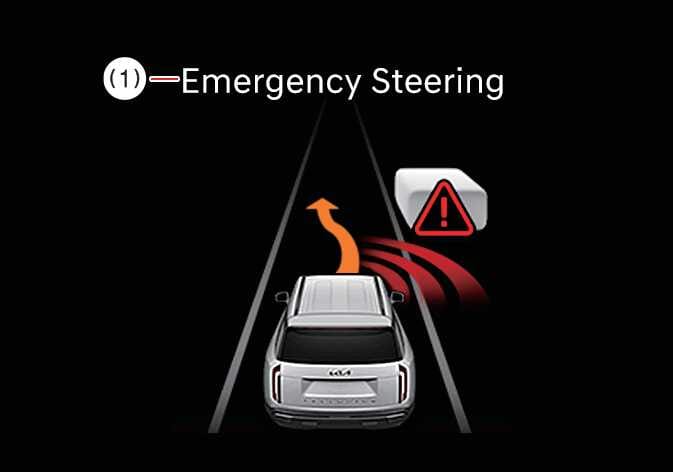 OLQ2A005009 |
|
Emergency Steering can alert you with Emergency Steering warning light blinking ( ), a warning message, an audible warning, and steering wheel vibration.
The warning light on the outside rearview mirror appears when a vehicle is detected in the right or left lane from the rear. Emergency Steering may activate to avoid a collision.
Emergency Steering may activate under the following conditions:
-
Your speed is approximately 25-90 mph (40-145 km/h).
-
Speed of the side vehicle or motorcycle: While driving
-
It is within a certain period of time after the system determines that the vehicle has departed from the lane.
-
The target enters the operating range of the Lane-Change Side function.
-
Driving on a straight road
-
Both lane markings are detected.
-
There is no risk of a secondary collision.
-
Lane-Change Side function does not operate if the oncoming vehicle is stopped.
-
These functions do not work when a car or motorcyclist in the next lane is stationary.
-
The front-side and rear-side radar detection range is based on the width of standard roads. On narrow roads, warnings may be triggered by a vehicle or motorcyclist driving in the next lane. Conversely, on wide roads, radars may fail to recognize a vehicle or motorcyclist driving in the next lane.
-
The Lane-Change Side function deactivates in the following situations:
-
You drive more than a certain distance into the next lane.
-
You move away from the direction where there is a risk of collision.
-
You turn the steering wheel rapidly.
-
You engage the brake pedal.
-
Forward Collision-Avoidance Assist activates.
-
-
After the Lane-Change Side function is triggered or after you change lanes, be sure to move into the center of the lane. If you continue to drive along the edge of the lane, the Lane-Change Side function may deactivate.
If an additional accident risk is detected due to Emergency Steering, only a Collision Warning may be issued to notify you of the danger.