

Changing tires
-
Park your vehicle on a level, firm surface, apply the parking brake, and turn the vehicle off.
-
Turn the hazard lights on.
-
Remove the wheel lug nut wrench, jack, jack handle, and spare tire from the vehicle.
-
Block both sides of the wheel diagonally opposite the jack position.
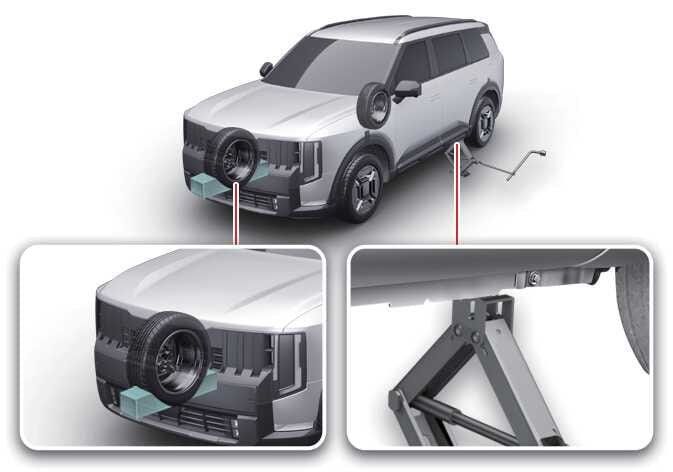 OLQ2A115009_2
 -
Loosen the wheel lug nuts counterclockwise one turn each, but do not remove any of the nuts until the tire is raised above ground.
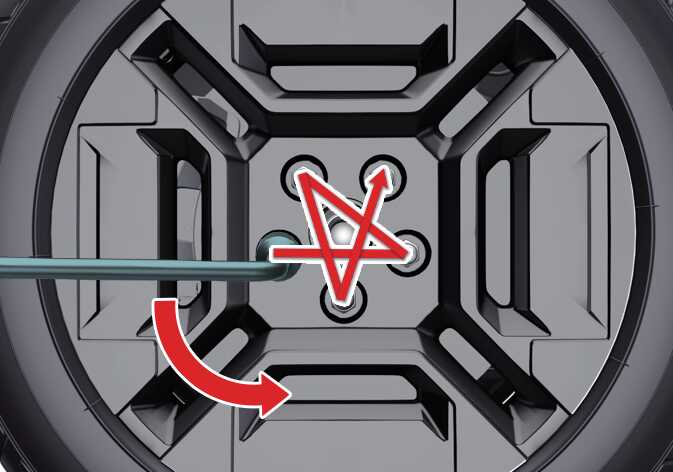 OLQ2A115011
 -
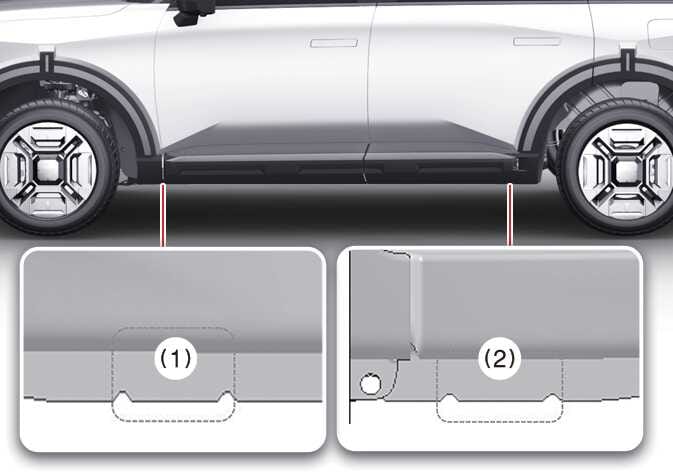
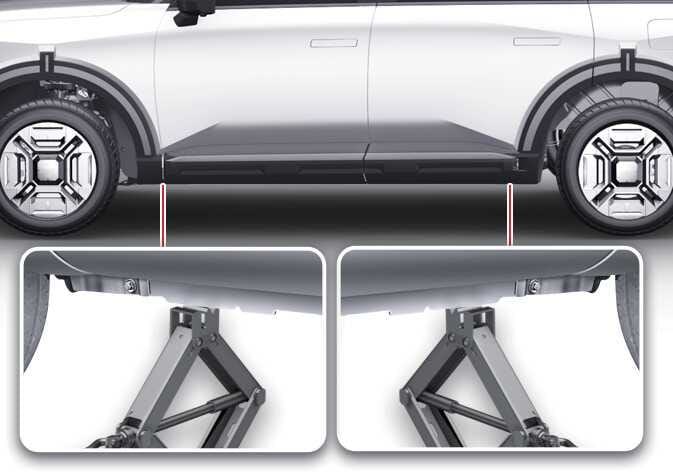
Place the jack at the front (1) or rear (2) jacking position closest to the tire you are changing. Place the jack at the designated locations under the frame. The jacking positions are plates welded to the frame with two tabs and a raised dot.
 OLQ2A115012_2
 OLQ2A115013_2
 -
Insert the jack handle into the jack and turn it clockwise, raising the vehicle until the tire just clears the ground (approximately 1.2 in (30 mm)). Before removing the wheel lug nuts, make sure the vehicle is stable and there is no chance of movement or slipping.
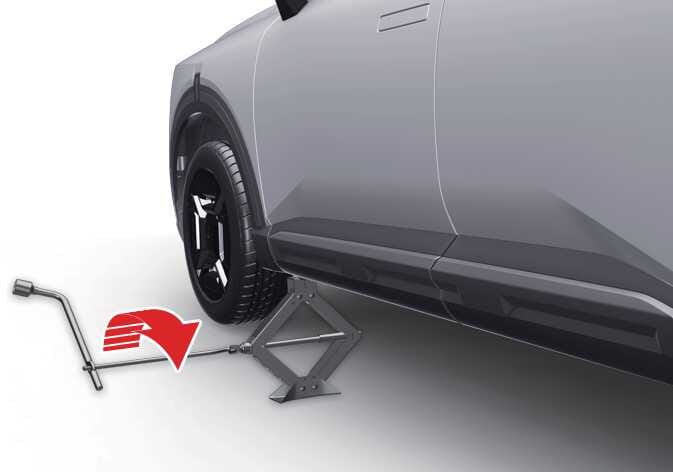 OLQ2A115014
 -
Loosen the wheel lug nuts and remove them with your hands. Slide the wheel off the studs and lay it flat so it cannot roll away. To put the wheel on the hub, pick up the spare tire, line the holes up with the studs, and slide the wheel into place.
If this is difficult, tip the wheel slightly and line up the top hole in the wheel with the top stud. Jiggle the wheel back and forth until you can slide the wheel over the other studs.
-
To reinstall the wheel, hold it on the studs, place the wheel lug nuts on the studs, and tighten them by hand. Jiggle the tire to be sure it is completely seated, then tighten the nuts by hand as much as possible.
-
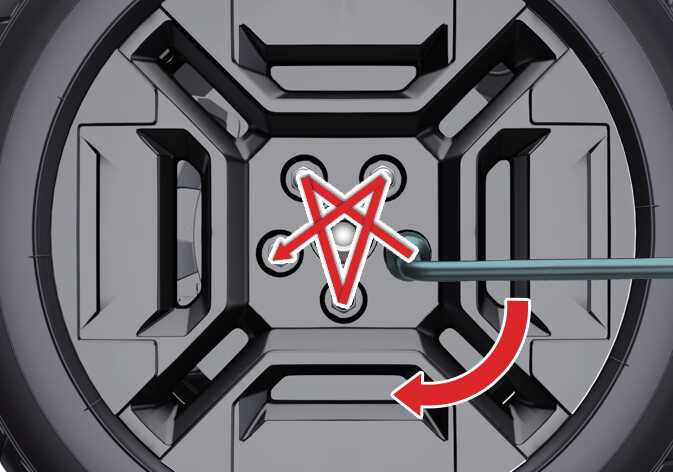
To lower the vehicle back to the ground, turn the wheel nut wrench clockwise.
Position the wrench as shown in the illustration above and tighten the wheel nuts. Make sure the socket is seated completely over the nut. Do not stand on the wrench handle or use an extension pipe over the wrench handle. Go around the wheel, tightening every nut. Double check each nut to be sure it is tight on the wheel. After you change a wheel, have an authorized Kia dealer tighten the wheel nuts to their proper torque as soon as possible.
 OLQ2A115015
-
To reduce the possibility of injury, only use the jack provided with your vehicle in the correct jack position. Never use any other part of the vehicle for jack support.
-
To prevent vehicle movement while changing a tire, always fully apply the parking brake and block the wheel diagonally opposite the tire you are changing.
-
You should block all of the wheels on the vehicle. No one should remain in the vehicle when you use the jack.
-
When you install a wheel, be sure to remove any corrosion, dirt, or foreign materials present on the mounting surfaces of the wheel or the surface of the wheel hub, brake drum, or brake disc that contacts the wheel. Secure any fasteners that attach the rotor to the hub so they do not interfere with the mounting surfaces on the wheel. Installing wheels without correct metal-to-metal contact at the wheel mounting surfaces can cause the wheel nuts to loosen and the wheel to come off while your vehicle is in motion. This could result in loss of vehicle control, personal injury, or death.
-
Make sure the wheel makes good contact with the hub when installed. If the contact of the mounting surface between the wheel and hub is not secure, the wheel nuts could come loose and cause the loss of a wheel. Loss of a wheel may result in loss of control of the vehicle.
-
Because a vehicle can slip or roll off a jack and cause serious injury or death to you or those nearby, you should take the following safety precautions:
-
Never put any part of your body under a vehicle that is only supported by a jack.
-
Never attempt to change a tire in a traffic lane. Always move the vehicle completely off of the road onto firm, level ground away from traffic before you try to change a tire. If you cannot find a firm, level place off of the road, call a towing services company for assistance.
-
Be sure to use the jack provided with your vehicle.
-
Be sure to use the correct front and rear jacking positions for your vehicle. Never use the bumpers or any other part of the vehicle for jacking support.
-
Do not start or run the vehicle while the vehicle is on the jack.
-
Do not allow anyone to remain in the vehicle while it is on the jack.
-
Make sure any children present are in a secure place away from the road and the vehicle.
-
Wheel nut tightening torque
Steel wheel and aluminum alloy wheel: 79–94 lbf·ft (11–13 kgf·m)
If you have a tire gauge, remove the valve cap and check the air pressure. If the air pressure is lower than recommended, drive slowly to the nearest service station and inflate your tires to the correct pressure. If the air pressure is higher than recommended, adjust the air pressure until it is correct. Always reinstall the valve cap after you check or adjust tire pressure. If the cap is not reinstalled, air may leak from the tire. If you lose a valve cap, buy another and install it as soon as possible.
After you change a wheel, always secure the flat tire in its place and return the jack and tools to their proper storage locations.
Note that most lug nuts do not have metric threads. Be extremely careful and check the thread style before you install aftermarket lug nuts or wheels. If in doubt, consult an authorized Kia dealer.
-
If the studs are damaged, they may lose the ability to hold the wheels in place. This could lead to the loss of a wheel, and a collision resulting in serious injuries.
-
Never use oil or grease on bolts or nuts because the nuts might come loose and the wheel could fall off, causing a crash.
Reusing lug nuts
When you remove a wheel, make sure the same nuts that were removed are reinstalled. If you must replace a nut, make sure the replacement nut has metric threads and the same chamfer configuration as the original nut. If you install a nut without metric threads, it will not properly secure the wheel to the hub and will damage the stud (and you will have to replace the stud).