
Smart Cruise Control operation switches
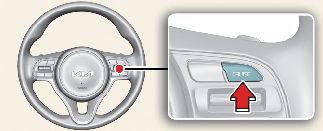
Driving Assist button: Turns Smart Cruise Control on or off.
RES+: Resumes or increases Smart Cruise Control speed.
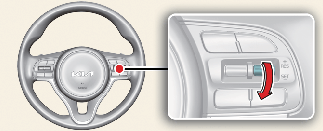
SET-: Sets or decreases Smart Cruise Control speed.
( ): Sets vehicle distance.
CNCL (O): Cancels Smart Cruise Control operation.
To set Smart Cruise Control Speed:
-
Press the Driving Assist button to turn the function on. CRUISE indicator in the instrument cluster will appear.
-
Accelerate to the desired speed.
Smart Cruise Control speed can be set as follows:
-
10~160 km/h (5~100 mph): when there is no vehicle in front
-
0~160 km/h (0~100 mph): when there is a vehicle in front
-
-
Push the switch down (to SET-), and release it at the desired speed. The set speed and vehicle to vehicle distance on the LCD screen will appear.
-
Release the accelerator pedal. The desired speed will automatically be maintained.
If there is a vehicle in front of you, the speed may decrease to maintain the distance to the vehicle ahead.
On a steep grade, the vehicle may slow down or speed up slightly while going uphill or downhill.
Vehicle speed may decrease on an downward slope and increase on a onward slope.
The speed will be set to 30 km/h (20 mph) when there is a vehicle ahead and your vehicle speed is 0~30 km/h (20 mph).
Also, the speed will be set to 30 km/h (20 mph) when there is no vehicles ahead and your vehicle speed is 10~30 km/h (5~20 mph).
Smart Cruise Control not operating conditions

A: SCC (Smart Cruise Ctrl.) conditions not met
-
The driver's door is opened.
-
The vehicle is shifted to N (Neutral)/R (Reverse)/P (Park).
-
The parking brake is applied.
-
The vehicle speed is not within the specified SCC range.
-
The ESC (Electronic Stability Control), TCS (Traction Control System) or ABS is operating.
-
The ESC (Electronic Stability Control), TCS (Traction Control System) or ABS is off.
-
The sensor cover is extremely contaminated.
-
The motor performance is abnormal.
-
Forward Collision-Avoidance Assist is activated.
-
The front radar sensing data is out of limit.
To increase Smart Cruise Control set speed:
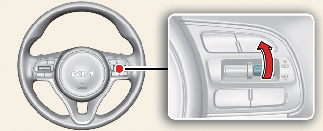
Follow either of these procedures:
-
Push the switch up (to RES+), and hold it. Your vehicle set speed will increase by 10 km/h (5 mph). Release the switch at the speed you want.
-
Push the switch up (to RES+), and release it immediately. The cruising speed will increase by 1 km/h (1 mph) each time you push the switch up (to RES+) in this manner.
-
You can increase the set speed to 160 km/h (100 mph).

Check the driving condition before using the toggle switch. Driving speed sharply increases, when you push up and hold the switch.
To decrease Smart Cruise Control set speed:
Follow either of these procedures:
-
Push the switch down (to SET-), and hold it. Your vehicle set speed will decrease by 10 km/h (5 mph). Release the switch at the speed you want.
-
Push the switch down (to SET-), and release it immediately. The cruising speed will decrease by 1 km/h (1 mph) each time you push the switch down (to SET-) in this manner.
-
You can decrease the set speed to 30 km/h (20 mph).
To temporarily accelerate with Smart Cruise Control on:
If you want to speed up temporarily when Smart Cruise Control is on, depress the accelerator pedal. Increased speed will not interfere with Smart Cruise Control operation or change the set speed.
To return to set speed, take your foot off the accelerator.
If you push the switch down (to SET-) at increased speed, the increased cruising speed will be set again.

Be careful when accelerating temporarily, because the speed is not controlled automatically at this time even if there is a vehicle in front of you.
Smart Cruise Control will be temporarily canceled when:
Canceled manually
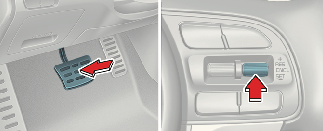
Smart Cruise Control is temporarily canceled when the brake pedal is depressed or the CNCL (O) switch is pressed. Depress the brake pedal and press the CNCL (O) switch at the same time, when the vehicle is at a standstill. The speed and vehicle distance indicator on the cluster is disappeared and CRUISE indicator is appeared continuously.
Canceled automatically
SCC will automatically cancel in the following situations:
-
The driver's door is opened.
-
The gear is shifted to N (Neutral), R (Reverse) or P (Parking).
-
The EPB (Electronic Parking Brake) is applied.
-
The vehicle speed is over 170 km/h (110 mph)
-
The ESC, ABS or TCS is operating.
-
The ESC is turned off.
-
The sensor or the cover is dirty or blocked with foreign matter.
-
The accelerator pedal is continuously depressed for long time.
-
The speed is in dangerous range.
-
Smart Cruise Control has malfunctioned.
-
When the braking control is operated for Forward Collision-Avoidance Assist
-
The vehicle is stopped for more than 5 minutes.
-
The vehicle stops and goes repeatedly for a long period of time.
-
When the parking brake is locked.
-
Vehicle has some problems.
Each of these actions will cancel Smart Cruise Control operation. (the set speed and vehicle distance on the LCD display will go off.) In a condition Smart Cruise Control is canceled automatically, Smart Cruise Control will not resume even though the (RES+) or (SET-) switch is pushed.
In a condition Smart Cruise Control is canceled automatically when the vehicle stops, the EPB will activate and the parking brake will be locked.
If Smart Cruise Control is canceled by other than the reasons mentioned, have the function checked by a professional workshop. Kia recommends to visit an authorized Kia dealer/service partner.
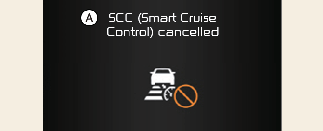
A: SCC (Smart Cruise Control) cancelled
If the function is automatically canceled, the warning chime will sound and a message will appear for a few seconds.
You must adjust the vehicle speed by depressing the accelerator or brake pedal according to the road condition ahead and driving condition.
Always check the road conditions. Do not rely on the warning chime.
To resume Smart Cruise Control set speed:
If any method other than the CNCL (O) switch was used to cancel cruising speed and the function is still activated, the cruising speed will automatically resume when you push the switch up (to RES+).
If you push the switch up (to RES+), the speed will resume to the recently set speed. However, if vehicle speed drops below 10 km/h (5 mph), it will resume when there is a vehicle in front of your vehicle.
To reduce the risk of an accident, always check the road conditions when reactivating Smart Cruise Control using the (RES+) switch to ensure the road conditions permit safe use of Cruise Control.
To turn Smart Cruise Control off:
Press the Driving Assist button. (CRUISE indicator in the instrument cluster will go off).
When Smart Cruise Control is not needed, press the Driving Assist button and deactivate the function.
The mode changes, as below, whenever the Driving Assist button is pressed.
-
Function off → Smart Cruise Control → Manual Speed Limit Assist → Function off

Take the following precautions:
-
If Smart Cruise Control is left on, (CRUISE indicator in the instrument cluster appeared) Smart Cruise Control can be activated unintentionally. Keep Smart Cruise Control off (CRUISE indicator off) when Smart Cruise Control is not used.
-
Do not leave the vehicle when it stop by Smart Cruise Control. If necessary to leave the vehicle, turn off Smart Cruise Control and change the gear to P (Parking) and engage the parking brake and off the vehicle while depressing the brake pedal.
Do not leave the vehicle when it was stopped by Smart Cruise Control. If it is necessary to leave the vehicle, turn off the Smart Cruise Control, change the gear shift to P (Parking), engage the parking brake and turn off the motor while depressing the brake pedal.
-
Use Smart Cruise Control only on the good traffic condition road. Do not use Smart Cruise Control in the following situations because the high risk of an accident.
-
Highway interchange and tollgate
-
Road surrounded by abnormally multiple steel constructions (subway construction, steel tunnel, etc.)
-
Parking lot
-
Lanes beside guard rail on a road
-
Slippery road with rain, ice, or snow covered
-
Abrupt curved road
-
Steep hills
-
Windy roads
-
Off roads
-
Rods under construction
-
Rumble strip
-
When driving near crash barriers
-
When the vehicle sensing ability decreases due to vehicle modification resulting level difference of the vehicle's front and rear
-
When driving with limited view (possibly due to bad weather, such as fog, snow, rain or sandstorm)
-
-
Pay particular attention to the driving conditions whenever using Smart Cruise Control.
-
Smart Cruise Control is not a substitute for safe driving. It is the responsibility of the driver to always check the speed and distance of the vehicle ahead.
-
Be careful when driving downhill using Smart Cruise Control.
-
Smart Cruise Control should not be used when the vehicle is being towed to prevent any damage.
-
Always set the vehicle speed under the speed limit in your country.
-
Unexpected situations may lead to possible accidents. Pay attention continuously to road conditions and driving even when Smart Cruise Control is being operated.