
Lane Following Assist malfunction and limitations
Lane Following Assist malfunction
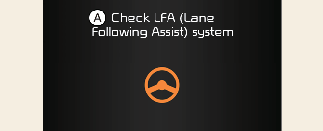
A: Check LFA (Lane Following Assist) system
The warning message popped up (turned off after a certain period of time) means a problem with Lane Following Assist. In this case, have the system checked by a professional workshop. Kia recommends to visit an authorized Kia dealer/service partner.

-
It is the driver's responsibility to operate the steering wheel while driving.
-
With Lane Following Assist on, the driver can steer the vehicle by operating the wheel on his own.
-
We recommend that the driver turns off Lane Following Assist and operates the steering wheel by himself in the following cases
-
Bad weather
-
Bad road conditions
-
When frequent operation of the steering wheel is required
-
When towing other vehicle or trailers
-
-
The steering wheel can feel heavy or light if Lane Following Assist is assisting the steering.
Limitations of Lane Following Assist
-
If the driver turns on the turn signal light or the emergency warning light to change the lane
-
Operate the turn signal light switch before changing the lane
-
If you change the lane without operating the turn signal lights, steering reaction force of the wheel may occur.
-
-
Once Lane Following Assist is turned on or the lane is changed, the vehicle should be in the center of the road to switch to the steering assist mode. If the driver keeps driving along the lane, Lane Following Assist will not assist the steering.
-
When the ESC or VSM is activated, the function does not assist steering.
-
When driving on a curved road at a high speed, steering assist mode may not work.
-
When driving at a speed faster than 150 km/h (90 mph), steering assist mode may not work.
-
When sudden steering is made, the function could be temporarily deactivated.
-
If you change the lane in a hurry, the function does not assist the steering.
-
If the vehicle suddenly stops, it does not assist the steering.
-
If the lane is too narrow or too wide, steering is not assisted.
-
If the function is not able to recognize a vehicle in front and either of the lanes is not recognized, the steering is not assisted
-
If the radius is too small for the curve
Cautions for the driver
If the lane recognition is difficult or limited for Lane Following Assist as shown below, the driver may need to be careful because it may not operate or may cause unnecessary operation.
-
When The lane is tainted or invisible
-
When the driver cannot see the lane due to rain, snow, dust, sand, oil, puddles, etc
-
When roads are set or the colors of the lane and road are not distinctive
-
If there is a sign other than the lane near the lane or a mark similar to the lane
-
When the lane is not clear or damaged
-
If the road is covered in the shadows of objects around the road, such as medians, guard rails, noise walls, and trees
-
If the number of lanes increases or decreases, or if the lanes intersect with each other more intensely (tollgate entry section, road section/joining section, etc.)
-
When there are two or more lane markings such as a construction section, a designated lane, etc.
-
When the lane is crowded such as the construction section or the lane is replaced by some structures
-
If there is a road marking such as a zigzag lane, crosswalk mark, or road surface milestone
-
When a lane suddenly becomes invisible or disappears from an intersection
-
If the outside brightness of the vehicle suddenly changes, such as when entering or exiting the tunnel or passing under the bridge
-
If the vehicle's headlights are not used at night or in the tunnel, or the brightness of the headlights is too weak
-
If there are boundary structures such as tollgate booths and sidewalk blocks
-
If it is difficult to distinguish lanes due to the reflection on the wet road made by sunlight, streetlight, and oncoming traffic.
-
When the backlight is strongly reflected in the direction of the vehicle
-
When Driving to the left or right lane by bus lane or on the bus lane
-
If there is no enough distance between the front car or if the lane is covered by the car ahead of me
-
When the lane change is large, such as a steep curve or a continuous curve
-
When passing through speed bump, sudden up/down or left/right slope
-
If the vehicle is severely shaken
-
When the temperature around the mirror is very high due to direct sunlight
-
If the windshield of the vehicle and the camera lens are covered with dust, fingerprints, or tinting.
-
If the camera has poor visibility due to bad weather such as fog, heavy rain, heavy snow.
-
If moisture is not completely removed from the windscreen.
-
When placing objects on the dashboard, etc.