
ALL WHEEL DRIVE (AWD/TERRAIN MODE)
ALL WHEEL DRIVE helps the vehicle to maintain its best driving performance by controlling 4 wheels, engine, transmission and braking according to road conditions such as snow, mud, sand, etc.
Advantages of ALL WHEEL DRIVE
-
Enhance safety when driving straight
-
Improve performance when cornering
-
Ensure operability in tough driving conditions such as snow, rain, sand, etc.
Switching from/to TERRAIN MODE
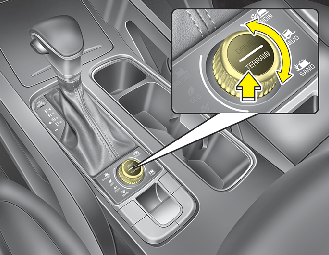
You can switch from DRIVE MODE to TERRAIN mode by pressing DRIVE/TERRAIN mode button and then select SNOW, MUD, or SAND mode within 4 seconds by turning TERRAIN MODE knob. If you press the DRIVE/TERRAIN mode button again, the vehicle will go back to last mode of DRIVE MODE.

-
If you don’t select the TERRAIN mode within 4 seconds after pressing DRIVE / TERRAIN mode button, it will go back to the last mode of DRIVE MODE.
-
Even though you turned off the vehicle in TERRAIN mode, DRIVE mode will be set when you restart the vehicle.
All Wheel Drive (AWD) transfer mode selection
|
Transfer mode |
Selection mode |
Description |
|---|---|---|
|
AWD AUTO |
- |
|
|
SNOW |
 |
SNOW mode is used to appropriately distribute the vehicle’s traction forces and prevent wheel slippage when driving on snowy or slippery road. |
|
MUD |
 |
MUD mode is used to ensure safe driving by appropriately distributing the vehicle’s traction forces when driving on muddy, unpaved or rough roads. |
|
SAND |
 |
SAND mode is used to ensure safe driving by appropriately distributing the vehicle’s traction forces when driving on sandy, graveled or unpaved off-roads. |

Maintain AWD Auto mode when driving on roads in normal conditions. Driving in TERRAIN mode on normal roads may damage the AWD system and cause mechanical vibration or noise.
When driving (especially when cornering) under normal road conditions in TERRAIN mode, a driver may find minor mechanical vibration or noise, which is extremely normal phenomenon, not a malfunction. When TERRAIN mode is released, such noise or vibration will be immediately gone. When you turn off TERRAIN mode, it can lead to little shocks but this is a normal phenomenon that lasts until the traction forces on the front and rear wheels of the vehicle are released.
For safe all wheel drive operation

All wheel drive
The conditions of on-road or off-road that demand all wheel drive mean all functions of your vehicle are exposed to extreme stress than under normal road conditions. Slow down and be ready for changes in the composition and traction of the surface under your tires. If you have any doubt about the safety of the conditions you are facing, stop and consider the best way to proceed. Do not exceed the ability of yourself or your vehicle to operate safely.

-
Do not try to drive in deep standing water or mud since such conditions can stall your engine and clog your exhaust pipes. Do not drive down steep hills since it requires extreme skill to maintain control of the vehicle.

-
When you are driving up or down hills drive as straight as possible. Use extreme caution in going up or down steep hills, since you may flip your vehicle over depending on the grade, terrain and water/mud conditions.
Hills
Driving across the contour of steep hills can be extremely dangerous. This danger can come from slight changes in the wheel angle which can destabilize the vehicle or, even if the vehicle is maintaining stability under power, it can lose that stability if the vehicle stops its forward motion. Your vehicle may roll over without warning and without time for you to correct a mistake that could cause serious injury or death.
-
You must consciously take the effort to learn how to corner in a AWD vehicle. Do not rely on your experience in conventional FWD vehicles in choosing safe cornering speed in AWD mode. For starters, you must drive more slowly in AWD.
-
Drive carefully off-road because your vehicle may be damaged by rocks or roots of trees. Become familiar with the off-road conditions where you are going to drive before you begin driving.
AWD
Reduce speed when you turn corners. The center of gravity of AWD vehicles is higher than that of conventional FWD vehicles, making them more likely to roll over when you turn corners too fast.
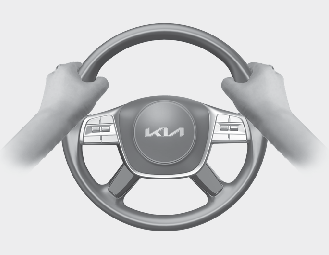
Steering wheel
Do not grab the inside of the steering wheel when you are driving off-road. You may hurt your arm by a sudden steering maneuver or from steering wheel rebound due to impact with objects on the ground.You could lose control of the steering wheel.
-
Always hold the steering wheel firmly when you are driving off-road.
-
Make sure all passengers are wearing seat belts.
Wind danger
If you are driving in heavy wind, the vehicle's higher center of gravity decreases your steering control capacity and requires you to drive more slowly.
Driving through water
Drive slowly. If you are driving too fast in water, the water can get into the engine compartment and wet the ignition system, causing your vehicle to suddenly stop. If this happens and your vehicle is in a tilted position, your vehicle may roll over.
-
Do not drive in water if the level is higher than the bottom of the vehicle.
-
Check your brake condition once you are out of mud or water. Press the brake pedal several times as you move slowly until you feel normal braking forces return.
-
Shorten your scheduled maintenance interval if you drive in offroad conditions such as sand, mud or water (see “Maintenance under severe usage conditions” in section 7). Always wash your vehicle thoroughly after off-road use, especially cleaning the bottom of the vehicle.
-
Since the driving torque is always applied to the 4 wheels the performance of the AWD vehicle is greatly affected by the condition of the tires. Be sure to equip the vehicle with four tires of the same size and type.
-
A full time all wheel drive vehicle cannot be towed by an ordinary tow truck. Make sure that the vehicle is placed on a flat bed truck for moving.
AWD driving
-
Avoid high cornering speed.
-
Do not make quick steering wheel movements, such as sharp lane changes or fast, sharp turns.
-
The risk of rollover is greatly increased if you lose control of your vehicle at high speed.
-
In a collision, an unbelted person is significantly more likely to die compared to a person wearing a seat belt.
-
Loss of control often occurs if two or more wheels drop off the roadway and the driver over-steers to re-enter the roadway. In the event your vehicle leaves the roadway, do not steer sharply. Instead, slow down before pulling back into the travel lanes.
Mud or snow
If one of the front or rear wheels begins to spin in mud, snow, etc. the vehicle can sometimes be driven out by engaging the accelerator pedal further; however avoid running the engine continuously at high rpm because doing so could damage the AWD system.
Driving in sand or mud
-
Maintain slow and constant speed. Operate the accelerator pedal slowly to ensure safe driving (wheel-slip prevention).
-
Use tire chains driving in mud if necessary.
-
Keep sufficient distance between your vehicle and the vehicle in front of you.
-
Reduce vehicle speed and always check the road condition.
-
Avoid speeding, rapid acceleration, sudden brake applications, and sharp turns to prevent getting stuck.
-
When the vehicle is stuck in snow, sand or mud, the tires may not operate.
This is to protect the transmission and not a malfunction.
Moving the car forcibly to get out of mud or sand can cause damage/overheat of the engine or damage/breakdown of the transmission, differential or 4WD system as well as damage to tires. If excessive wheel slip occurs after entering a sandy/muddy road, the vehicle may fall into the sand/mud. When it happens, put a stone or a tree branch under the tire, and then try to pull out the car, or try to get it unstuck by repeatedly moving forwards and backwards.
-
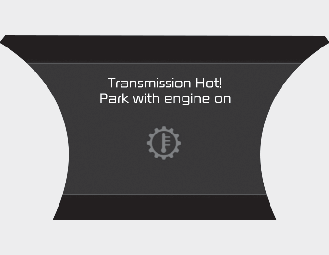
When driving on muddy and sandy roads under the severe condition, the transmission could be overheated.
-
When the transmission is overheated, the safe protection mode engages and the “Transmission Hot! Park with engine on” warning message will appear on the LCD display with a chime.
-
If this occurs, pull over to a safe location, stop the vehicle with the engine running, apply the brakes and shift the vehicle to P (Park), and allow the transmission to cool.
-
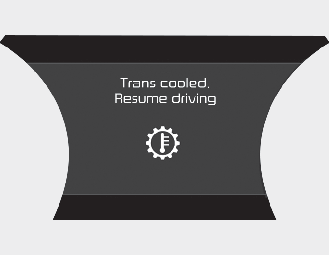
If you ignore this warning, the driving condition may become worse. You may experience abrupt shifts, frequent shifts, or jerkiness. To return to the normal driving condition, stop the vehicle and apply the foot brake or shift into P (Park). Then allow the transmission to cool for a few minutes with engine on, before driving off.
-
When the message "Trans cooled. Resume driving.“ appears you can continue to drive your vehicle.
If the warning messages in the LCD display continue to blink, for your safety, have the system checked by an authorized Kia dealer.
Reducing the risk of a rollover
This multi-purpose passenger vehicle is defined as a Sports Utility Vehicle (SUV).
Utility vehicles have a significantly higher rollover rate than other types of vehicles. SUV's have higher ground clearance and a narrower track to make them capable of performing in a wide variety of off-road applications.
Specific design characteristics give them a higher center of gravity than ordinary vehicles.
An advantage of the higher ground clearance is a better view of the road, which allows you to anticipate problems. They are not designed for cornering at the same speeds as conventional passenger vehicles, any more than low slung sports vehicles are designed to perform satisfactorily in off-road conditions. Due to this risk, driver and passengers are strongly recommended to buckle their seat belts. In a rollover crash, an unbelted person is significantly more likely to die than a person wearing a seat belt.
There are steps that a driver can make to reduce the risk of a rollover.
If at all possible, avoid sharp turns or abrupt maneuvers, do not load your roof rack with heavy cargo, and never modify your vehicle in any way.
Rollover
As with other Sports Utility Vehicle (SUV), failure to operate this vehicle correctly may result in loss of control, an accident or vehicle rollover.
-
Utility vehicles have a significantly higher rollover rate than other types of vehicles.
-
Specific design characteristics (higher ground clearance, narrower track, etc.) give this vehicle a higher center of gravity than ordinary vehicles.
-
A SUV is not designed for cornering at the same speeds as conventional vehicles.
-
Avoid sharp turns or abrupt maneuvers.
-
In a rollover crash, an unbelted person is significantly more likely to die than a person wearing a seat belt. Make sure everyone in the vehicle is properly buckled up.
Your vehicle is equipped with tires designed to provide safe ride and handling capability. Do not use a size and type of tire and wheel that is different from the one that is originally installed on your vehicle. It can affect the safety and performance of your vehicle, which could lead to steering failure or rollover and serious injury. When replacing the tires, be sure to equip all four tires with the tire and wheel of the same size, type, tread, brand and load-carrying capacity. If you nevertheless decide to equip your vehicle with any tire/wheel combination not recommended by Kia for off road driving, you should not use these tires for highway driving.
Jacked vehicle
While the full-time AWD vehicle is being raised on a jack, never start the engine or cause the tires to rotate.
There is the danger that rotating tires touching the ground could cause the vehicle to go off the jack and to jump forward.
-
Full-time AWD vehicles must be tested on a special four wheel chassis dynamometer.
Never engage the parking brake while performing these tests.
-
A full-time AWD vehicle should not be tested on a FWD roll tester. If a FWD roll tester must be used, perform the following:
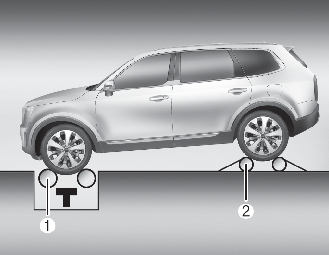
-
Check the tire pressures recommended for your vehicle.
-
Place the front wheels on the roll tester (1) for a speedometer test as shown in the illustration.
-
Release the parking brake.
-
Place the rear wheels on the temporary free roller (2) as shown in the illustration.
Dynamometer testing
Keep away from the front of the vehicle while the vehicle is in gear on the dynamometer. This is very dangerous as the vehicle can jump forward and cause serious injury or death.
-
When lifting up the vehicle, do not operate front and rear wheel separately. All four wheels should be operated.
-
If you need to operate the front wheel and rear wheel when lifting up the vehicle, you should release the parking brake.