
Forward Collision-Avoidance Assist warning message and brake control
Collision Warning (1st warning)
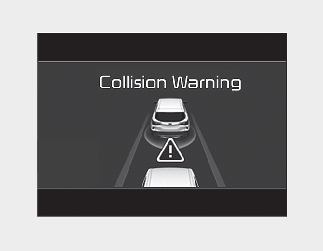
This warning message appears on the LCD display with a warning chime. Additionally, some vehicle function intervention occurs by the engine management function to help decelerate the vehicle.
-
Your vehicle may slow down slightly.
-
It will operate if the vehicle speed is greater than 10 km/h (6 mph) and less than or equal to 180 km/h (112 mph) on a forward vehicle. (Depending on the condition of the vehicle ahead and the environment surrounding it, the possible maximum operating speed may be reduced.)
-
For pedestrians the vehicle speed is greater than or equal to 10 km/h (6 mph) and less than 60 km/h (37 mph). (Depending on the condition of pedestrians and the surrounding environment the possible maximum operating speed may be reduced.)
-
If you select 'Warning only', Forward Collision-Avoidance Assist activates and produces only warning alarms in accordance with the collision risk levels. You should control the brakes directly because Forward Collision-Avoidance Assist does not control the brakes.
Emergency Braking (2nd does not)
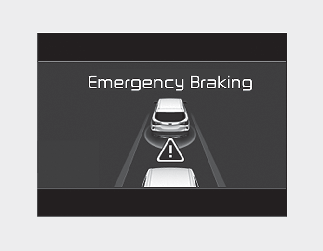
This warning message appears on the LCD display with a warning chime. Additionally, some vehicle function intervention occurs by the engine management function to help decelerate the vehicle.
The brake control is maximized just before a collision, reducing impact when it strikes a forward vehicle.
-
It will operate if the vehicle speed is greater than 10 km/h (6 mph) and less than or equal to 60 km/h(37 mph) on a forward vehicle. (Depending on the condition of the vehicle ahead and the environment surrounding it, the possible maximum operating speed may be reduced.)
-
For pedestrians, the vehicle speed is greater than or equal to 10 km/h (6 mph) and less than 60 km/h (37 mph). (Depending on the condition of pedestrians and the surrounding environment the possible maximum operating speed may be reduced.)
-
If you select 'Warning Only', Forward Collision-Avoidance Assist activates and produces only warning alarms in accordance with the collision risk levels. You should control the brakes directly because Forward Collision-Avoidance Assist does not control the brakes.
The others
-
In an urgent situation, the braking system enters into the ready status for prompt reaction against the driver's depressing the brake pedal.
-
Forward Collision-Avoidance Assist provides additional braking power for optimum braking performance, when the driver depresses the brake pedal.
-
The braking control is automatically deactivated, when the driver sharply depresses the accelerator pedal, or when the driver abruptly operates the steering wheel.
-
Forward Collision-Avoidance Assist brake control is automatically canceled, when risk factors disappear.

-
The driver should always use extreme caution while operating the vehicle, whether or not there is a warning message or alarm from Forward Collision-Avoidance Assist.
-
After the brake control is activated, the driver must immediately depress the brake pedal and check the surroundings. The brake activation by the function lasts for about 2 seconds.
-
If any other warning sound such as seat belt warning chime is already generated, Forward Collision-Avoidance Assist warning may not sound.
-
Playing the vehicle audio at high volume may prevent occupants from hearing the function warning sounds.

The braking control cannot completely stop the vehicle nor avoid all collisions. The driver should hold the responsibility to safely drive and control the vehicle.
Forward Collision-Avoidance Assist logic operates within certain parameters, such as the distance from the vehicle ahead, the speed of the vehicle ahead, and the driver's vehicle speed. Certain conditions such as inclement weather and road conditions may affect the operation of Forward Collision-Avoidance Assist.
Never deliberately drive dangerously to activate the function.