
Warning and Rear Cross-Traffic Collision Avoidance Assist control
Rear Cross-Traffic Collision Warning
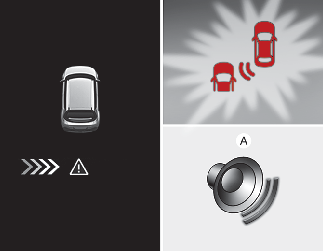
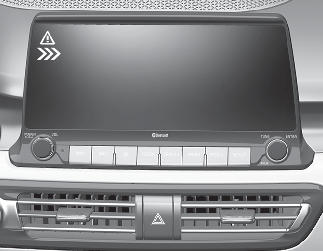
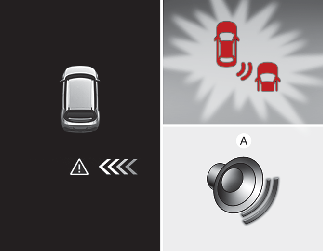
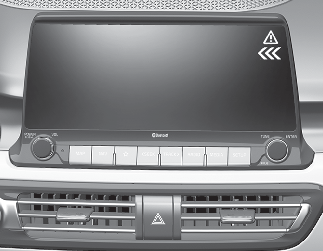
If the vehicle detected by the sensors approaches from the rear left/right side of your vehicle, the warning chime will sound, the warning light on the outside rear view mirror will blink and a message will appear on the LCD display. If Rear View Monitor is in activation, a message will also appear on the infotainment function screen.
The warning will stop when:
-
The detected vehicle moves out of the sensing area or
-
when the vehicle is right behind your vehicle or
-
when the vehicle is not approaching your vehicle or
-
when the other vehicle slows down.
-
The vehicle's approaching speed is decreased.
Rear Cross-Traffic Collision-Avoidance Assist
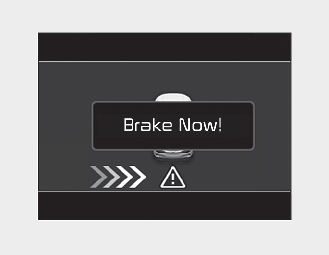
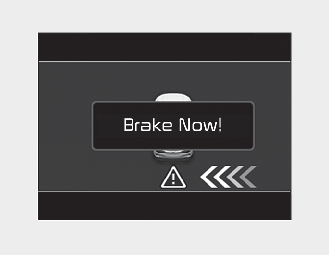
If the risk of collision is detected while Rear Cross-Traffic Collision Warning is generated, brake is controlled. The instrument cluster will inform the driver of the brake control. If Rear View Monitor is in activation, a message will also appear on the infotainment function screen.
After the brake control, the driver must immediately depress the brake pedal and check the surroundings.
-
The brake activation by the function lasts for about 2 seconds. The driver must pay attention as the brake is disengaged after 2 seconds.
-
The brake control by the function is canceled if the driver depresses the brake pedal with sufficient power.
-
Brake control is activated once for each right/left approach after shifting the shift button to R (Reverse).
The brake control may not operate properly according to the status of the ESC (Electronic Stability Control). The same warning message is displayed on the instrument cluster for this case also.
-
When the ESC (Electronic Stability Control) warning light is on.
-
When the ESC (Electronic Stability Control) is engaged in a different function.

-
When the operation condition of Rear Cross-Traffic Collision Warning is satisfied, the warning will occur every time a vehicle approaches the side or rear of your stopped (0 km/h vehicle speed) vehicle.
-
The function's warning or brake may not operate properly if the left or right of your vehicle's rear bumper is blocked by a vehicle or obstacle.
-
The driver should always use extreme caution while operating the vehicle, whether or not the warning light on the outside rear view mirror illuminates or there is a warning alarm.
-
Playing the vehicle audio function at high volume may offset the function's warning sounds.
-
The warning of Rear Cross-Traffic Collision Warning may not sound while other function's warning sounds.
-
If any other warning sound such as seat belt warning chime is already generated, Rear Cross-Traffic Collision Warning warning may not sound.

-
Drive safely even though the vehicle is equipped with Rear Cross-Traffic Collision Warning and Rear Cross-Traffic Collision-Avoidance Assist. Do not solely rely on the function but check your surrounding when backing the vehicle up.
-
The driver is responsible for accurate brake control.
-
Always pay extreme caution while driving. Rear Cross-Traffic Collision Warning and Rear Cross-Traffic Collision-Avoidance Assist may not operate properly or unnecessarily operate in accordance with your driving situations.
-
Rear Cross-Traffic Collision-Avoidance Assist is not a substitute for safe driving practices, but a convenience function only. It is the responsibility of the driver to always drive cautiously to prevent unexpected and sudden situations from occurring. Pay attention to the road conditions at all times.
Detecting sensors
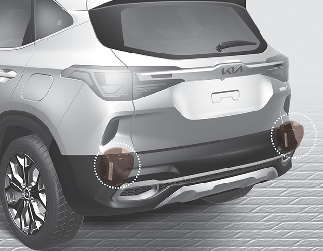
The rear corner radars are the sensors inside the rear bumper for detecting the side and rear areas. Always keep the rear bumper clean for proper operation of the function.
-
The function may not work properly when the bumper has been damaged, or if the rear bumper has been replaced or repaired.
-
The function may turn off due to strong electromagnetic waves.
-
Always keep the sensors clean.
-
NEVER arbitrarily disassemble the sensor component nor apply any impact on the sensor component.
-
Be careful not to apply unnecessary force on the radar sensor or sensor cover. If the sensor is forcibly moved out of proper alignment, the function may not operate correctly. In this case, a warning message may not be displayed. Have the vehicle inspected by an authorized Kia dealer/service partner.
-
Do not apply foreign objects such as a bumper sticker or a bumper guard near the radar sensor or apply paint to the sensor area. Doing so may adversely affect the performance of the sensor.
Warning message
Blind-Spot Collision Warning (BCW) system disabled. Radar blocked
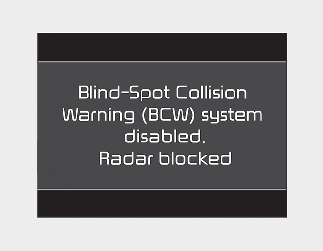
This warning message may appear when:
-
One or both of the sensors on the rear bumper is blocked by dirt or snow or a foreign object.
-
A trailer or carrier is installed.
-
Driving in rural areas where the sensor does not detect another vehicle for an extended period of time.
-
When there is inclement weather such as heavy snow or rain.
If any of these conditions occur, the function will turn off automatically.
When Blind-Spot Collision Warning canceled warning message is displayed in the cluster, check to make sure that the rear bumper is free from any dirt or snow in the areas where the sensor is located. Remove any dirt, snow, or foreign material that could interfere with the radar sensors.
After any dirt or debris is removed, the function should operate normally after about 10 minutes of driving the vehicle.
If the function still does not operate normally have your vehicle inspected by an authorized Kia dealer/service partner.

Turn off Blind-Spot Collision-Avoidance Assist and Rear Cross-Traffic Collision-Avoidance Assist when a trailer or carrier is installed.
-
Deactivate Blind-Spot Collision Warning and Blind-Spot Collision-Avoidance Assist by selecting "User Settings → Driver Assistance → Blind-Spot Safety → Off" in the cluster or infotainment system.
-
Deactivate Rear Cross-Traffic Collision-Avoidance Assist by deselecting "User settings → Driver Assistance → Parking Safety → Rear Cross Traffic Safety" in the cluster or infotainment system.
Check Blind-Spot Collision Warning (BCW) system
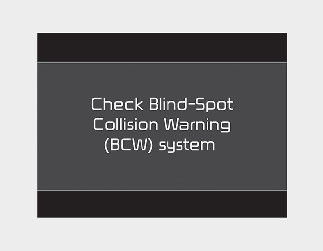
If there is a problem with Blind-Spot Collision Warning, a warning message will appear. The function will turn off automatically. Rear Cross-Traffic Collision Warning and Rear Cross-Traffic Collision-Avoidance Assist will not operate also if Blind-Spot Collision Warning turns off due to malfunction. We recommend that you have your vehicle inspected by an authorized Kia dealer/service partner.
Limitations of Rear Cross-Traffic Collision-Avoidance Assist
The driver must be cautious in the below situations, because the function may not detect other vehicles or objects in certain circumstances.
-
When a trailer or carrier is installed.
-
The vehicle drives in inclement weather such as heavy rain or snow.
-
The radar sensor is polluted with rain, snow, mud, etc.
-
The rear bumper where the radar sensors are located is covered with a foreign object such as a bumper sticker, a bumper guard, a bike rack, etc.
-
The rear bumper is damaged, or the sensor is out of the original default position.
-
The vehicle height gets lower or higher due to heavy loading in a tailgate, abnormal tire pressure, etc.
-
When the temperature of the rear bumper is high.
-
When the sensors are blocked by other vehicles, walls or parking-lot pillars.
-
The vehicle drives on a curved road.
-
The road pavement (or the peripheral ground) abnormally contains metallic components (i.e. possibly due to subway construction).
-
There is a fixed object near the vehicle, such as a guardrail.
-
While going down or up a steep road where the height of the lane is different.
-
Driving on a narrow road where trees or grass or overgrown.
-
Driving in rural areas where the sensor does not detect another vehicle for an extended period of time.
-
Driving on a wet road.
-
Driving on a road where the guardrail or wall is in double structure.
-
A big vehicle is near such as a bus or truck.
-
When the other vehicle approaches or passes very close.
-
When the other vehicle passes at a very fast speed.
-
While changing lanes.
-
If the vehicle has started at the same time as the vehicle next to you and has accelerated.
-
When the vehicle in the next lane moves two lanes away from you or when the vehicle two lanes away moves to the next lane from you.
-
A motorcycle or bicycle is near.
-
A flat trailer is near.
-
If there are small objects in the detecting area such as a shopping cart or a baby stroller.
-
If there is a low height vehicle such as a sports car.
-
The brake pedal is depressed.
-
ESC (Electronic Stability Control) is activated.
-
ESC (Electronic Stability Control) malfunctions.
-
The tire pressure is low or a tire is damaged.
-
The brake is reworked.
-
The vehicle sharply stops.
-
Temperature is extremely low around the vehicle.
-
The vehicle severely vibrates while driving over a bumpy road, uneven/ bumpy road, or concrete patch.
-
The vehicle drives on a slippery surface due to snow, water puddle, or ice.
-
If the vehicle moves backward after the vehicle is parked with a diagonal line.
-
Driving where there. is a vehicle or structure near
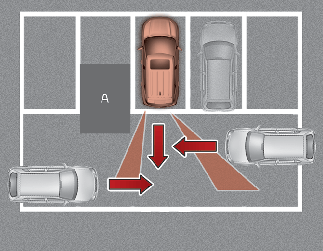
[A] : Structure
Rear Cross-Traffic Collision-Avoidance Assist may not operate properly when driving where there is a vehicle or structure near.
In certain instances, the function may not detect the vehicle approaching from behind and the warning or brake may not operate properly.
Always pay attention to your surrounding while driving.
-
When the vehicle is in a complex parking environment
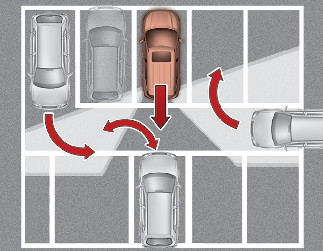
Rear Cross-Traffic Collision-Avoidance Assist may not operate properly when the vehicle is in a complex parking environment.
In certain instances, the function may not be able to exactly determine the risk of collision for the vehicles which are parking or pulling out near your vehicle (e.g. a vehicle escaping beside your vehicle, a vehicle parking or pulling out in the rear area, a vehicle approaching your vehicle making a turn, etc.).
In this case, the warning or brake may not operate properly.
-
When the vehicle is parked diagonally
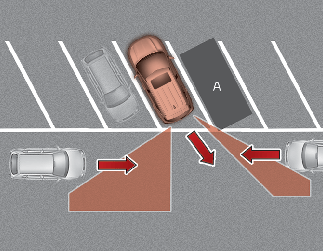
[A]: Vehicle
Rear Cross-Traffic Collision-Avoidance Assist may not operate properly when the vehicle is parked diagonally.
In certain instances, when the diagonally parked vehicle is pulled out of the parking space, the function may not detect the vehicle approaching from the rear left/right of your vehicle. In this case, the warning or brake may not operate properly.
Always pay attention to your surrounding while driving.
-
When the vehicle is on/near a slope
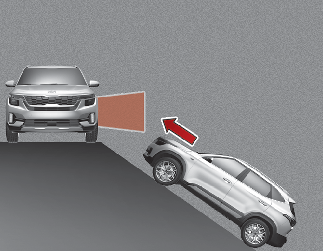
Rear Cross-Traffic Collision-Avoidance Assist may not operate properly when the vehicle is on/near a slope.
In certain instances, the function may not detect the vehicle approaching from the rear left/right and the warning or brake may not operate properly.
Always pay attention to your surrounding while driving.
-
Pulling into the parking space where there is a structure.
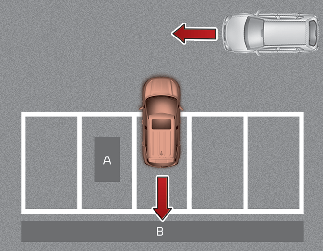
[A]: Structure, [B] : Wall
Rear Cross-Traffic Collision-Avoidance Assist may not operate properly when pulling in the vehicle to the parking space where there is a structure at the back or side of your vehicle.
In certain instances, when backing into the parking space, the function may not detect the vehicle moving in front of your vehicle. In this case, the warning or brake may not operate properly.
Always pay attention to the parking space while driving.
-
When the vehicle is parked rearward
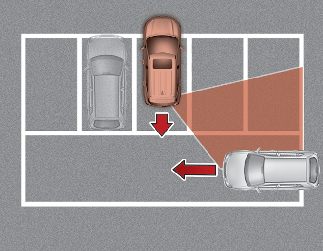
If the vehicle is parked rearward and the radar sensor detects the another vehicle in the rear area of the parking space, the function can warn or control braking. Always pay attention to the parking space while driving.