
Limitations of Forward Collision-Avoidance Assist
Detecting vehicles
The sensor may be limited when:
-
Starting engine or rebooting front camera function wouldn't operate for 15 seconds.
-
Radar and camera contaminated or blocked.
-
The function may not work around 15 seconds after starting the vehicle or the initialization or rebooting of the front view camera function.
-
The radar sensor or front view camera is blocked with a foreign object or debris.
-
The camera lens is contaminated due to tinted, filmed or coated windshield, damaged glass, or stuck of foreign matter (sticker, bug, etc.) on the glass.
-
Inclement weather such as heavy rain or snow obscures the field of view of the radar sensor or front view camera.
-
In case of interference caused by other electromagnetic waves.
-
The vehicle in front is too small to be detected. (for example a motorcycle etc.)
-
In case of a vehicle in front is an oversized vehicle or trailer that is too big to be detected by the camera recognition function. (for example a tractor, trailer, etc.)
-
The camera does not recognize the entire vehicle in front.
-
In case of a vehicle in front is driving erratically.
-
In case of radar or camera sensor recognition is in a marginal state.
-
The camera is damaged.
-
The vehicle is severely shaken.
-
When backlight is projected in the direction of the vehicle. (including opposite vehicle headlights)
-
In case of a vehicle in front has extremely high ground clearance.
-
In case of being towed by a trailer or other vehicle.
-
There is interference by electromagnetic waves.
-
There is severe irregular reflection from the radar sensor. (for example guardrail or oncoming vehicle, etc.)
-
The radar sensor or front view camera sensor recognition is limited.
-
The front view camera does not recognize the entire vehicle in front.
-
The front view camera is damaged.
-
The brightness outside is too low such as when the headlamps are not on at night or the vehicle is going through a tunnel.
-
The shadow is on the road by a median strip, trees, etc.
-
The vehicle drives through a tollgate.
-
The rear part of the vehicle in front is not normally visible. (the vehicle turns in other direction or the vehicle is overturned.)
-
The vehicle in front is too small to be detected. (for example a motorcycle or a bicycle, etc.)
-
The vehicle in front is an oversize vehicle or trailer that is too big to be detected by the camera recognition function. (for example a tractor trailer, etc.)
-
The camera's field of view is not well illuminated. (either too dark or too much reflection or too much backlight that obscures the field of view)
-
The vehicle in front does not have their rear lights or their rear lights does not turned ON or their rear lights are located unusually.
-
The outside brightness changes suddenly, for example when entering or exiting a tunnel.
-
When light coming from a street light or an oncoming vehicle is reflected on a wet road surface such as a puddle in the road.
-
The field of view in front is obstructed by sun glare.
-
The windshield glass is fogged up; a clear view of the road is obstructed.
-
The vehicle in front is driving erratically.
-
The vehicle is on unpaved or uneven rough surfaces, or road with sudden gradient changes.
-
The vehicle is driven near areas containing metal substances as a construction zone, railroad, etc.
-
The vehicle drives inside a building, such as a basement parking lot.
-
The adverse road conditions cause excessive vehicle vibrations while driving.
-
The sensor recognition changes suddenly when passing over a speed bump.
-
The vehicle in front is moving vertically to the driving direction.
-
The vehicle in front is stopped vertically.
-
The vehicle in front is driving towards your vehicle or reversing.
-
You are on a roundabout and the vehicle in front circles.
Driving on a curved road
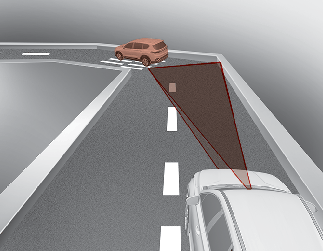
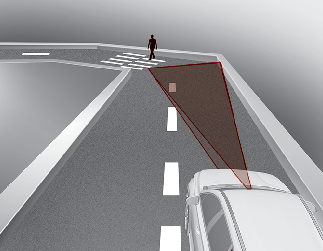
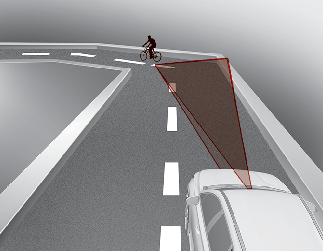
The performance of Forward Collision-Avoidance Assist may be limited when driving on a curved road.
On curved roads, the other vehicle on the same lane is not recognized and Forward Collision-Avoidance Assist's performance may be degraded. This may result in unnecessary alarm or braking or no alarm or braking when necessary.
Also, in certain instances the front radar sensor or front view camera recognition function may not detect the vehicle traveling on a curved road.
In these cases, the driver must maintain a safe braking distance, and if necessary, depress the brake pedal to reduce your driving speed in order to maintain a safe distance.
Forward Collision-Avoidance Assist may recognize a vehicle in the next lane when driving on a curved road.
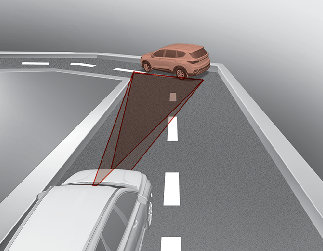
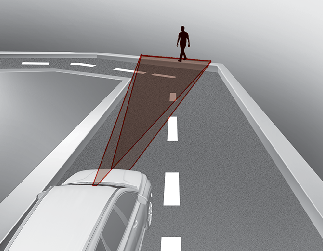
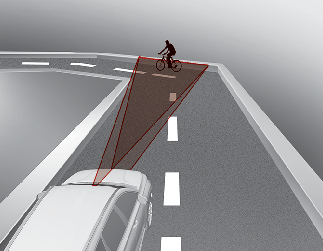
In this case, the function may unnecessarily alarm the driver and apply the brake.
Always pay attention to road and driving conditions, while driving. If necessary, depress the brake pedal to reduce your driving speed in order to maintain a safe distance.
Also, when necessary depress the accelerator pedal to prevent the function from unnecessarily decelerating your vehicle.
Check to be sure that the road conditions permit safe operation of Forward Collision-Avoidance Assist.
Driving on a sloped road
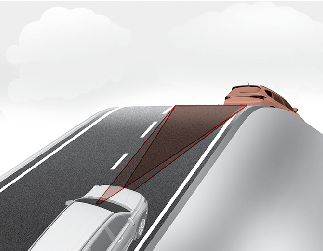
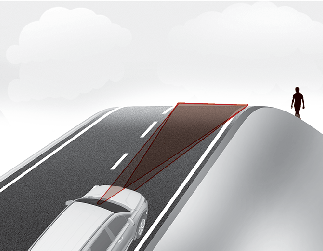
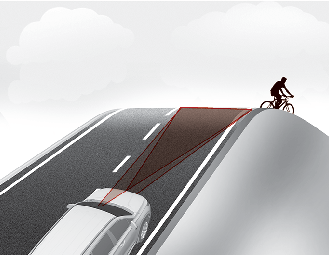
The performance of Forward Collision-Avoidance Assist decreases while driving upward or downward on a slope, not recognizing the vehicle in front in the same lane. It may unnecessarily produce the warning message and the warning alarm, or it may not produce the warning message and the warning alarm at all.
When Forward Collision-Avoidance Assist suddenly recognizes the vehicle in front while passing over a slope, you may experience sharp deceleration.
Always keep your eyes forward while driving upward or downward on a slope, and, if necessary, depress the brake pedal to reduce your driving speed in order to maintain distance.
Changing lanes
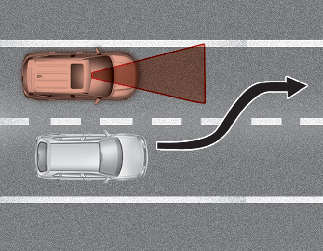
When a vehicle changes lanes in front of you, Forward Collision-Avoidance Assist may not immediately detect the vehicle, especially if the vehicle changes lanes abruptly. In this case, you must maintain a safe braking distance, and if necessary, depress the brake pedal to reduce your driving speed in order to maintain a safe distance.
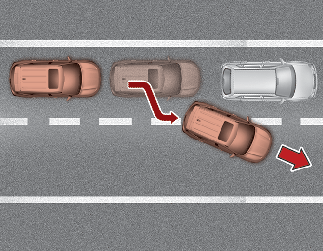
When driving in stop-and-go traffic, and a stopped vehicle in front of you merges out of the lane, Forward Collision-Avoidance Assist may not immediately detect the new vehicle that is now in front of you. In this case, you must maintain a safe braking distance, and if necessary, depress the brake pedal to reduce your driving speed in order to maintain a safe distance.
Recognizing the vehicle
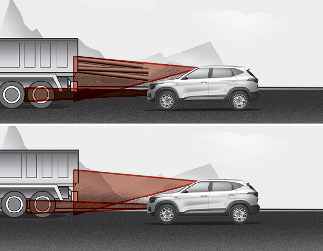
If the vehicle in front of you has cargo that extends rearward from the cab, or when the vehicle in front of you has higher ground clearance, additional special attention is required. Forward Collision-Avoidance Assist may not be able to detect the cargo extending from the vehicle. In these instances, you must maintain a safe braking distance from the rearmost object, and if necessary, depress the brake pedal to reduce your driving speed in order to maintain distance.
Situation in which the function may not detect pedestrian and cyclist properly.
The sensor may be limited when:
-
The pedestrians or cyclists are not fully detected by the front view camera recognition function, for example, if the pedestrian is leaning over or is not fully walking upright.
-
The pedestrians or cyclists are moving very quickly or appears abruptly in the front view camera detection area.
-
The pedestrians or cyclists are wearing clothing that easily blends into the background, making it difficult to be detected by the front view camera recognition function.
-
The outside lighting is too bright (e.g. when driving in bright sunlight or in sun glare) or too dark (e.g. when driving on a dark rural road at night).
-
It is difficult to detect and distinguish the pedestrians or cyclists from other objects in the surroundings, for example, when there is a group of pedestrians or cyclists or a large crowd.
-
There is an item similar to a person's body structure.
-
The pedestrians or cyclists are small.
-
The pedestrian has impaired mobility.
-
The sensor recognition is limited.
-
In case of radar or camera sensor recognition is in a marginal state.
-
In case of a large number of pastries or cyclists are gathered.
-
The radar sensor or front view camera is blocked with a foreign object or debris.
-
The camera lens is contaminated due to tinted, filmed or coated windshield, damaged glass, or stuck of foreign matter (sticker, bug, etc.) on the glass.
-
The brightness outside is too low such as when the headlamps are not on at night or the vehicle is going through a tunnel.
-
Inclement weather such as heavy rain or snow obscures the field of view of the radar sensor or front view camera.
-
When light coming from a street light or an oncoming vehicle is reflected on a wet road surface such as a puddle in the road.
-
The field of view in front is obstructed by sun glare.
-
The windshield glass is fogged up; a clear view of the road is obstructed.
-
The adverse road conditions cause excessive vehicle vibrations while driving.
-
The sensor recognition changes suddenly when passing over a speed bump.
-
You are on a roundabout.
-
When the pedestrian or cyclist suddenly interrupts in front of the vehicle.
-
When the cyclist in front is riding intersected with the driving direction.
-
When there is any other electromagnetic interference.
-
When the construction area, rail or other metal object is near the cyclist.
-
If the bicycle material is not reflected well on the radar.

-
Do not use Forward Collision-Avoidance Assist when towing a vehicle. Application of Forward Collision-Avoidance Assist while towing may adversely affect the safety of your vehicle or the towing vehicle.
-
Use extreme caution when the vehicle in front of you has cargo that extends rearward from the cab, or when the vehicle in front of you has higher ground clearance.
-
Forward Collision-Avoidance Assist is designed to detect and monitor the vehicle ahead or detect a pedestrian or cyclist (if equipped) in the roadway through radar signals and camera recognition. It is not designed to detect bicycles, motorcycles, or smaller wheeled objects such as luggage bags, shopping carts, or strollers.
-
Never try to test the operation of Forward Collision-Avoidance Assist. Doing so may cause severe injury or death.
-
If the front bumper, front glass, front radar or front view camera have been replaced or repaired, we recommend that you have your vehicle inspected by an authorized Kia dealer/service partner.

In some instances, Forward Collision-Avoidance Assist may be canceled when subjected to electromagnetic interference.