
Warning and Blind-Spot Collision-Avoidance Assist control
Blind-Spot Collision Warning
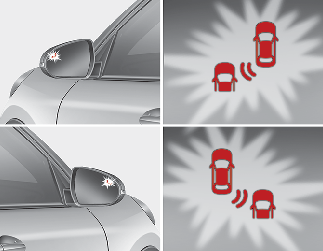
If a vehicle is detected within the boundary of the function, a warning light will illuminate on the outside rear view mirror.
Once the detected vehicle is no longer within the blind spot area, the warning will turn off according to the driving conditions of the vehicle.
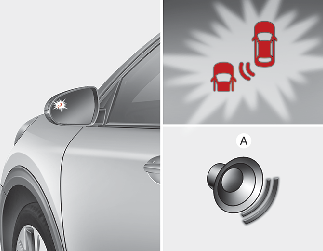
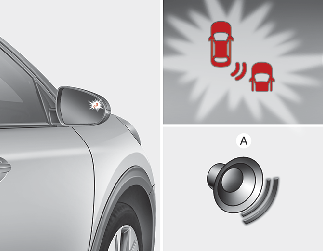
[A]: Warning sound
A warning chime to warn the driver will activate when:
-
A vehicle has been detected in the blind spot area by the radar AND.
-
The turn signal is applied (same side as where the vehicle is being detected).
When this warn is activated, the warning light on the outside rear view mirror will blink. And a warning chime will sound.
If you turn off the turn signal indicator, the second stage warn will be deactivated.
Once the detected vehicle is no longer within the blind spot area, the warning will turn off according to the driving conditions of the vehicle.

-
The warning light on the outside rear view mirror will illuminate whenever a vehicle is detected at the rear side by the function.
To avoid accidents, do not focus only on the warning light and neglect to see the surroundings of the vehicle.
-
Drive safely even though the vehicle is equipped with Blind-Spot Collision Warning. Do not solely rely on the function but check your surroundings before changing lanes or backing the vehicle up.
-
The function may not warn the driver in some situations due to function limitations so always check your surroundings while driving.

-
Always pay attention to road and traffic conditions while driving, whether or not the warning light on the outside rear view mirror illuminates or there is a warning alarm.
-
Playing the vehicle audio system at high volume may prevent occupants from hearing Blind-Spot Collision Warning warning sounds.
-
The warning of Blind-Spot Collision Warning may not sound while other function's warning sounds.
Blind-Spot Collision-Avoidance Assist
It gently applies braking power on the tire, which is located in the opposite side of the possibly-colliding point. The instrument cluster will inform the driver of the function activation.
Blind-Spot Collision-Avoidance Assist is automatically deactivated when:
-
The vehicle drives a certain distance away
-
The vehicle direction is changed against the possible-colliding point
-
The steering wheel is abruptly moved
-
The brake pedal is depressed
-
After a certain period of time
The driver should drive the vehicle in the middle of the vehicle lanes to keep the function in the ready status. When the vehicle drives too close to one side of the vehicle lanes, the function may not properly operate.
In addition, the function may not properly control your vehicle in accordance with driving situations. Thus, always pay close attention to road situations.
-
The driver is responsible for accurate steering.
-
Do not unnecessarily operate the steering wheel, when Blind-Spot Collision-Avoidance Assist is in operation.
-
Always pay extreme caution while driving. Blind-Spot Collision-Avoidance Assist may not operate or unnecessarily operate in accordance with your driving situations.
-
Blind-Spot Collision-Avoidance Assist is not a substitute for safe driving practices, but a convenience function only. It is the responsibility of the driver to always drive cautiously to prevent unexpected and sudden situations from occurring. Pay attention to the road conditions at all times.