
Seat belts - Front passenger and rear seat 3-point system with combination locking retractor
Fastening the seat belt:
Combination retractor type seat belts are installed in the rear seat positions to help accommodate the installation of Child Restraint System (CRS). Although a combination retractor is also installed in the front passenger seat position, it is strongly recommended that children always be seated in the rear seat. NEVER place any infant restraint system in the front seat of the vehicle.
This type of seat belt combines the features of both an emergency locking retractor seat belt and an automatic locking retractor seat belt.
-
Pull it out of the retractor and insert the metal tab into the buckle. There will be an audible "click" when the tab locks into the buckle. When not securing a child restraint, the seat belt operates in the same way as the driver's seat belt (emergency locking retractor type).
It automatically adjusts to the proper length only after the lap belt portion of the seat belt is adjusted manually so that it fits snugly around your hips.
When the seat belt is fully extended from the retractor to allow the installation of a CRS, the seat belt operation changes to allow the belt to retract, but not to extend (automatic locking retractor type). Refer to More Details.

Although the combination retractor provides the same level of protection for seated passengers in either emergency or automatic locking modes, have the seated passengers use the emergency locking feature for improved convenience. The automatic locking function is intended to facilitate child restraint installation. To convert from the automatic locking feature to the emergency locking operation mode, allow the unbuckled seat belt to fully retract.

Do NOT fold down the left portion of the rear seatback when the rear center seat belt is buckled. ALWAYS UNBUCKLE the rear center seat belt before folding down the left portion of the rear seatback. If the rear center seat belt is buckled when the left portion of the rear seatback is folded down, distortion and damage to the top portion of the seatback and seat belt garnish may result, causing the seatback to lock into the folded down position.
The seat belt should be locked into the buckle on each seat cushion to be properly fastened.
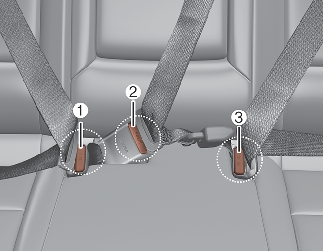
-
Rear right seat belt fastening buckle
-
Rear center seat belt fastening buckle
-
Rear left seat belt fastening buckle

Prior to fastening the rear seat belts, ensure the latch matches the seat belt buckle. Forcefully fastening the left or right seat belt to the center buckle can result in an improper fastening scenario that will not protect you in an accident.
When using the rear center seat belt, the buckle with the "CENTER" mark must be used.
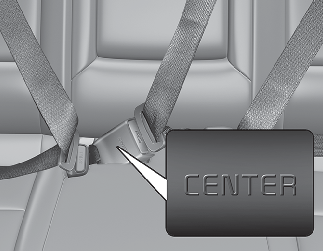
Releasing the seat belt:
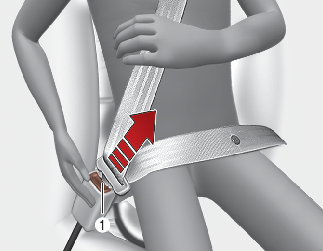
-
The seat belt is released by pressing the release button (1) on the locking buckle.
When it is released, the belt should automatically draw back into the retractor.
If this does not happen, check the belt to make sure it is not twisted, then try again.
3-point rear center belt
Rear center seat belt
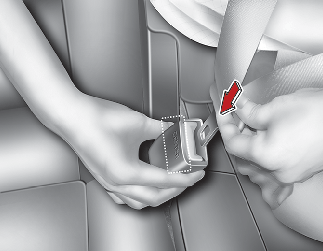
Do not separate mini tongue (1) and mini buckle (2) even if there is not an occupant.
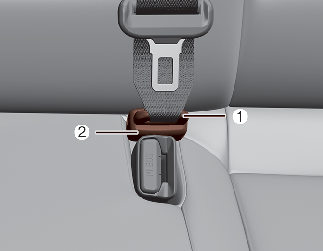
If it is separated, It may hit the rear seat occupants in a collision or sudden stops.
-
Pull the tongue plate and insert the tongue plate into the open end of the buckle until an audible "click" is heard, indication the latch is locked. Make sure the belt is not twisted.
 CAUTION
When using the rear center seat belt, the buckle with the "CENTER" mark must be used.
There will be an audible "click" when the tab locks in the buckle. The seat belt automatically adjusts to the proper length only after the lap belt is adjusted manually so that it fits snugly around your hips, if you lean forward in a slow, easy motion, the belt will extend and let you move around. If there is a sudden stop or impact, the belt will lock into position. It will also lock if you try to lean forward too quickly.
When using the rear seat center belt, you must lock all tongue plates and buckles. If any tongue plate or buckle is not locked, it will increase the chance of injury in the event of collision.