
Automatic transmission operation
The automatic transmission automatically shifts from 1st to 5th according to the position of shift lever and accelerator pedal, and vehicle speed.
If releasing the brake without depressing the accelerator pedal In the position of D, R or in Manual shift mode (+,-), the vehicle moves forward or backward. Depress and hold the brake pedal if you want to stop the vehicle.
P (Park)
-
This is the position where the transmission is locked to prevent the vehicle from moving when parking or the engine stop/start.
-
Place the shift lever into P (Park) position and pull the parking brake lever, with depressing the brake pedal while parking or stopping the vehicle.
-
Do not use P (Park) position in place of the parking brake. Always make sure to use with the parking brake.

Always come to a complete stop before shifting into P (Park) position. You may damage the automatic transmission if you shift into P (Park) position while the vehicle is in motion.
* Follow the below steps when parking if you want to allow to push and move the parked vehicle.
-
Place the shift lever into P (Park) position with depressing the brake pedal, and then stop the engine.
-
After applying the parking brake, place the ignition switch in the ON position.
-
Shift the automatic transmission into N (Neutral) position with depressing the brake pedal.
-
Release the parking brake.
-
Remove the key.
Except for emergency parking (Level and flat parking ground) as above, for your safety, shift into P (Park) position and apply the parking brake fully.
R (Reverse)
-
Use this position to drive the vehicle backward.
-
Stop the vehicle when shifting into R (Reverse) position. If shifting into R (Reverse) position while the vehicle is in motion, it may cause unexpected danger, so make sure to stop before shifting into R (Reverse) position.
-
When stopping the vehicle for a moment, be careful that the vehicle may move if not depressing the brake pedal fully.
Always come to a complete stop before shifting into or out of R (Reverse) position.
You may damage the transmission if you shift into R (Reverse) position while the vehicle is in motion.
N (Neutral)
-
Use this position when stopping the vehicle with the engine running for a long period. When stopping the vehicle, depress the brake pedal or apply the parking brake.
-
Even though the engine can be started in N (Neutral) position, for your safety, start the engine in P (Park) position.

Do not shift into N (Neutral) position when the vehicle is in motion. The engine brake may not operate and It may cause unexpected accident.
Parking in N (Neutral)
Follow the below steps when parking if you want to allow to push and move the parked vehicle.
Except for emergency parking, for your safety, always shift into P (Park) position and apply the parking brake fully.
-
Turn off the engine while depressing the brake pedal in P (Park) position.
-
Place the wheel chocks.
-
Release the brake.
-
Place the ignition switch in the OFF position.
-
Push the SHIFT LOCK RELEASE button placed in front while depressing the brake pedal and then shift into N (Neutral) position. The vehicle will move when external force is applied.
-
For your safety, except for emergency or N (Neutral) position parking, always apply the parking brake after shifting into P (Park) position.
-
Make sure that the parking ground is level when parking in N (Neutral) position. Do not park the vehicle in N (Neutral) position on a slope. The vehicle may move and accidents may occur.
D (Drive)
-
This is normal forward driving position.
-
The transmission will automatically shifts through a 1st to 5th gear sequence, providing the best fuel economy and power.
-
When the shift lever is in P (Park) position, start the engine and shift into D (Drive) position while depressing the brake pedal. After that, take your foot off the brake pedal, check that the vehicle moves slowly, then start the vehicle by depressing the accelerator pedal.
When stopping the vehicle for a moment, be careful that the vehicle may move if not depressing the brake pedal fully.
When starting the vehicle after stopping on a hill, even if the shifting lever is in the D (Drive) position, if you do not depress the accelerator or brake pedal, the car may move backward depending on the situation (climbing angle) and a serious accident may occur.
Manual mode (+, -)
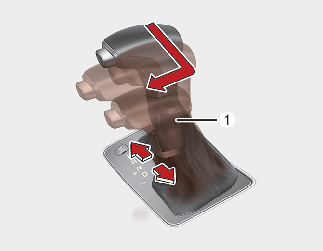
*1 : Manual shift mode
-
+ (UP)
Push the shift lever forward once into the + side to shift up 1 gear. It can be activated by depressing the accelerator pedal.
-
- (DOWN)
If you depress the brake pedal, it shifts automatically according to the vehicle speed.
Each time pushing the shift lever to the – side, it goes down 1 gear.
Push the shift lever to the – side to lower the gear one by one with depressing the brake pedal when you want to use the engine brake.
When stopping the vehicle for a moment, if not depressing the brake pedal fully, the vehicle may move due to the characteristics of the automatic transmission.
-
Only forward shifting is possible in manual shift mode, select R (Reverse) and P (Park) when reversing or parking.
-
It is possible to shift from 3rd to 1st and 4th to 2nd by operating the shift lever twice to the – (DOWN) side rapidly.
-
In Manual shift mode, downshifts are made automatically when the vehicle slows down. When the vehicle stops, 1st gear is selected.
-
In order to improve the starting performance on a slippery surface, 2nd gear start is possible by operating it to the +(UP) side once while stopping and it downshifts to 1st gear by operating it to the –(DOWN) side.
-
In order to secure the driving performance, depending on the vehicle speed, shifting may not be possible even if it is operated to the +(UP) side, and in order to prevent excessive rotation of the engine, depending on the speed of the vehicle, shifting may not be possible even if it is operated to the –(DOWN) side.
Shift lock system (if equipped)
-
When shifting the automatic transmission shift lever from P (Park) position into another position, to prevent the driver’s mal-operation, it can only be changed by depressing the brake pedal.
-
When shifting the transmission from P (Park) position into another position, do the following.
-
Depress and hold the brake pedal.
-
Turn the ignition switch to the ON position.
-
Press the shift lever button on the shift lever and shift into another position. The shifting lever cannot be moved while the ignition switch is in the ACC or LOCK position.
-
-
If the brake pedal is repeatedly depressed and released while the shift lever is in P (Park) position, a chattering noise from the shift lock system may be heard.
-
The shift lock system does not operate in N (Neutral) position, so be sure to start the engine in P (Park) position.
-
The shift lock system (if equipped) is released only when the brake pedal is depressed and the shift lever button is pressed, so be sure to follow the unlock sequence.
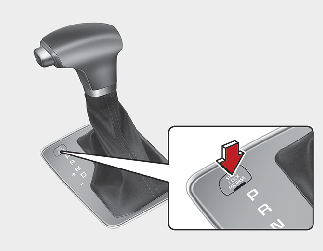
If the battery is discharged or the ignition is not ON, the shift lever will not move from P (Park) position to R (Reverse) position even when the brake pedal is depressed. In this case, while pressing the shift lock release button in front of the shift lever, press the shift lever button to move the shift lever, you can shift to another position.
If the manual release is used, the shift lock system will operate normally again after restarting the engine. If the following situations occur, have the system serviced by a professional workshop. Kia recommends to visit an authorized Kia dealer/service partner.
-
When the shift lock system is not operating.
-
When the shift lever does not move from P (Park) position to R (Reverse) position even though the brake pedal is depressed with the ignition in ON position.