
Transfer lever position

-
Do not select 4WD mode on flat and normal roads.
-
Four-wheel driving on flat roads for a long period causes poor fuel economy and noise, and it also causes tires to wear faster.
-
Four-wheel driving on flat and normal roads can result in a severe binding and chattering condition when turning the steering wheel.
-
Four-wheel driving on flat roads for a long period can also cause the differential oil temperature to increase, resulting in damage to parts in the power train.
-
When the vehicle shifts into 4WD mode, a slight mechanical sound and vibration may be felt and does not indicate a problem with the system.

When shifting the transfer lever into the 4WD positions (4H and 4L), make sure the lever is fully engaged in the gear setting. Failure to fully engage the gear could allow the transfer lever to slip out of gear causing loss of power to the drive wheels. This could cause a loss of vehicle control and could possibly result in a serious accident.
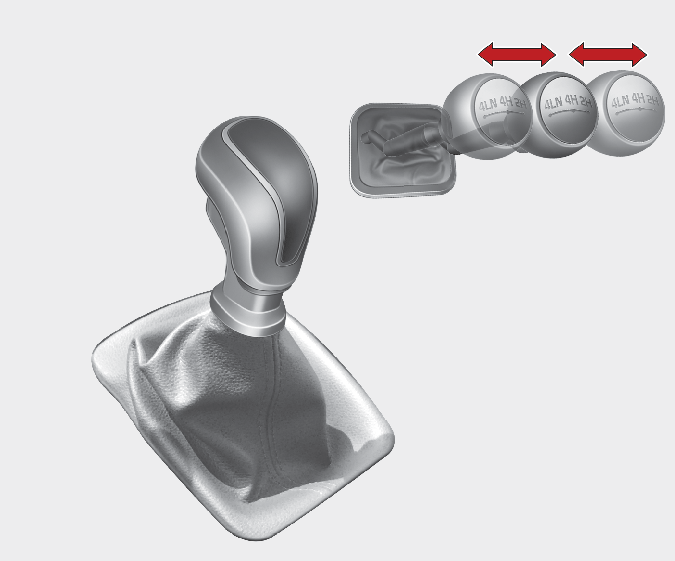
This is used to set different positions.
2H (Two-wheel drive high speed)
This mode is used, when driving on normal roads and highway.
4H (Four-wheel drive high speed) : maximum speed 80 km/h
This mode is used, when driving offroads, wet or snow covered roads with normal speed.
The 4WD indicator light ( ) will be turned on to remind you that you are in the 4H mode.
4L (Four-wheel drive low speed) : maximum speed 40 km/h
Use 4L for climbing or descending hills, off-roads driving and towing the vehicle, especially when increased power is required.
The 4WD indicator light () will be turned on to remind you that you are in the 4L mode.